The Story That Begins When a Perfect Life Falls Apart
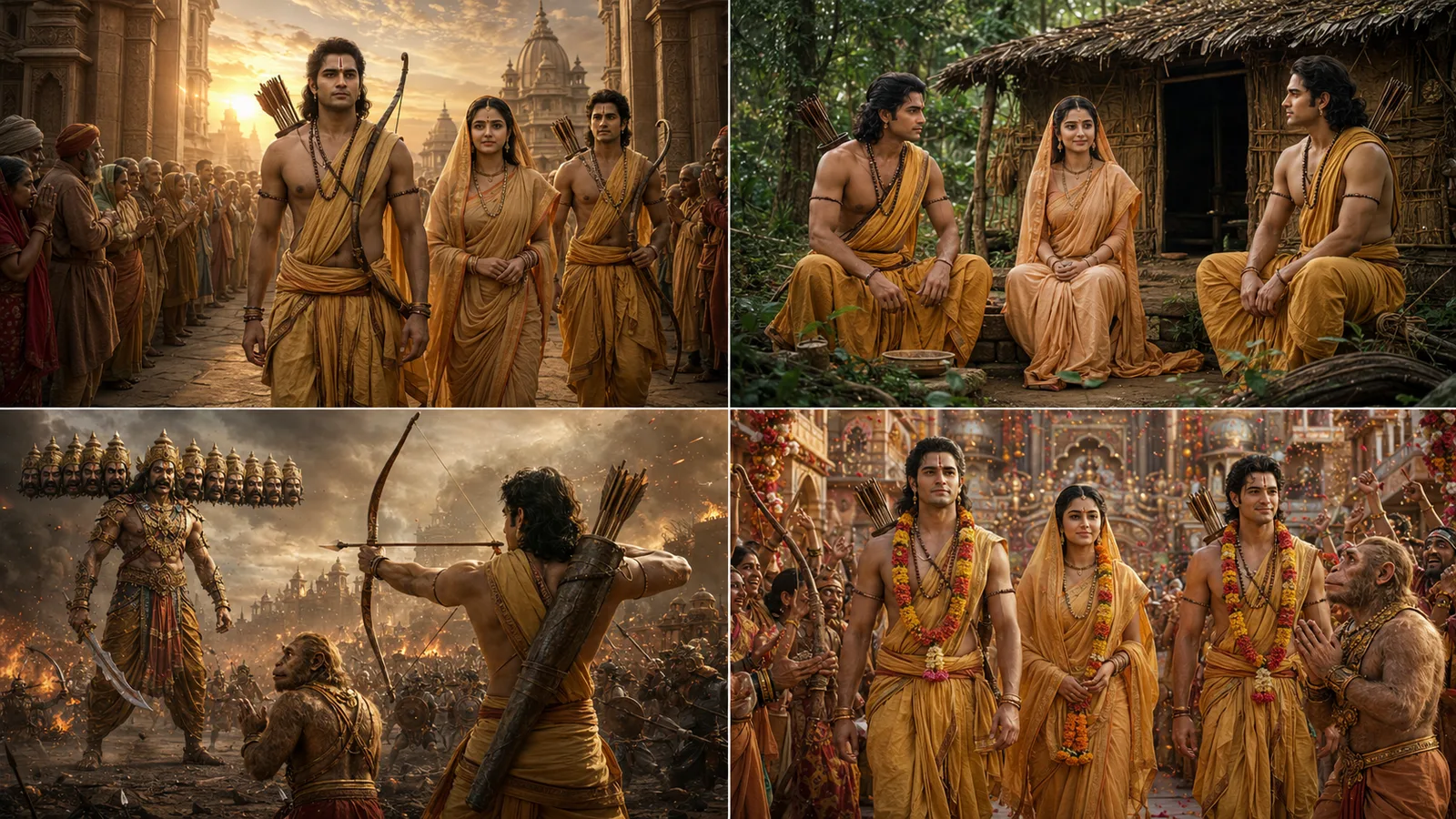
Rama is about to be crowned king of Ayodhya.
The city is preparing to celebrate.
His father is proud. His family is gathered. His future appears secure.
Then, within a single night, everything changes.
A promise made years earlier is used against him. His coronation is cancelled. His younger brother is named heir. Rama is ordered to leave the kingdom and live in the forest for fourteen years.
He could resist.
The people support him. He possesses the ability to take power. Even members of his family urge him to challenge the decision.
Instead, Rama removes his royal clothing and prepares for exile.
Sita refuses to let him go alone.
Lakshmana leaves comfort and position to accompany them.
Bharata, the brother who benefits from the decision, rejects the throne gained through injustice.
What begins as a royal celebration becomes a story of exile, separation, temptation, abduction, friendship, war, return and sacrifice.
That is why the Ramayana has remained alive for generations.
It is not simply a story in which good people defeat an evil king.
It is a study of what happens when life stops being fair.
It asks:
What does duty require when keeping a promise causes pain?
How do we remain loyal without becoming blind?
What is the difference between possessing power and deserving it?
Can love remain strong during separation?
What should we do when our own family supports something wrong?
How does knowledge become dangerous when ego controls it?
The Ramayana does not offer one easy rule for every situation.
It gives us characters whose choices allow us to examine our own.
What Is the Ramayana?
The Ramayana is one of the two great Sanskrit epics of Hindu tradition, alongside the Mahabharata.
The foundational Sanskrit work is traditionally attributed to the sage Valmiki, who is honoured as the Adi Kavi, the first poet.
The word Ramayana may be understood as the journey, story or path of Rama.
Rama is revered in Vaishnava traditions as an avatar of Vishnu and, in several devotional traditions, as the Supreme Lord himself.
The Ramayana is also a human story about:
- A son and his father
- A husband and wife
- Four brothers
- A ruler and his citizens
- A woman resisting captivity
- A servant discovering his strength
- A king destroyed by his own desire
- People forced to choose between family loyalty and moral truth
Traditional complete editions commonly present the story through seven kandas, or books:
- Bala Kanda — Rama's birth, youth and marriage to Sita
- Ayodhya Kanda — the cancelled coronation and exile
- Aranya Kanda — forest life and Sita's abduction
- Kishkindha Kanda — Rama's alliance with Sugriva and meeting with Hanuman
- Sundara Kanda — Hanuman's journey to Lanka and discovery of Sita
- Yuddha Kanda — the war in Lanka, Ravana's defeat and Sita's return
- Uttara Kanda — later events including Sita's exile, Lava and Kusha, and the conclusion of Rama's earthly life
Different editions, scholars and traditions discuss the textual history and status of the Uttara Kanda differently. Traditional editions commonly include it, while some readers and scholars consider parts of it to belong to a later textual layer.
The Ramayana has also been retold across India and Asia in many languages and forms.
Influential versions include:
- Valmiki's Sanskrit Ramayana
- Tulsidas's Ramcharitmanas
- Kamban's Tamil Ramavataram
- The Adhyatma Ramayana
- The Bengali, Assamese, Telugu, Malayalam and other regional Ramayanas
- Thailand's Ramakien
- Cambodia's Reamker
- Indonesian and Javanese Ramayana traditions
- Jain, Buddhist, folk and tribal retellings
These versions do not reproduce every character or event identically.
The Ramayana is therefore both a foundational sacred narrative and a living family of interpretations.
This article primarily follows the Valmiki narrative while identifying important later or popular traditions where necessary.
For a broader map of Hindu texts, read Hindu Scriptures Explained.
A Brief Summary of the Ramayana
King Dasharatha of Ayodhya has four sons: Rama, Bharata, Lakshmana and Shatrughna.
Rama marries Sita, the daughter of King Janaka.
When Dasharatha prepares to crown Rama, Queen Kaikeyi demands the fulfilment of two boons previously promised to her. Influenced by Manthara, she asks that Bharata be crowned and Rama be sent into exile for fourteen years.
Rama accepts the exile.
Sita and Lakshmana accompany him.
During their forest life, Ravana, the powerful ruler of Lanka, abducts Sita through deception and carries her away.
Rama and Lakshmana search for her. They meet Hanuman and form an alliance with Sugriva and the vanaras of Kishkindha.
Hanuman crosses the ocean, finds Sita in Lanka and assures her that Rama is coming.
Rama's forces build a passage across the sea, enter Lanka and fight Ravana's army.
Ravana is defeated, and Sita is freed.
Rama, Sita and Lakshmana return to Ayodhya, where Rama is crowned.
The later Uttara Kanda describes continuing public suspicion about Sita, her departure to Valmiki's hermitage, the birth of Lava and Kusha, and her final return to the Earth.
The plot may sound simple when compressed into a few paragraphs.
Its moral world is not.
Nearly every major character embodies a different response to duty, love, fear, ambition and power.
Their choices give us twelve enduring lessons.
Lesson 1: Rama — Dharma Matters Most When It Costs You Something
Rama is often called Maryada Purushottama — the highest embodiment of honourable conduct, discipline and moral boundaries.
His acceptance of exile is one of the clearest examples.
He loses:
- A kingdom
- Public honour
- Physical comfort
- Time with his family
- The future prepared for him
Yet he refuses to seize the throne by force.
Rama sees his father's promise as carrying an obligation that extends beyond personal convenience.
Whether every modern reader agrees with his decision is less important than the question it creates:
Are our values still values when following them becomes expensive?
It is easy to speak honestly when honesty costs nothing.
It is easy to remain loyal when loyalty provides benefits.
It is easy to appear principled when everyone approves.
Character becomes visible when doing what we believe is right threatens comfort, status or opportunity.
The Modern-Life Lesson
Rama's example does not mean that every promise must be followed blindly.
A promise to conceal abuse, commit wrongdoing or obey an unlawful demand should not be honoured.
Dharma requires discernment, not mechanical obedience.
The practical lesson is that commitments should not be abandoned merely because a more attractive option appears.
Before making a promise, understand its cost.
After making it, treat it seriously.
In business, relationships and leadership, trust collapses when words change according to convenience.
Rama teaches:
Do not promise lightly, and do not abandon responsibility easily.
Read Dharma: Discovering Your True Purpose in the 21st Century.
Lesson 2: Sita — Inner Strength Is Not the Same as Passivity
Sita is sometimes described only as an obedient wife who follows Rama into exile.
That description is incomplete.
She argues for her right to accompany him.
She does not simply wait for Rama to decide her life. She expresses her own understanding of marriage, duty and companionship.
During captivity in Lanka, she refuses Ravana's threats, wealth and attempts at persuasion.
She is isolated, surrounded by hostile guards and separated from everyone she loves.
Yet Ravana cannot make her surrender inwardly.
He controls her physical location.
He does not control her conscience.
Sita's strength is not expressed through physical combat.
It is expressed through her refusal to allow fear, loneliness or coercion to redefine her.
The Modern-Life Lesson
Strength is often confused with aggression.
Sita reveals another kind of strength:
- The ability to remain truthful under pressure
- The refusal to cooperate with manipulation
- The protection of personal dignity
- The ability to endure without inward surrender
- The courage to make one's own moral choice
This does not mean anyone should remain in an abusive or dangerous situation.
Seeking safety is not weakness.
Asking for help is not failure.
Sita's captivity should never be used to romanticise suffering or tell someone to silently tolerate abuse.
Her lesson is that external pressure does not have to gain ownership of the inner self.
You may not control everything happening around you.
You can still protect what you agree to become.
Lesson 3: Lakshmana — Loyalty Must Be Active, Not Blind
Lakshmana immediately chooses to accompany Rama into exile.
He leaves behind royal comfort and dedicates himself to protecting Rama and Sita.
His loyalty is extraordinary.
But Lakshmana is not emotionally empty.
He becomes angry at injustice.
He questions decisions.
He expresses frustration.
He struggles with the tension between obedience and his own judgment.
This makes his loyalty more meaningful.
He does not follow because he lacks a mind of his own.
He follows because he repeatedly chooses commitment.
The Modern-Life Lesson
Loyalty is valuable, but blind loyalty is dangerous.
A loyal friend should be able to tell you when you are wrong.
A responsible employee should not hide misconduct to protect a company.
A loving family member should not enable addiction, violence or deception.
Real loyalty protects the person's deeper wellbeing and dharma — not every temporary desire.
Lakshmana teaches us to ask:
Am I supporting this person's highest good, or am I merely helping them avoid accountability?
One factual distinction is also useful.
The famous Lakshman Rekha, the protective line said to have been drawn around the forest dwelling, is central to several later retellings and popular culture. It is not explicitly part of the Sita-abduction episode in the Valmiki Ramayana.
That does not make the later story spiritually meaningless.
It reminds us that the Ramayana tradition has developed through many retellings.
Lesson 4: Bharata — Leadership Does Not Mean Ownership
Bharata is absent when Kaikeyi secures Rama's exile and the throne for him.
When he returns and discovers what has happened, he does not celebrate.
He condemns the injustice and travels to the forest to ask Rama to return.
Rama refuses because the fourteen-year commitment must be completed.
Bharata then takes Rama's sandals back to the kingdom and places them upon the throne as a symbol of Rama's authority.
He governs without treating the kingdom as his personal possession.
This is one of the Ramayana's most powerful models of leadership.
Bharata has access to the crown.
He refuses to let the crown take possession of his character.
The Modern-Life Lesson
Many people want leadership because they want status.
Bharata accepts leadership because someone must carry responsibility.
The difference is enormous.
Leadership without attachment means:
- Treating authority as a trust
- Remembering that resources belong to the mission, not the leader
- Avoiding personal enrichment through public responsibility
- Preparing to hand power back
- Remaining accountable even when no one can easily remove you
A chief executive does not own the people working for the company.
A politician does not own the country.
A parent does not own a child's future.
A spiritual teacher does not own the student.
Bharata teaches that the best leader may be the person least interested in possessing the throne.
Lesson 5: Hanuman — Selfless Service Reveals Strength You Did Not Know You Had
When Hanuman first appears, he approaches Rama intelligently, respectfully and with excellent speech.
His greatness is not based on strength alone.
He possesses:
- Discernment
- Communication
- Courage
- Humility
- Strategy
- Devotion
- The ability to act independently
Before crossing the ocean to Lanka, Hanuman is reminded of powers he has forgotten.
Once he remembers who he is and whom he serves, hesitation gives way to action.
He crosses the sea, finds Sita, evaluates Lanka, delivers Rama's message and returns with information the entire mission needs.
Hanuman's strength is never merely personal display.
It is strength directed towards service.
The Modern-Life Lesson
Many people underestimate themselves because they think only about themselves.
The question:
"Am I impressive enough?"
can create paralysis.
Hanuman operates from another question:
"What does the mission require from me?"
When attention shifts from self-image to service, dormant abilities often become available.
You may speak more courageously when protecting another person than when defending your ego.
You may endure more difficulty when caring for family than when seeking recognition.
You may discover leadership because a community needs someone to act.
Hanuman also shows that humility is not pretending to be weak.
Humility means knowing that your abilities are most valuable when they serve something greater than personal praise.
Read Hanuman's Path to Courage and Resilience and Karma Yoga: The Path of Selfless Action.
Lesson 6: Shabari — Devotion Is Measured by Sincerity, Not Status
Shabari is an elderly ascetic who has waited faithfully for Rama's arrival.
When Rama and Lakshmana reach her hermitage, she welcomes them with reverence and offers hospitality and fruits.
Rama receives her devotion without judging her by social status, wealth or public importance.
In popular retellings, Shabari tastes each berry first to ensure that only the sweetest are offered to Rama.
That beloved detail is prominent in later devotional storytelling. The Valmiki Ramayana emphasises her disciplined spiritual life, hospitality and offerings but does not explicitly describe the tasting of every berry in the same familiar form.
The deeper teaching remains unchanged.
Rama responds to sincerity.
The Modern-Life Lesson
Modern life repeatedly teaches us to judge value through visibility.
We assume that a wealthy person's offering is greater.
We notice large donations and ignore quiet service.
We admire spiritual performance and overlook sincerity.
Shabari has no royal court, public platform or elaborate ceremony.
She has attention, patience and love.
Her story asks:
What is the quality of consciousness behind what I give?
A simple meal prepared with care can express more love than an expensive gift purchased without thought.
Five minutes of complete attention can mean more to a child than hours spent in the same room while looking at a phone.
Spiritual life is not measured only by the size of the offering.
It is measured by how much of the heart is present within it.
Read Bhakti Yoga: How Devotion Heals Loneliness and Opens the Heart.
Lesson 7: Jatayu — Courage Still Matters When Victory Is Unlikely
Jatayu, the elderly vulture king, sees Ravana abducting Sita.
He knows Ravana is powerful.
He knows he is old.
He has little reason to believe he can win.
Yet he intervenes.
Jatayu fights to stop the abduction and is mortally wounded.
When Rama later finds him, Jatayu uses his remaining strength to explain what happened.
He does not save Sita by himself.
But his action is not meaningless.
He refuses to let injustice pass without resistance.
The Modern-Life Lesson
We often decide whether to act by asking:
"Can I solve the entire problem?"
If the answer is no, we do nothing.
Jatayu offers another standard.
You may not be able to end every injustice.
You may still:
- Call for help
- Document what happened
- Refuse to participate
- Protect someone temporarily
- Speak when silence would assist the aggressor
- Give information that helps others continue the work
Moral courage is not measured only by victory.
Sometimes it is measured by whether a person stood up at all.
This does not mean taking reckless action without considering safety.
Effective courage may involve contacting authorities, gathering support or creating an escape route.
Jatayu's lesson is not that everyone must become a lone hero.
It is that inability to guarantee success does not remove every responsibility to act.
Lesson 8: Vibhishana — Conscience May Require Standing Against Your Own Side
Vibhishana is Ravana's brother.
He belongs to Lanka.
His family, security and identity are connected with Ravana's kingdom.
Yet he repeatedly advises Ravana to return Sita and prevent the destruction that his actions are bringing.
Ravana refuses.
Vibhishana eventually leaves Lanka and seeks refuge with Rama.
Some members of Rama's alliance suspect him.
They wonder whether he is a spy.
Rama decides to receive him.
Vibhishana later assists in the campaign against Ravana and becomes ruler of Lanka after the war.
His decision raises a difficult question:
When does loyalty to family or country become cooperation with wrongdoing?
The Modern-Life Lesson
It is easy to condemn misconduct committed by strangers.
It is much harder when the person responsible is:
- A family member
- A close friend
- A political leader you supported
- A religious figure you admired
- A company that employs you
- A community with which you identify
Group identity can weaken moral judgment.
We begin defending actions we would condemn if performed by the opposing side.
Vibhishana teaches that dharma must be greater than tribe.
Standing against your own group does not automatically make you righteous. Motives still matter.
But family loyalty cannot transform injustice into justice.
Sometimes the most loyal thing a person can do is refuse to help someone continue destroying themselves and others.
Lesson 9: Kaikeyi and Manthara — Fear Makes Manipulation Powerful
Kaikeyi is not introduced simply as someone who has always hated Rama.
She had affection, position and security.
Manthara redirects her attention towards fear.
She suggests that Rama's coronation will threaten Kaikeyi and Bharata.
The possibility of loss becomes more emotionally powerful than existing love.
Kaikeyi begins interpreting events through suspicion.
Once fear takes control, the same people and circumstances appear different.
A celebration becomes a threat.
Rama becomes a rival.
A husband's trust becomes an opportunity to be used.
Manthara influences Kaikeyi, but Kaikeyi remains responsible for the choice she makes.
Manipulation succeeds because it finds an insecurity willing to cooperate.
The Modern-Life Lesson
Manipulation rarely begins with:
"Let me convince you to become unjust."
It begins with:
- "They are going to take what belongs to you."
- "You are being disrespected."
- "Your family will become irrelevant."
- "Everyone else is gaining while you are losing."
- "Act now before it is too late."
Fear narrows attention.
It makes extreme action appear necessary.
This pattern operates in families, workplaces, politics and social media.
Before making a major decision under emotional pressure, ask:
- What evidence supports this fear?
- Who benefits if I react immediately?
- Have I spoken directly to the person involved?
- Am I being encouraged to distrust everyone except the person advising me?
- Would I make the same choice after a night of calm reflection?
Kaikeyi teaches that one unexamined fear can redirect an entire life.
Lesson 10: Ravana — Knowledge Without Self-Mastery Becomes Dangerous
Ravana is not portrayed as unintelligent.
He possesses learning, power, courage, political authority and extraordinary capability.
Later traditions also remember his austerities and devotion to Shiva.
Yet none of these protects him from destruction.
Why?
Because knowledge has not become self-mastery.
Ravana can govern a kingdom but cannot govern desire.
He can advise others but refuses wise advice directed towards him.
He can recognise power but assumes that power makes him exempt from moral limits.
His central failure is not lack of information.
It is the ego's refusal to accept restraint.
The Modern-Life Lesson
Education does not automatically produce character.
A person may be:
- Highly qualified and dishonest
- Spiritually knowledgeable and abusive
- Successful and deeply insecure
- Charismatic and incapable of accepting criticism
- Intelligent enough to justify every harmful action
Ravana's fall warns us about the combination of talent and entitlement.
The more capable a person becomes, the more important self-discipline becomes.
Power magnifies whatever already exists within character.
In a compassionate person, power expands protection.
In an insecure person, it can expand control.
In an arrogant person, it can accelerate destruction.
Ravana also receives repeated opportunities to change.
Vibhishana advises him.
Mandodari warns him.
Hanuman demonstrates Rama's reach.
Rama offers pathways that could have prevented total destruction.
Ravana's tragedy is not that he makes one mistake.
It is that ego turns correction into humiliation and advice into insult.
Lesson 11: Tara and Mandodari — Wisdom Must Be Heard Before the Crisis Becomes Irreversible
Tara advises Vali not to rush into another confrontation with Sugriva.
She senses that something has changed and urges caution.
Vali dismisses her counsel.
Mandodari warns Ravana about the consequences of his actions and the danger of continuing the conflict.
Her understanding does not change his direction.
Both women see danger before the powerful men around them are willing to acknowledge it.
Their advice fails not because it lacks wisdom, but because pride has made listening impossible.
The Modern-Life Lesson
Many failures are visible before they become disasters.
Employees warn management.
Family members notice an addiction.
Engineers identify a safety risk.
A partner recognises growing distance.
Financial records show that spending cannot continue.
The warning is ignored because accepting it would require change.
Good leadership is not proved by always having the correct answer.
It is proved by creating conditions in which uncomfortable truth can be spoken and heard.
Ask:
- Who can disagree with me safely?
- Do I punish people who bring bad news?
- Do I seek advice only from those who confirm my opinion?
- Have I confused confidence with infallibility?
A leader surrounded by silence may not be respected.
They may simply be feared.
Tara and Mandodari teach that wise advice has little value when ego has locked the door through which it must enter.
Lesson 12: Rama Rajya — Power Becomes Righteous Only When It Serves
Rama's return to Ayodhya and coronation represent the restoration of moral order.
The ideal of Rama Rajya later became associated with just governance, social wellbeing, safety, accountability and a ruler who places public duty above private comfort.
The central principle is not that a ruler becomes powerful.
It is that power becomes accountable to dharma.
A kingdom is not righteous merely because it is wealthy or militarily strong.
It must consider:
- Whether people are protected
- Whether justice is available
- Whether rulers keep their word
- Whether the vulnerable can live safely
- Whether public resources are used responsibly
- Whether leadership restrains itself
The Modern-Life Lesson
Rama Rajya should not be reduced to a political slogan.
Its real test is conduct.
A government invoking Rama while tolerating corruption contradicts the principle.
A business praising dharma while exploiting workers contradicts the principle.
A family demanding obedience while denying dignity contradicts the principle.
The difference between Ravana's power and Rama's authority is not merely that one wins the war.
Ravana uses others to protect his desire.
Rama is expected to restrain desire in order to protect others.
The spiritual meaning of leadership is therefore service.
Authority is legitimate only when it remains answerable to something higher than itself.
The Difficult Episodes Should Not Be Hidden
The Ramayana is deeply sacred to millions of people.
Respect for the text does not require pretending that every episode is emotionally or morally easy for every reader.
Several passages have generated debate for centuries.
They should be approached with context, humility and honesty.
Rama's Killing of Vali
Rama kills Vali with an arrow while Vali is fighting Sugriva rather than confronting him in an ordinary face-to-face duel.
Vali challenges Rama's action.
Rama responds by referring to Vali's conduct towards Sugriva, his relationship with Sugriva's wife and Rama's authority to punish wrongdoing.
Traditional commentators offer several defences of Rama's decision.
Modern readers may still feel troubled by the method used.
Both facts should be acknowledged.
The episode invites questions about:
- The limits of political authority
- Whether a just goal permits indirect methods
- Who has the right to punish
- Whether alliances can distort judgment
- How context changes the ethics of combat
A serious reader should not remove the discomfort too quickly.
The Ramayana often makes us examine dharma rather than simply providing a slogan about it.
Sita's Fire Ordeal
After Ravana's defeat, Rama speaks harshly to Sita in public.
Sita responds and enters fire.
Agni, the fire deity, returns her and affirms her purity.
Devotional interpretations often describe the episode as a public demonstration of a purity Rama already knew, or explain it through theological ideas such as a protected or shadow Sita.
Other readers experience the episode as a painful demand placed upon a woman who has already survived abduction, captivity and intimidation.
That discomfort deserves recognition.
Whatever theological interpretation is followed, the episode should not be used to teach that survivors of kidnapping, assault or abuse must prove their purity.
Responsibility belongs to the person who commits the violation — not to the person who survives it.
Sita's Later Exile
The Uttara Kanda describes public gossip concerning Sita.
Although she is pregnant, Rama arranges for her to be left near Valmiki's hermitage.
There she gives birth to Lava and Kusha.
Later, when asked again to affirm her purity, Sita calls upon the Earth, her mother, to receive her.
The Earth opens, and Sita departs.
Traditions interpret these events differently.
Some emphasise Rama's tragic conflict between personal knowledge and the perceived demands of kingship.
Some regard the episode as showing the terrible cost of public responsibility.
Some criticise the decision and centre Sita's suffering.
Some read Sita's final return to the Earth as an act of dignity and refusal to submit to endless suspicion.
Some readers and scholars also debate the textual history of the Uttara Kanda itself.
The article does not need to declare that only one response is permitted.
It should, however, reject one harmful conclusion:
The episode must never be used to justify abandoning a spouse, distrusting survivors or placing public reputation above someone's safety and dignity.
The spiritual question is not:
"How can we make this episode comfortable?"
It is:
"What does this tragedy reveal about leadership, reputation, gender and the danger of allowing public suspicion to become more powerful than justice?"
Surpanakha and the Ethics of Humiliation
Surpanakha approaches Rama and Lakshmana and becomes part of an escalating confrontation.
The episode ends with severe physical mutilation.
Versions differ in tone and detail, and the story has been interpreted through questions of desire, threat, mockery, violence and the chain of events leading towards Sita's abduction.
Modern readers may reasonably find the episode disturbing.
It should not be used to justify humiliating women, mocking appearance or treating unwanted attraction as permission for violence.
It also warns that ridicule and uncontrolled retaliation can escalate conflict far beyond the original encounter.
The Ramayana Is Not a Collection of Commands to Copy Literally
Sacred literature frequently teaches through the consequences of actions.
Not everything a character does automatically becomes a universal instruction.
The Ramayana should not be read as:
- Every child must obey every parental demand
- Every spouse must remain silent
- Every leader is above criticism
- Every family member deserves loyalty regardless of conduct
- Every conflict should be solved through force
- Every traditional practice must remain unchanged
- Every later social custom is divinely commanded
The epic invites reflection on dharma.
Reflection requires:
- Context
- Conscience
- Reliable commentary
- Awareness of different versions
- Recognition of historical conditions
- Compassion for those affected by an interpretation
A reading that consistently protects power while silencing the vulnerable should be examined carefully.
Five Ways to Live the Ramayana Today
Keep One Promise More Carefully
Identify one commitment you have been neglecting.
Do not make a dramatic new vow.
Complete the responsibility already waiting.
Become Shelter for Someone
Govardhan belongs to Krishna's story, but the Ramayana repeatedly shows protection as a sacred duty.
Ask who becomes safer, calmer or stronger because you are present.
Help one person without making them feel indebted.
Listen to the Advice You Least Want to Hear
Think of one person whose criticism immediately makes you defensive.
Separate their tone from the possible truth within their message.
Pride may reject the warning that could prevent the next mistake.
Interrupt One Ravana-Like Pattern
Choose one tendency:
- Entitlement
- Anger
- Obsession
- Refusal to apologise
- Need for control
- Inability to hear "no"
Do not merely condemn Ravana.
Identify where a smaller version of the same pattern operates within you.
Practise Hanuman's Question
Before one important action, ask:
"What does service require here?"
This may produce a different answer from:
"What will make me look successful?"
Common Misunderstandings About the Ramayana
"The Ramayana Is Only a Story About Good Defeating Evil"
The conflict between Rama and Ravana is central, but the epic also explores family duty, leadership, grief, loyalty, temptation, social reputation and morally difficult choices.
"Every Ramayana Tells Exactly the Same Story"
No.
The Ramayana has been retold across languages, religious traditions and cultures. Characters, events, emphasis and theology may vary.
"Sita Is a Weak Character"
Sita displays agency, endurance, moral clarity and resistance under coercion.
Different retellings emphasise different aspects of her strength.
"Hanuman Is Important Only Because He Is Powerful"
Hanuman's intelligence, communication, judgment, humility and devotion are as important as his physical strength.
"Ravana Was Evil Because He Had No Good Qualities"
Ravana is portrayed as capable and learned.
His tragedy is that ability and knowledge remain governed by desire, pride and refusal to accept correction.
"Kaikeyi Alone Caused Everything"
Kaikeyi is responsible for her choices, while Manthara's manipulation and Dasharatha's earlier promise are also part of the chain of events.
The epic repeatedly shows that major disasters develop through several decisions.
"Lakshman Rekha Appears in Every Ramayana"
No.
The protective line is prominent in several later traditions and popular retellings but is not explicitly part of Valmiki's account of Sita's abduction.
"Shabari's Tasted Berries Appear in Every Version"
No.
The tasting of the berries is a beloved later devotional detail. Valmiki's account emphasises Shabari's hospitality, fruits, spiritual discipline and devotion.
"Rama Rajya Means Supporting Any Government That Uses Rama's Name"
No.
The ideal concerns justice, responsibility, restraint and public wellbeing.
A name does not make conduct dharmic.
"Questioning a Difficult Episode Is Disrespectful"
Respectful questioning has always been part of engagement with Hindu sacred literature.
Questions should be informed, honest and free from deliberate mockery, but devotion does not require intellectual dishonesty.
The Ramayana Does Not Ask You to Become Rama Overnight
The Ramayana contains kings, warriors, sages, divine beings and extraordinary acts of courage.
But its spiritual lessons appear in ordinary choices.
Every day, there is a Kaikeyi moment when fear tries to rewrite love.
There is a Bharata moment when power becomes available and we must decide whether to possess it or serve through it.
There is a Lakshmana moment when loyalty must remain awake.
There is a Shabari moment when a simple act can carry complete devotion.
There is a Jatayu moment when we must decide whether inability to guarantee victory excuses silence.
There is a Vibhishana moment when conscience stands against our own group.
There is a Hanuman moment when forgotten strength returns because someone needs us to act.
There is a Ravana moment when ego tells us that knowledge, status or past achievements make us immune from correction.
And there is a Rama moment when dharma requires something more difficult than what we personally prefer.
The Ramayana does not ask us to admire these choices only from a distance.
It asks us to recognise them within ourselves.
Ravana is not defeated merely when an image of him burns during a festival.
Ravana is defeated when arrogance becomes capable of listening.
When desire accepts a boundary.
When power stops treating other people as possessions.
When intelligence begins serving wisdom.
Rama Rajya does not begin only when a king is crowned.
It begins when authority becomes service.
When promises become trustworthy.
When the vulnerable are protected.
When leadership becomes accountable.
When dharma becomes more important than personal advantage.
Sita's strength is not honoured merely by praising her name.
It is honoured when women are believed, protected and treated with dignity.
Hanuman's devotion is not honoured merely by reciting his story.
It is honoured when strength becomes humble service.
Bharata's sacrifice is not honoured merely by admiring the sandals on the throne.
It is honoured when leaders remember that power is borrowed.
The deepest spiritual meaning of the Ramayana is therefore not that one perfect family lived without conflict.
It is that dharma must be rediscovered within conflict.
Love must survive separation.
Courage must act without certainty.
Power must accept limits.
And every person must decide which inner voice will guide the next choice.
The final question is not only:
"What happened to Rama, Sita and Hanuman?"
It is:
"Which Ramayana character is shaping the way I am living today?"