Why We Feel Empty Despite Working So Hard
You wake up, check your notifications, jump into your daily routine, check off tasks, hit targets, and meet deadlines. Yet, at the end of the day, an underlying sense of hollow exhaustion remains. You are working hard, but you feel like you are living on the surface of your own life—moving through actions without experiencing deep meaning.
This friction between constant activity and inner fulfillment is one of the defining crises of modern life. We have been conditioned to believe that happiness is a prize waiting at the finish line of our achievements: the next promotion, the project launch, the paycheck, or the praise of peers.
The ancient Hindu path of Karma Yoga was designed precisely for this crisis. Karma Yoga is not "karma" in the popular pop-culture sense—the simplistic idea that good deeds act like a cosmic vending machine returning good luck. It is something far more profound: the complete science of acting in the world without being enslaved by it.
Key Takeaways from Karma Yoga
- Action without Attachment: Karma Yoga teaches that suffering comes not from hard work, but from psychological attachment to outcome (Nishkama Karma).
- Work as Worship: Any task—whether writing software, preparing dinner, or managing a team—becomes a spiritual practice when done with pure presence and service (Seva).
- The Antidote to Burnout: By focusing 100% of your energy on the process and 0% on worrying about results, you preserve your mental reserves and eliminate anxiety.
What Is Karma Yoga? Sacred Texts & Core Meaning
Karma Yoga is one of the four classical paths to liberation (Moksha) in Hindu philosophy, alongside Jnana Yoga (knowledge), Bhakti Yoga (devotion), and Raja Yoga (meditation). The word Karma comes from the Sanskrit root Kri (कृ), meaning "to do" or "action."
While other paths might suggest withdrawing from society to find peace, Karma Yoga insists that the battlefield of everyday life—your office, your family, your community—is the ultimate ashram.
       ┌─────────────────────────────────────────┐
       │             FOUR PATHS OF YOGA          │
       └────────────────────┬────────────────────┘
                            │
       ┌──────────────┬─────┴──────┬──────────────┐
       │              │            │              │
 ┌─────▼─────┐  ┌─────▼─────┐┌─────▼─────┐  ┌─────▼─────┐
 │Karma Yoga │  │Bhakti Yoga││Jnana Yoga │  │ Raja Yoga │
 │ (Action)  │  │(Devotion) ││(Knowledge)│  │(Meditation│
 └───────────┘  └───────────┘└───────────┘  └───────────┘
The Bhagavad Gita's Golden Rule of Action
The central text of Karma Yoga is the Bhagavad Gita, spoken on the battlefield of Kurukshetra when Arjuna was paralyzed by anxiety over the consequences of his actions. In Chapter 2, Verse 47, Lord Krishna delivers the single most famous instruction on action in Eastern philosophy:
"Karmanye vadhikaraste ma phaleshu kadachana |
Ma karma-phala-hetur bhur ma te sango 'stv akarmani ||"Translation: "You have a right to perform your prescribed duties, but you are never entitled to the fruits of your actions. Never consider yourself the cause of the results, nor be attached to inaction."
This single verse contains a radical psychological breakthrough:
- You own the effort, not the outcome: You control your focus, preparation, and execution. You do not control market shifts, other people's reactions, or unforeseen circumstances.
- Outcome-obsession breeds paralysis: When you obsess over the "fruit" (Karma-Phala), your mind leaves the present moment and wanders into future anxiety.
- Inaction is not the solution: Releasing attachment does not mean becoming passive, lazy, or cynical (Akarmani). You are called to act with maximum vigor.
To understand how this connects to broader Hindu philosophy, exploring What Is Hinduism and our comprehensive breakdown of Understanding Your True Purpose (Dharma) provides essential context on how personal duty aligns with cosmic order.
Isha Upanishad & Lokasangraha (Welfare of the World)
The principle of Karma Yoga is rooted in the Isha Upanishad (Verse 2), which declares that by performing actions without selfish attachment, work leaves no psychological stain on the soul:
"Performing work in this world, one should wish to live a hundred years. Thus it is right for you, not otherwise; action will not cling to a man."
Furthermore, in Bhagavad Gita (Chapter 3, Verse 20), Krishna introduces the concept of Lokasangraha (लोकसंग्रह)—action performed for the maintenance and upliftment of the world. The Karma Yogi acts not just for personal survival, but as a conscious participant in the health of the entire ecosystem.
Sakama Karma vs. Nishkama Karma: The Paradigm Shift
To practice Karma Yoga, one must understand the shift from Sakama Karma to Nishkama Karma:
| Feature | Sakama Karma (Desire-Driven) | Nishkama Karma (Desireless Action) |
|---|---|---|
| Primary Motive | Personal reward, status, praise, fear of failure | Duty (Dharma), service (Seva), process excellence |
| Mental Focus | Divided between present task and future result | 100% present in the current action |
| Emotional State | Highly anxious, volatile, easily disappointed | Calm, resilient, emotionally steady |
| Karmic Effect | Creates ego-bonds and ongoing anxiety | Purifies the mind (Chitta Shuddhi) and liberates |
As explored in our deep-dive on Karma and Reincarnation, actions driven by heavy ego-desire generate lingering psychological impressions (Samskaras) that trap the mind in repetitive reactivity. Nishkama Karma burns away these impressions.
Swami Vivekananda & The Secret of Work
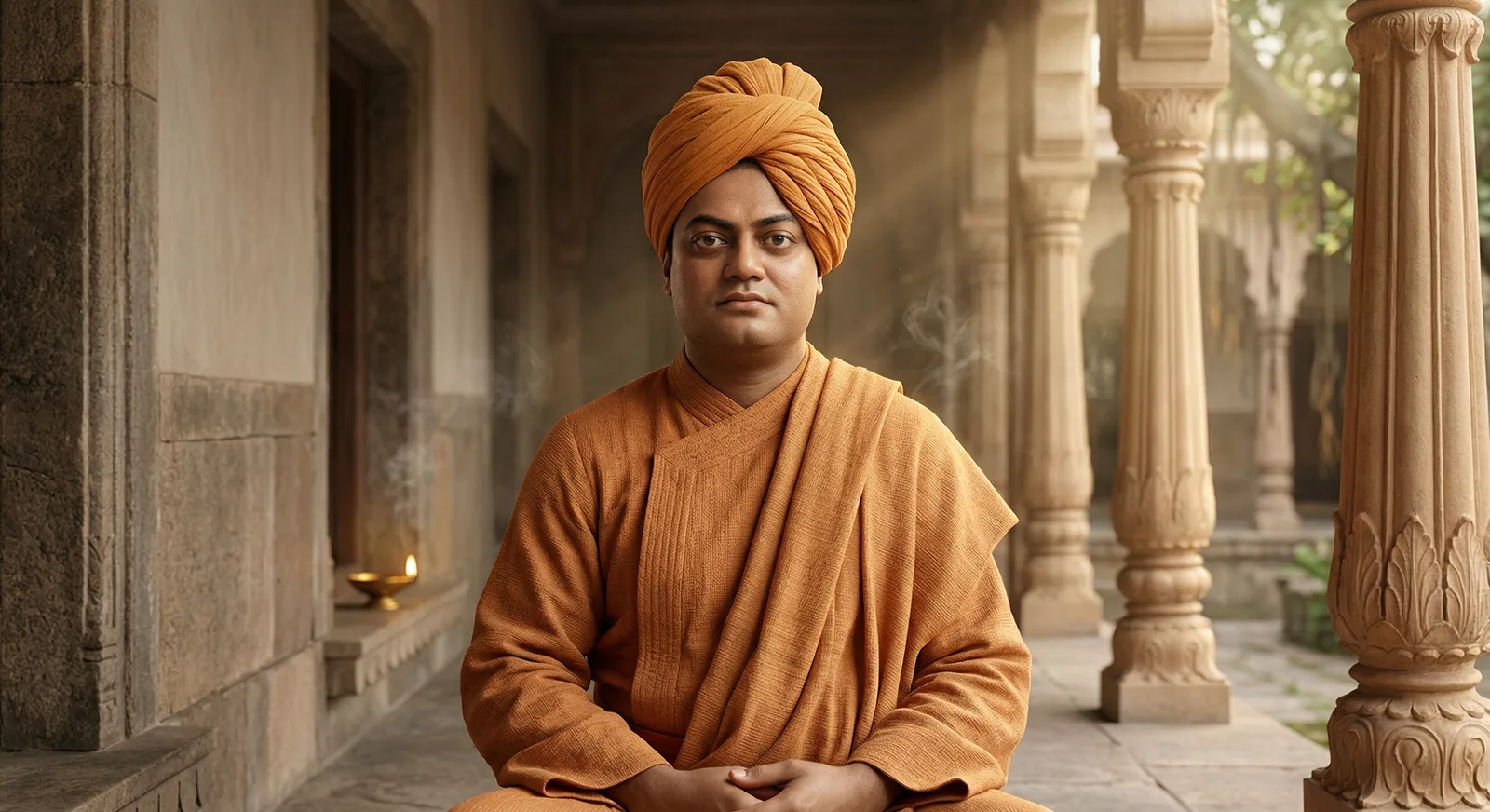
In 1896, Swami Vivekananda delivered a series of landmark lectures in New York and London, later compiled into his classic book Karma Yoga. Vivekananda demystified the practice for the modern world:
"Every work that we do becomes holy if we do it in the right spirit. The ideal man is he who, in the midst of the greatest silence and solitude, finds the intensest activity, and in the midst of the intensest activity finds the silence and solitude of the desert."
Vivekananda emphasized that true unselfishness is a superpower. When you want nothing for yourself from an interaction, you cannot be manipulated, intimidated, or discouraged. You gain complete clarity of mind.
This principle is closely tied to the witness state taught in The Bhagavad Gita's Guide to Anxiety and Stress, where observing the mind's reactivity allows one to act with wisdom rather than impulse.
Karma Yoga in Relationships: Ending Transactional Love
The most rigorous arena for Karma Yoga is not the corporate office—it is the home.
Most modern relationships operate on an unspoken transactional model: "I give you attention, affection, and safety; therefore, you must treat me in the exact way I expect." When the other person fails to deliver, resentment builds.
Karma Yoga proposes a radical alternative: Love without scorekeeping.
TRANSACTIONAL RELATIONSHIP:
[My Effort] ──► (Expectation of Return) ──► [Disappointment / Resentment]

KARMA YOGA RELATIONSHIP:
[My Effort] ──► (Offered as Pure Service) ──► [Inner Peace & Freedom]
- Serve without demanding credit: Loving your partner, caring for aging parents, or raising children without demanding constant gratitude.
- Respect their freedom: Loving someone means supporting their growth, not controlling their choices to suit your comfort.
- Boundaries with Compassion: Karma Yoga does not mean allowing abuse. Action can include setting firm boundaries, provided the boundary is set out of clarity and self-care, not vindictive anger.
3 Practical Ways to Practice Karma Yoga This Week
You do not need to abandon your possessions or join an ashram. You can start practicing Karma Yoga today in your normal routine:
1. The 100/0 Rule at Work
Whenever you sit down to work on a task—whether writing a report, coding a feature, or cleaning your desk:
- Give 100% of your energy to executing the work with craftsmanship.
- Reserve 0% of your energy for worrying about how your boss will react, what praise you will receive, or whether it will succeed.
- When anxiety about the outcome enters your thoughts, gently state: "The effort is mine; the fruit belongs to the universe."
2. Practice Anonymous Seva (Quiet Service)
Perform one small act of service every day without telling a single soul.
- Clean a shared space, pay for someone's coffee, mentor a junior colleague, or help an elderly neighbor.
- Crucial Rule: Do not post about it on social media. Do not bring it up in conversation. The ego weakens when service is kept in silent sacredness.
3. Reframe Annoyances as Non-Attachment Training
The next time you encounter a disruption—a flight delay, a traffic jam, or a canceled appointment—view it through the lens of Karma Yoga.
- Instead of reacting with frustration ("Why is this happening to me?"), remind yourself: "This situation is an opportunity to practice releasing my demand for reality to match my preference."
- Pair this practice with classical breathwork disciplines found in The Ancient Science of Yoga to stabilize your nervous system.
Conclusion: Freedom in the Midst of Action
Karma Yoga offers the ultimate spiritual freedom: you do not need to run away from your responsibilities to find peace. The office, the kitchen, the commute, and the computer keyboard are your spiritual ground.
When you surrender the need to control the results of your life, the weight of the world lifts off your shoulders. You become capable of immense work, boundless energy, and deep joy—because you are no longer working for the fragile ego, but for the divine flow of life itself.
Are you ready to deepen your understanding of ancient spiritual paths? Start My Transformation and explore personalized insights with AI guidance trained on the timeless wisdom of world traditions.