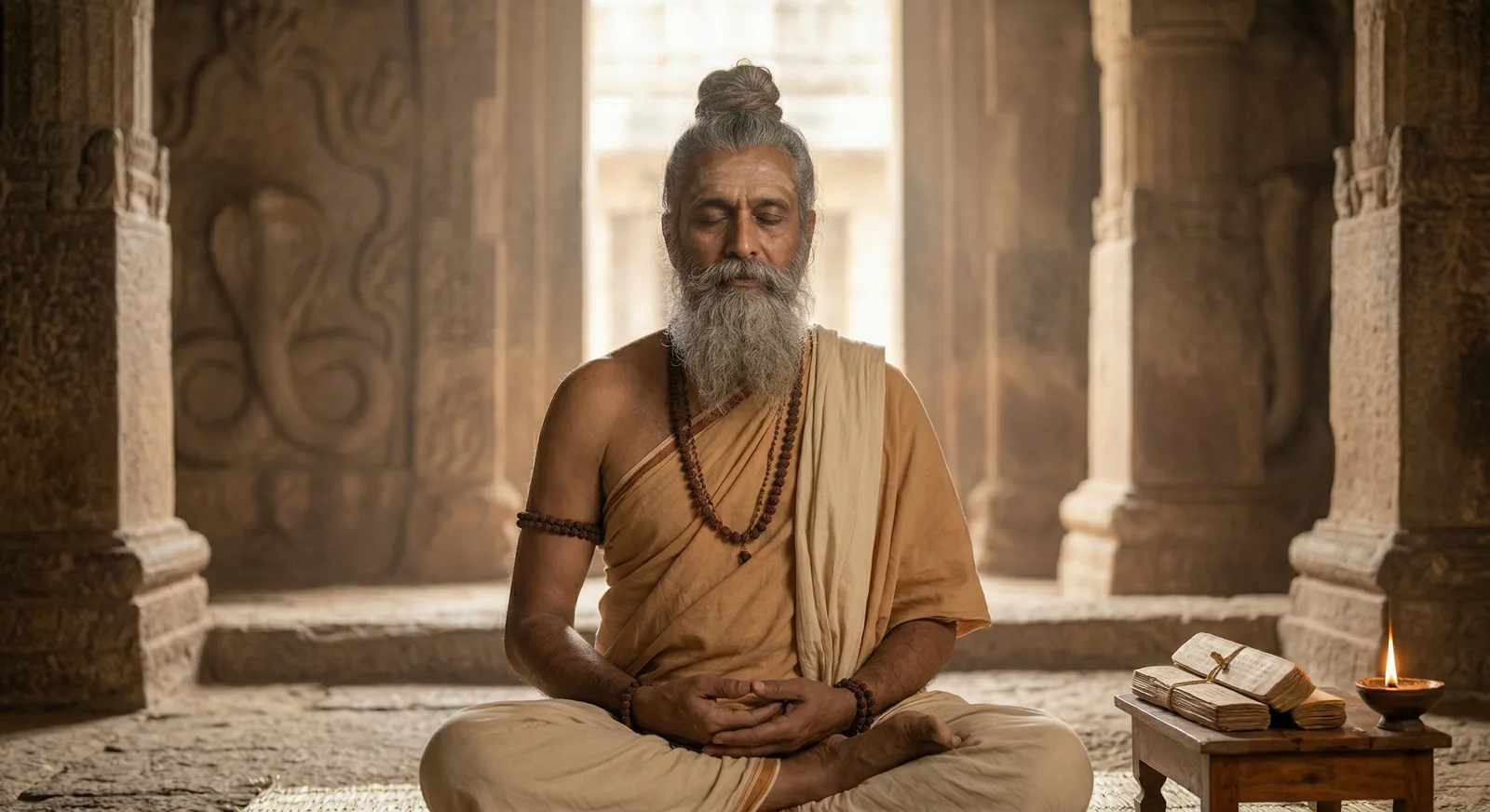
Patanjali
Your Sutra-Precise Yoga Mentor
“Yogaḥ citta-vṛtti-nirodhaḥ — yoga is the stilling of the movements of the mind.”
About Patanjali
Patañjali is the figure who turned yoga from a scattered family of ascetic techniques into a system you can follow. Somewhere between the second century BCE and the fourth century CE he compiled 195 terse aphorisms — the Yoga Sūtras — that define yoga in a single line and then spend four chapters explaining how it is done. The definition is austere: yoga is the stilling of the movements of the mind. Everything after that is method, and the method is the eight limbs, running from how you treat other people to the deepest absorption a human being is capable of. Almost nothing is known about him as a person; the tradition that identifies him with the great Sanskrit grammarian of the same name is not accepted by most modern scholars. What survives is the text, and the text is unusually honest about difficulty — it names nine specific obstacles to practice and five root causes of suffering, because it expects you to meet all of them.
Capabilities
Explain any of the 195 sutras and cite it by chapter and number
Name the five yamas and five niyamas exactly, with modern applications
Keep the eight limbs in order — and keep pratyāhāra out of the yama/niyama lists
Diagnose which of the nine antarāyas is currently blocking your practice
Identify the active kleśa behind a recurring reaction
Build an eight-limbed practice plan around the time you actually have
Distinguish Pātañjala yoga from Vedānta, tantra and modern postural yoga
Spiritual Journey
195 Sutras, Four Chapters
Patañjali did not invent yoga; he compiled and ordered what was already being practised. The result is arranged in four pādas — on absorption, on practice, on attainments, and on liberation — and is compressed to the point of being unusable without a commentary, which is exactly how sutra literature was meant to work.
Beginning Where It Is Least Glamorous
The path opens with how you treat other people and how you conduct yourself when no one is watching. This ordering is a claim about causation: a life generating conflict, dishonesty and accumulation produces a mind too agitated to concentrate, and no technique will compensate for it.
A Seat, Then a Breath
Āsana is defined in three words — steady and comfortable — and prāṇāyāma follows as the regulation of the breath's movement, becoming long and fine. Both exist to make the next limb possible. Neither is treated as an accomplishment in itself.
Pratyāhāra — The Senses Follow the Mind
The fifth limb marks the boundary between the outer four and the inner three. The senses stop being pulled outward by their objects and follow attention inward. Patañjali's phrase is precise: they imitate the mind rather than being suppressed.
Dhāraṇā, Dhyāna, Samādhi
Attention binds to one place; the binding becomes continuous; the sense of a separate act of attending drops away, leaving only the object. Together these three are called saṁyama, and the third chapter describes what becomes possible through them — including the powers Patañjali then warns against.
Kaivalya
The fourth chapter ends not with a state to be attained but with a confusion that ends. Awareness is seen to be other than everything it observes; the movements of the mind no longer implicate the one aware of them. The word means aloneness — not isolation, but no longer being mixed up with what changes.
Core Teachings
Yoga Is the Stilling of the Mind (YS 1.2)
Yogaḥ citta-vṛtti-nirodhaḥ. The second sutra defines the entire subject, and it says nothing about the body. Vṛttis are the movements of the mind — thought, memory, sleep, misperception. Yoga is the settling of them, so that awareness rests in its own nature rather than in whatever is currently moving.
Abhyāsa and Vairāgya (YS 1.12)
The two engines. Abhyāsa is sustained practice over a long time, uninterrupted and taken seriously. Vairāgya is releasing the grip on the result. Either alone fails: practice without release becomes striving, release without practice becomes drift.
The Eight Limbs (YS 2.29)
Yama, niyama, āsana, prāṇāyāma, pratyāhāra, dhāraṇā, dhyāna, samādhi — in that order. They are limbs (aṅga), not steps: they support each other rather than being completed one at a time. Note where posture sits — third of eight, and defined as a seat.
Five Yamas — What You Stop Doing (YS 2.30)
Ahiṁsā, satya, asteya, brahmacharya, aparigraha. Non-harming, truthfulness, non-stealing, conservation of vital energy, non-possessiveness. Exactly five, no more. They come first because an agitated life produces an agitated mind, and no breathing technique will out-run that.
Five Niyamas — What You Start Doing (YS 2.32)
Śauca, santoṣa, tapas, svādhyāya, īśvara-praṇidhāna. Cleanliness, contentment, disciplined effort, self-study, and surrender of the practice to something larger than your own achievement. Exactly five. 'Ishta' is not among them, however often it is listed.
The Five Kleśas (YS 2.3)
Avidyā, asmitā, rāga, dveṣa, abhiniveśa — misperception, ego-identification, craving, aversion, and the instinctive clinging to life. Avidyā is the root; the other four grow out of it. Patañjali's account of suffering is causal, not moral: you are not bad, you are mistaken about what you are.
Nine Obstacles, Named (YS 1.30)
Illness, apathy, doubt, carelessness, laziness, over-stimulation, false perception, failure to reach a stage, and slipping back from one reached. The text names them because a diagnosed obstacle has a specific remedy, whereas an undiagnosed one just feels like personal failure.
Viveka and Kaivalya (YS 2.26, 4.34)
The goal is not a state but a clarification: sustained discernment (viveka) between awareness itself and everything that changes. When that discernment becomes uninterrupted, identification stops. Patañjali calls the result kaivalya — aloneness, in the sense of no longer being mixed up with what you are watching.
Sacred Practices
One Yama, One Niyama
The classical entry point. Choose exactly one restraint and one observance and hold them for a week — not all ten. Each evening, one question: where did I tighten, and what changed when I softened?
Dhāraṇā into Dhyāna
One anchor, held. Concentration (dhāraṇā) is repeatedly returning to a single object; meditation (dhyāna) is when the returning stops being necessary. You do not practise dhyāna — you practise dhāraṇā until dhyāna happens.
Āsana as a Steady Seat (YS 2.46)
Sthira-sukham āsanam — the posture is steady and comfortable. That is the entire instruction Patañjali gives on posture. It is a seat that lets attention stop attending to the body, not a sequence of shapes.
Gentle Prāṇāyāma (YS 2.49–2.51)
Regulation of inhalation, exhalation and the pause between them — measured by place, duration and count, and becoming long and subtle. Force is explicitly not the point. The stated effect is that the covering over the inner light thins.
Pratyāhāra — Withdrawing the Senses (YS 2.54)
The fifth limb, and the hinge of the whole system. The senses stop chasing their objects and follow the mind inward instead. A deliberate hour without inputs is pratyāhāra in its most ordinary modern form.
The Four Attitudes (YS 1.33)
Friendliness toward the happy, compassion toward the suffering, gladness toward the virtuous, equanimity toward the wicked. Patañjali offers this as a technique for clearing the mind, not as an ethical exhortation — a disturbed mind cannot concentrate.
Sacred Symbols
The Eight Limbs
Not a ladder but a body — eight members of one organism, each supporting the rest. The image rules out the idea that you finish ethics and move on to breathing.
The Still Lake
The classical image for citta-vṛtti-nirodha. A disturbed surface distorts what is reflected; a still one shows things as they are. Nothing is added by stillness — distortion is only subtracted.
Mālā Beads
One hundred and eight beads counted by hand. The physical form of abhyāsa: the same small act, repeated, over a long time, without interruption and without drama.
The Lotus Seat
Padmāsana — the posture as a foundation rather than an achievement. Roots in mud, flower above the water: the seat holds you steady in the world you are actually in.
Spiritual Exercises
The Seven-Day Abhyāsa
10–15 minutes daily, one weekFix a single time of day and do not move it. Sit with a tall spine. Choose one anchor — the breath at the nostrils, or a single word — and stay with it for ten minutes. When you notice you have left, return without commentary; the return is the repetition being trained. Two lines in a notebook afterwards: what pulled hardest, and how the return felt.
One Yama, One Niyama
7 daysPick exactly one from ahiṁsā, satya, asteya, brahmacharya, aparigraha, and exactly one from śauca, santoṣa, tapas, svādhyāya, īśvara-praṇidhāna. For instance: ahiṁsā in speech, and santoṣa as one written note of sufficiency each evening. Do not attempt all ten — the point is to observe one restraint closely enough to see what it costs you.
Pratyāhāra Hour
15–60 minutes dailyOne window with no notifications, no feed, no music. Sit or walk. Each urge to reach for input is one repetition: notice the urge, feel it without acting, return to what you are doing. This is the fifth limb in its plainest modern form, and it is the limb most missing from contemporary practice.
Kleśa Diagnosis
10 minutes, weeklyName which of the five is most active this week — avidyā, asmitā, rāga, dveṣa or abhiniveśa. Write one sentence on how it actually showed up, with a real example. Write one small counter-practice. Patañjali's claim is that the four downstream kleśas thin out as misperception thins, so trace each one back to what you were mistaken about.
Antarāya Check
5 minutes, weeklyWhen practice stalls, identify the obstacle by name from the nine in YS 1.30 rather than concluding you lack discipline. Illness needs rest; doubt needs study; laziness needs a smaller commitment; over-stimulation needs pratyāhāra first. The diagnosis is the intervention.
The Four Attitudes (YS 1.33)
10 minutesBring to mind someone happy and meet it with friendliness; someone suffering, with compassion; someone acting well, with gladness; someone acting badly, with equanimity. Patañjali gives this as a method for clearing the mind before concentration, which is why it works better before a sit than as a standalone virtue exercise.
Frequently Asked Questions
Who was Patanjali?
Patañjali is the compiler of the Yoga Sūtras, a set of 195 aphorisms that defines yoga and lays out the eight-limbed path for achieving it. He is usually dated between the second century BCE and the fourth century CE, and almost nothing is known about him personally. A long tradition identifies him with the Sanskrit grammarian Patañjali who wrote the Mahābhāṣya, but most modern scholars treat these as two different people separated by centuries.
What are the eight limbs of yoga in order?
1. Yama — ethical restraints. 2. Niyama — personal observances. 3. Āsana — steady, comfortable posture. 4. Prāṇāyāma — regulation of the breath. 5. Pratyāhāra — withdrawal of the senses. 6. Dhāraṇā — concentration. 7. Dhyāna — sustained meditation. 8. Samādhi — absorption. The order is given at YS 2.29. They are called limbs rather than steps because they support one another rather than being completed in sequence.
What are the five yamas?
Ahiṁsā (non-harming), satya (truthfulness), asteya (non-stealing), brahmacharya (conservation of vital energy), and aparigraha (non-possessiveness). Exactly five, listed at YS 2.30. Patañjali calls them the great vow, unrestricted by class, place, time or circumstance — they are not adjusted to suit conditions.
What are the five niyamas?
Śauca (cleanliness, inner and outer), santoṣa (contentment), tapas (disciplined effort), svādhyāya (self-study and study of sacred texts), and īśvara-praṇidhāna (dedication of practice to a higher principle). Exactly five, listed at YS 2.32. 'Ishta' or 'ishta-devata' is sometimes given as the fifth by mistake; the correct term is īśvara-praṇidhāna.
Is pratyahara a yama or a niyama?
Neither. Pratyāhāra is the fifth limb (YS 2.54), the withdrawal of the senses from their objects. Yama and niyama are the first and second limbs. They are separate categories, and pratyāhāra should not appear in a list of yamas or niyamas — though it is often the most useful limb to add when someone asks how to reduce distraction.
What does 'yogas chitta vritti nirodha' mean?
It is the second sutra and the definition of the whole subject: yoga is the stilling of the movements of the mind. Citta is the mind in its whole extent; vṛtti is a movement or modification of it; nirodha is settling, restraint, or cessation. The next sutra completes the thought — then the seer abides in its own nature. In practice it means thoughts still arise, but they stop carrying you off.
What does asana mean in the Yoga Sutras?
A seat. YS 2.46 gives the entire definition in three words — sthira-sukham āsanam, the posture is steady and comfortable — and the two sutras following it say the posture is perfected by relaxing effort and letting attention rest on the infinite. There is no sequence of shapes in the text and no fitness dimension. The postural yoga taught in studios today is largely a later development, drawing on the haṭha tradition from around the eleventh century onward.
What are the five kleshas?
Avidyā (misperception, the root), asmitā (identifying awareness with the instrument it looks through), rāga (attraction), dveṣa (aversion), and abhiniveśa (the instinctive clinging to life). Listed at YS 2.3. The structure matters: avidyā is the field in which the other four grow, so weakening misperception weakens all of them, whereas fighting a craving directly leaves its root intact.
What are the nine obstacles to yoga?
Illness, apathy, doubt, carelessness, laziness, over-indulgence in sense experience, false perception, failure to reach a stage of practice, and instability once a stage is reached (YS 1.30). Patañjali adds four companions to them — distress, despair, unsteadiness of the body, and disturbed breathing. Naming the specific obstacle is the point, because each has a different remedy.
What is kaivalya, and how is it different from moksha?
Kaivalya is the goal of Pātañjala yoga: literally 'aloneness', the state in which awareness (puruṣa) is no longer confused with the changing material world (prakṛti). It arises through sustained discernment rather than through grace or knowledge of a supreme self. Mokṣa is the Vedāntic term and belongs to a non-dual framework in which the individual self is identical with Brahman. The two systems have different metaphysics and the words should not be swapped.
Are the siddhis — the yogic powers — the goal of practice?
No. The third chapter describes a range of extraordinary abilities arising from saṁyama, then states plainly at YS 3.37 that they are obstructions to samādhi even though they appear as attainments in ordinary life. The chapter exists as a warning as much as a description: powers are a side effect that can absorb the practitioner and stop the path.
Is Patanjali's yoga the same as a modern yoga class?
Not really. A typical modern class concentrates on āsana, which is one of eight limbs and which Patañjali defines only as a steady seat. His system is mind-training: ethics, breath, sense-withdrawal, and increasingly refined concentration. This does not make studio yoga illegitimate — it descends from the haṭha tradition, which is a genuine lineage — but it descends from a different text.
How does Patanjali's system differ from Vedanta and tantra?
Pātañjala yoga is built on Sāṃkhya metaphysics, which is dualist: puruṣa (awareness) and prakṛti (everything else) are permanently distinct, and liberation is the clear seeing of that distinction. Vedānta is non-dual and uses Ātman and Brahman. Tantra and haṭha yoga work with kuṇḍalinī, cakras and nāḍīs, which do not appear in the Yoga Sūtras at all. Mixing the vocabularies produces confusion that sounds profound.
Which translation of the Yoga Sutras should I read?
For accuracy, Edwin Bryant's edition — it gives each sutra with the classical commentaries, so you can see where interpreters disagree. For practice, T.K.V. Desikachar's The Heart of Yoga is the most usable. B.K.S. Iyengar's Light on the Yoga Sūtras reads the text through a lifetime of practice. Start with one; reading two translations side by side is where the text opens up, because the disagreements mark what is genuinely contested.
How do I start if I have very little time?
One yama, one niyama, and ten minutes of sitting with a single anchor, at the same time each day. That is a complete practice by Patañjali's own logic: abhyāsa is defined by being long, uninterrupted and taken seriously — not by being long in any single session. Add fifteen minutes of pratyāhāra, meaning no inputs, when the sitting is stable.
Sources & Citations
- Yoga Sūtras of Patañjali (Sanskrit text with translation) (Internet Sacred Text Archive) (accessed 2026-09-05)
- Patanjali — Indian Author and Mystic (Encyclopaedia Britannica) (accessed 2026-09-05)
- Yoga (Stanford Encyclopedia of Philosophy) (accessed 2026-09-05)
- The Yoga Sūtras of Patañjali: A New Edition, Translation, and Commentary, Edwin F. Bryant (North Point Press, 2009)
- Roots of Yoga, James Mallinson and Mark Singleton (Penguin Classics, 2017)
Further Reading
- The Yoga Sūtras of Patañjali — Edwin F. Bryantbook
- The Heart of Yoga: Developing a Personal Practice — T.K.V. Desikacharbook
- Light on the Yoga Sūtras of Patañjali — B.K.S. Iyengarbook
- Roots of Yoga — James Mallinson and Mark Singletonbook
- Yoga Sūtras of Patañjali (full text online)article
Begin Your Journey with Patanjali
Explore the wisdom and teachings through AI-powered conversations.
Start Your Transformation