Key Takeaways
- The Core Paradigm: True courage is not the absence of fear or ego-driven bravado; it is unflinching action sustained by devotion (Bhakti) to a purpose greater than the self.
- The Remedy for Self-Doubt: Like Hanuman, who forgot his divine abilities until reminded by the wise bear Jambavan, our greatest inner strength often lies buried under psychological amnesia (learned helplessness).
- The Sundarkand Blueprint: The five obstacles Hanuman encountered while leaping across the southern ocean map precisely onto human psychological barriers: comfort traps, rigid demands, subconscious fears, outer gatekeepers, and vicarious despair.
- Holistic Crisis Management: When faced with urgent, complex crises (the Sanjeevani moment), resilience requires taking decisive, high-level action rather than succumbing to paralysis by analysis.
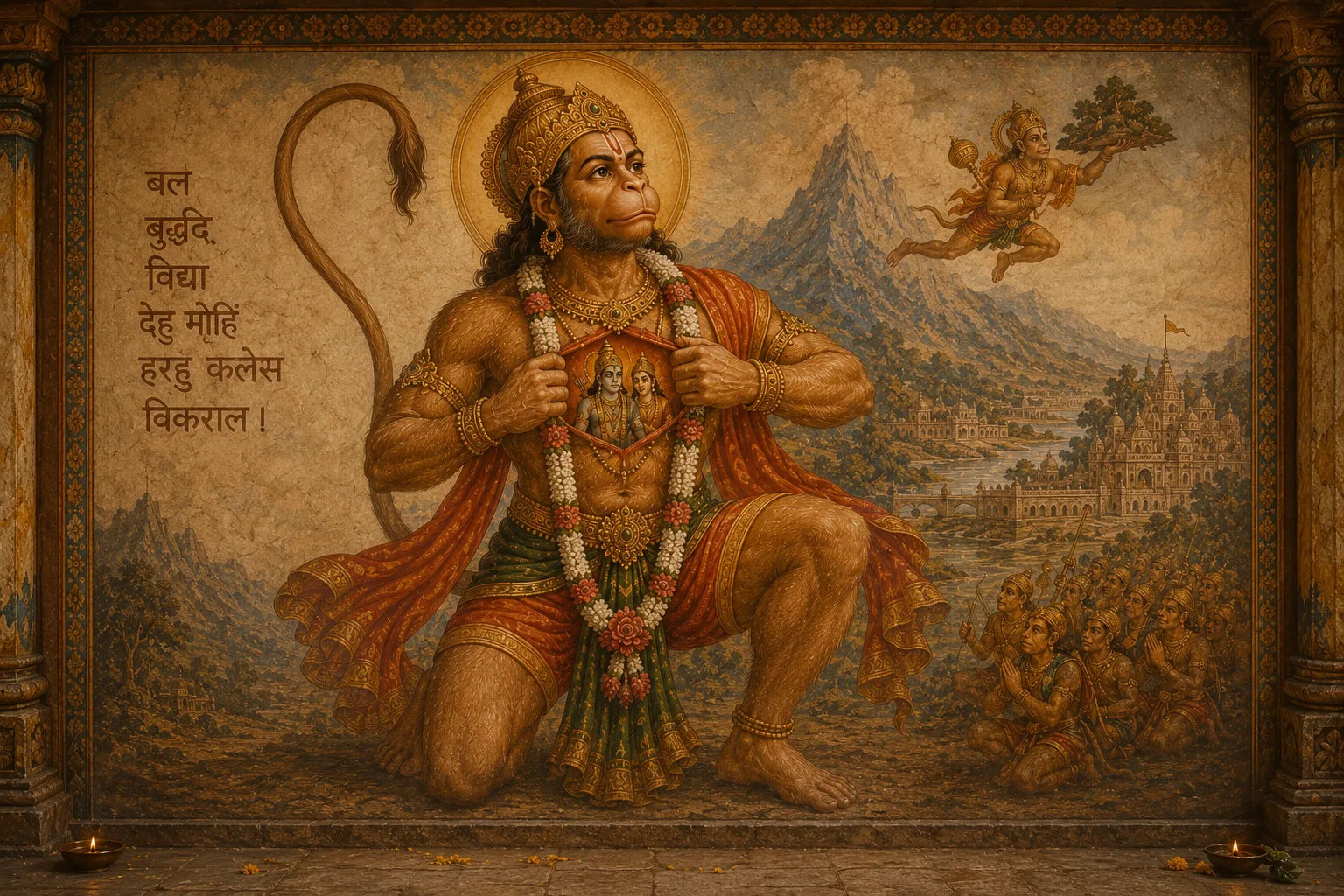
The Devotee Who Moved Mountains
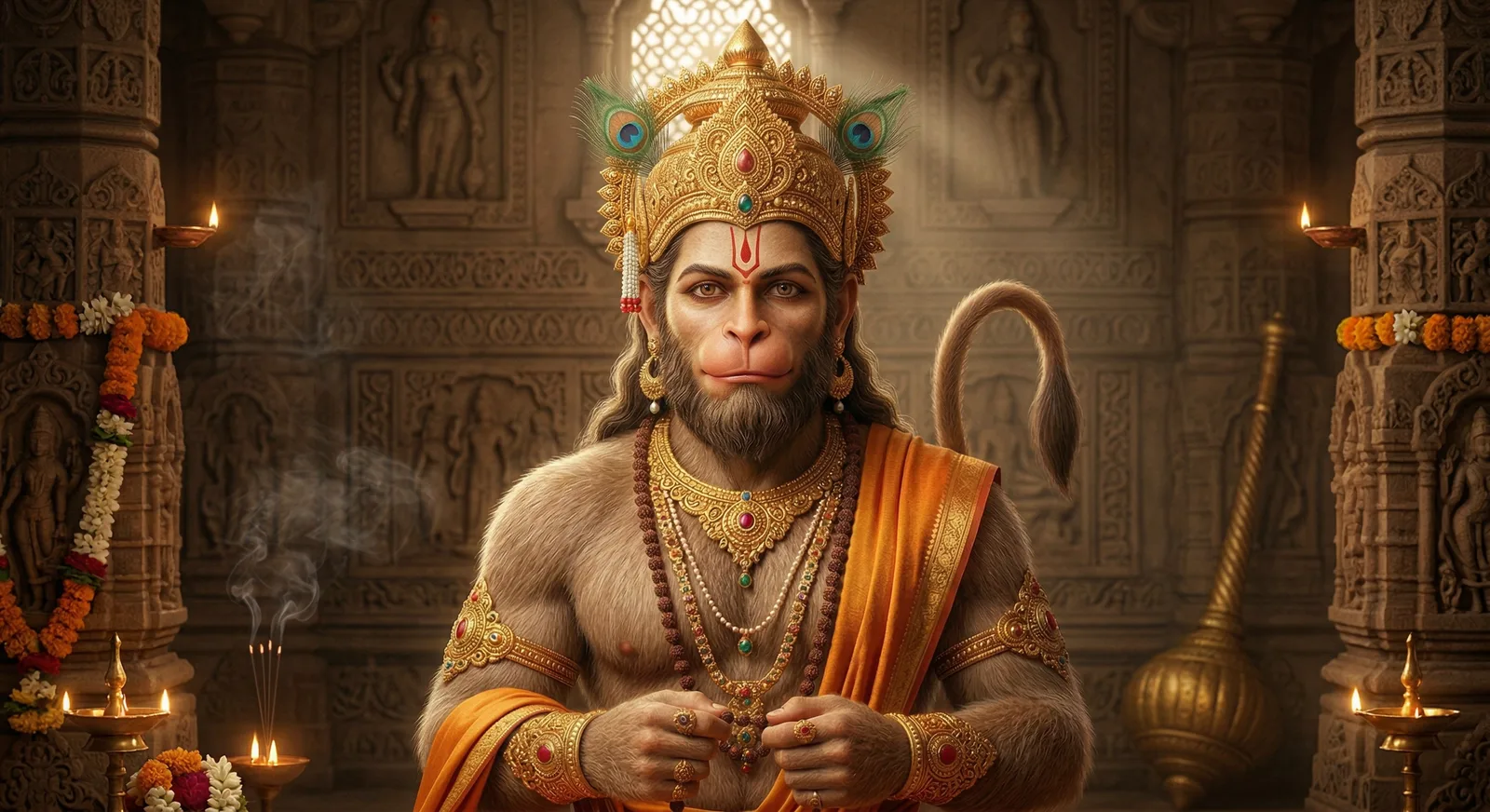
There is no figure in Eastern spiritual tradition quite like Hanuman. Son of the wind deity Vayu and the celestial princess Anjana, earthly ward of King Kesari, and revered as an incarnation (Rudra Avatar) of Lord Shiva—Hanuman stands as the central heroic figure of the ancient epic Ramayana.
Across India and Southeast Asia, Hanuman is worshipped not as a mere mythological character, but as a living deity (Chiranjeevi—an immortal who remains on Earth as long as the divine name is remembered). He is the ultimate synthesis of three distinct human paths:
- Physical Power (Bala): Unmatched physical strength and vitality.
- Intellectual Mastery (Buddhi): Master of grammar, Sanskrit scriptures, and strategic diplomacy.
- Unwavering Devotion (Bhakti): Complete surrender of the ego to Lord Rama.
He crossed an expansive ocean in a single leap, outwitted demonic sea monsters, carried a Himalayan mountain peak on his palm, and walked through fire unscathed. Yet, whenever he was praised for these miraculous achievements, his answer in both the Sanskrit Valmiki Ramayana and Tulsidas’s Awadhi Ramcharitmanas remained identical:
"Nāmasmarana—everything was accomplished solely by the power, grace, and presence of Ram's name."
Hanuman's narrative is a profound psychological blueprint for human resilience. In modern life—when career collapse, personal grief, burnout, or chronic uncertainty make the road ahead seem impassable—Hanuman's journey demonstrates how to unlock deep energy reserves hidden within the human spirit.
Scriptural Foundations: Valmiki Ramayana vs. Ramcharitmanas
To understand Hanuman's significance, one must look at the two primary sacred texts that detail his life:
| Scriptural Detail | Valmiki Ramayana (c. 500 BCE) | Ramcharitmanas by Tulsidas (1574 CE) |
|---|---|---|
| Language & Style | Classical Sanskrit; epic, historical, and heroic narrative. | Awadhi dialect; deeply devotional (Bhakti), poetic, and accessible. |
| Portrayal of Hanuman | A wise Vanara general, diplomat, scholar of the Vedas, and powerful warrior. | The divine embodiment of grace (Kripa), humility, and the ultimate intercessor for devotees. |
| Focus in Sundarkand | Strategic brilliance, espionage, physical feats, and diplomatic dialogue with Ravana. | Spiritual surrender, the transformative power of Ram-Nama, and emotional devotion. |
Together, these texts present a complete picture: Hanuman is neither mindless brute strength nor passive piety. He represents intellect and energy brought into complete harmony through spiritual devotion.
The Curse of Forgetfulness: Overcoming Psychological Amnesia
Before Hanuman could leap across the ocean to Lanka to locate Sita, he faced a hurdle familiar to anyone who has ever frozen before a daunting challenge: he forgot his own strength.
┌─────────────────────────────────────────────────────────┐
│              THE CYCLE OF INNER RESILIENCE              │
└────────────────────────────┬────────────────────────────┘
                             │
            ┌────────────────┴────────────────┐
            ▼                                 ▼
┌───────────────────────┐         ┌───────────────────────┐
│THE SHORELINE PARALYSIS│         │  THE JAMBAVAN EFFECT  │
│ • Amnesia of past     │         │ • External wise voice │
│   triumphs            │────►    │ • Reframing abilities │
│ • Overwhelmed by sea  │         │ • Awakening latent    │
│   of obstacles        │         │   inner potential     │
└───────────────────────┘         └───────────────────────┘
                            │
                            ▼
                  ┌───────────────────────┐
                  │   THE OCEANIC LEAP    │
                  │ • Action driven by    │
                  │   transcendent purpose│
                  └───────────────────────┘
In his childhood, the spirited Hanuman was given a gentle curse by wise sages whom he had playfully disrupted: he would remain unaware of his own immense cosmic powers until a wise guide reminded him of them.
When the search party reached the southern shore at Mahendra Parvat and stared across hundreds of miles of turbulent sea, every warrior shrank back in despair:
- Prince Angada declared he could jump across, but doubted he had the strength to return.
- The elderly bear-king Jambavan noted that age had diminished his physical reach.
- Hanuman sat quietly apart from the group, convinced he was merely an ordinary monkey incapable of accomplishing the task.
Recognizing the latent power sitting in silence, Jambavan approached Hanuman and recounted his divine birth, his lineage as the son of the Wind God, and his childhood leap toward the Sun. Hearing these words, Hanuman's psychological paralysis shattered. His body expanded in size (Mahima siddhi), his energy ignited, and he let out a roar that shook the shoreline.
The Modern Psychological Parallel
Modern cognitive psychology refers to this state as learned helplessness or acute cognitive narrowing. Under severe stress, the human brain's threat-detection system locks onto immediate danger, obscuring memories of past achievements, problem-solving skills, and innate resilience.
Like Hanuman, you do not need to acquire foreign powers to face your current crisis—you need to dismantle the amnesia obscuring the strength you already possess. Surrounding yourself with wise mentors, sacred texts, or trusted allies who act as your "Jambavan" is often the catalyst needed to break paralysis.
The Sundarkand: A 5-Stage Manual for Crisis Management
The fifth chapter of the Ramayana—the Sundarkand—is named Sundar ("Beautiful") because it marks the turning point where hopelessness turns into triumph. As Hanuman leaps across the ocean, he encounters five distinct obstacles, each representing a specific psychological trap encountered during major life transitions:
1. Mount Mainaka: The Comfort Trap (Temptation)
A golden mountain rose from the ocean depths, inviting Hanuman to land, eat its sweet fruits, and rest before continuing his journey.
- Psychological Meaning: The temptation to settle for early comfort, distraction, or partial relief when a long-term goal gets difficult.
- Hanuman's Response: Hanuman gently touched the mountain to acknowledge its hospitality, but refused to delay his mission, stating: "Ram kāju kīnhe binu mohi kahām viśrāma" ("Until Ram's work is completed, there can be no rest for me").
2. Surasa: The Rigid Demand (Adaptability)
The devas sent Surasa, the mother of serpents, to test Hanuman's wits. She expanded her terrifying jaws to swallow him whole, citing a boon that anything passing through her domain must enter her mouth.
- Psychological Meaning: Sudden, immovable challenges that cannot be overcome by brute force or stubborn resistance, but require cognitive flexibility (Yukti).
- Hanuman's Response: As Surasa expanded her mouth to 16 leagues, Hanuman expanded his body to 32 leagues. When she opened to 100 leagues, Hanuman instantly shrank to the size of a thumb, darted inside her mouth, and popped back out before she could close it—satisfying her rule while continuing his journey.
3. Simhika: Shadow Insecurities (Projection)
Simhika was a demoness who lurked beneath the waves, capturing flying creatures by catching hold of their shadows cast on the water, dragging them down into the depths.
- Psychological Meaning: Subconscious baggage, past failures, imposter syndrome, and hidden fears (Chhaya-grahi) that grab us from below and ruin our momentum.
- Hanuman's Response: Recognizing that she was manipulating an illusion (his shadow), Hanuman dove directly into her cavernous mouth, destroyed her inner core, and emerged victorious. You cannot defeat shadow fears by running away; you must confront their root cause directly.
4. Lankini: Outer Gatekeepers (Intimidation)
Upon reaching Lanka, Hanuman was confronted at the city gates by Lankini, the fierce demonic guardian personifying the defensive power of the city.
- Psychological Meaning: External gatekeepers, institutional resistance, and societal intimidation that tell you that you do not belong.
- Hanuman's Response: Hanuman delivered a swift, measured blow with his left fist—knocking her down and shattering her arrogance without destroying her. When you stand in righteous truth, outer intimidation loses its authority.
5. Ashoka Vatika: Despair & Vicarious Grief (Composure)
Inside Lanka, Hanuman found Sita imprisoned beneath an Ashoka tree, surrounded by tormentors and contemplating ending her life in despair.
- Psychological Meaning: Entering an environment saturated with grief, suffering, and emotional devastation without becoming paralyzed yourself.
- Hanuman's Response: Hanuman remained hidden in the branches above, softly chanting the virtues and history of Lord Rama to soothe her mind before revealing himself gently with Rama's signet ring (Anguliyakam).
The Sanjeevani Episode: Decisive Action Over Paralysis
During the battle of Lanka, Rama's brother Lakshmana was struck by a lethal missile launched by Indrajit. The royal physician Sushena declared that Lakshmana would die before dawn unless a rare medicinal herb—Sanjeevani Booti—was brought from the distant Himalayan peak of Dronagiri.
                 ┌──────────────────────────┐
                 │ THE SANJEEVANI DILEMMA   │
                 │  • Time running out      │
                 │  • Micro-solution unknown│
                 └────────────┬─────────────┘
                              │
                              ▼
                 ┌──────────────────────────┐
                 │   THE HANUMAN DECISION   │
                 │  • Refuse paralysis      │
                 │  • Scale up effort       │
                 │  • Bring the Mountain    │
                 └────────────┬─────────────┘
                              │
                              ▼
                 ┌──────────────────────────┐
                 │      CRISIS RESOLVED     │
                 │  • Life saved before     │
                 │    the rising sun        │
                 └──────────────────────────┘
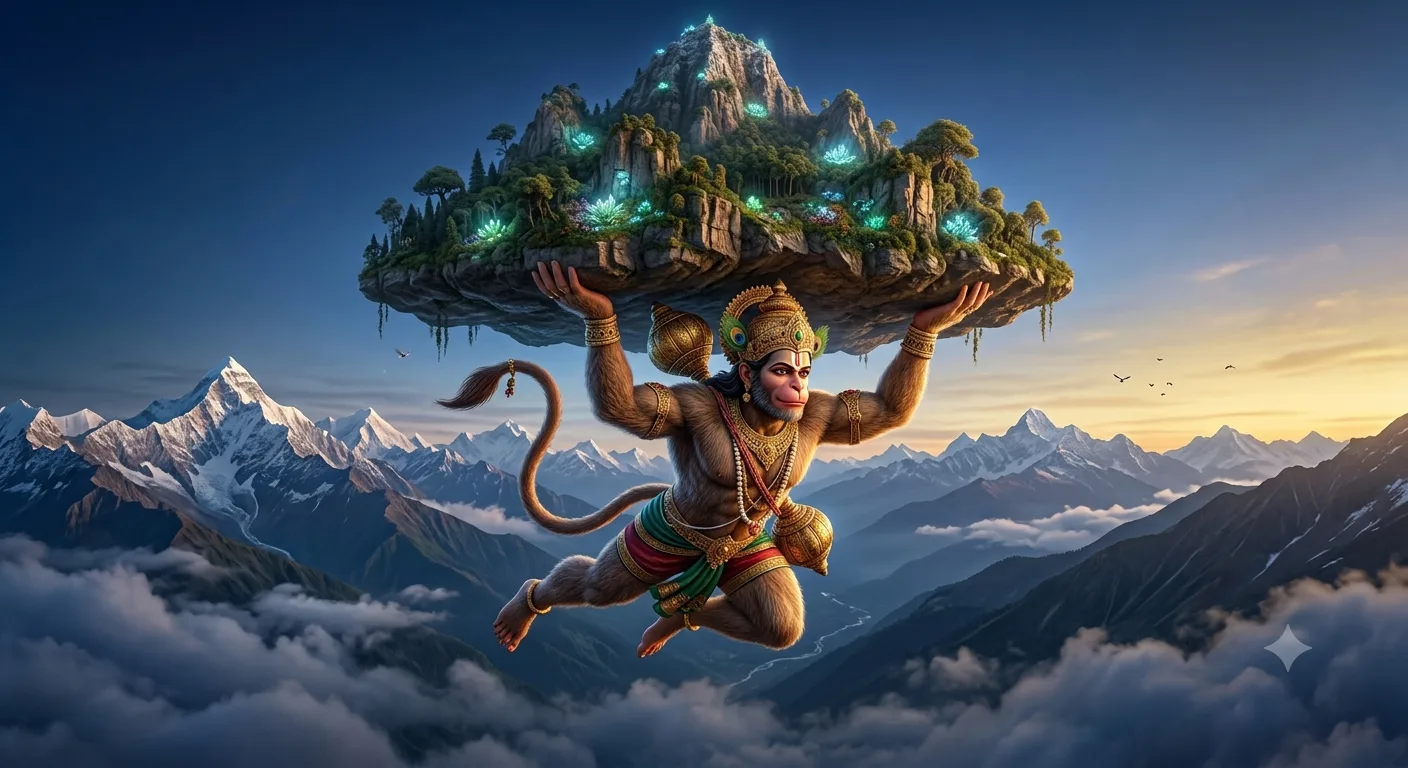
Hanuman flew thousands of miles north before nightfall. However, upon reaching Dronagiri, he found the mountain slope covered in glowing herbs and could not distinguish the specific plant in the dark.
With the clock ticking toward sunrise, Hanuman made a bold strategic pivot: he placed his hand under the mountain, broke it from its base, and carried the entire peak back to Lanka.
The "Bring the Mountain" Strategic Model
In moments of acute crisis, leaders and individuals often fall into paralysis by analysis—spending precious hours debating minor details while the core situation deteriorates.
When time is critical and information is incomplete:
- Avoid getting stuck on micro-details.
- Scale up your commitment and take holistic action.
- Apply every healthy resource at your disposal simultaneously (change your environment, seek counsel, restructure your routines) rather than waiting for a single "perfect" solution.
Panchamukhi Hanuman & Mastery Over the Ashta Siddhi
In later Puranic and regional traditions (such as the Krittivasi Ramayana), Hanuman's multidimensional power is symbolized by Panchamukhi Hanuman (Five-Faced Hanuman).
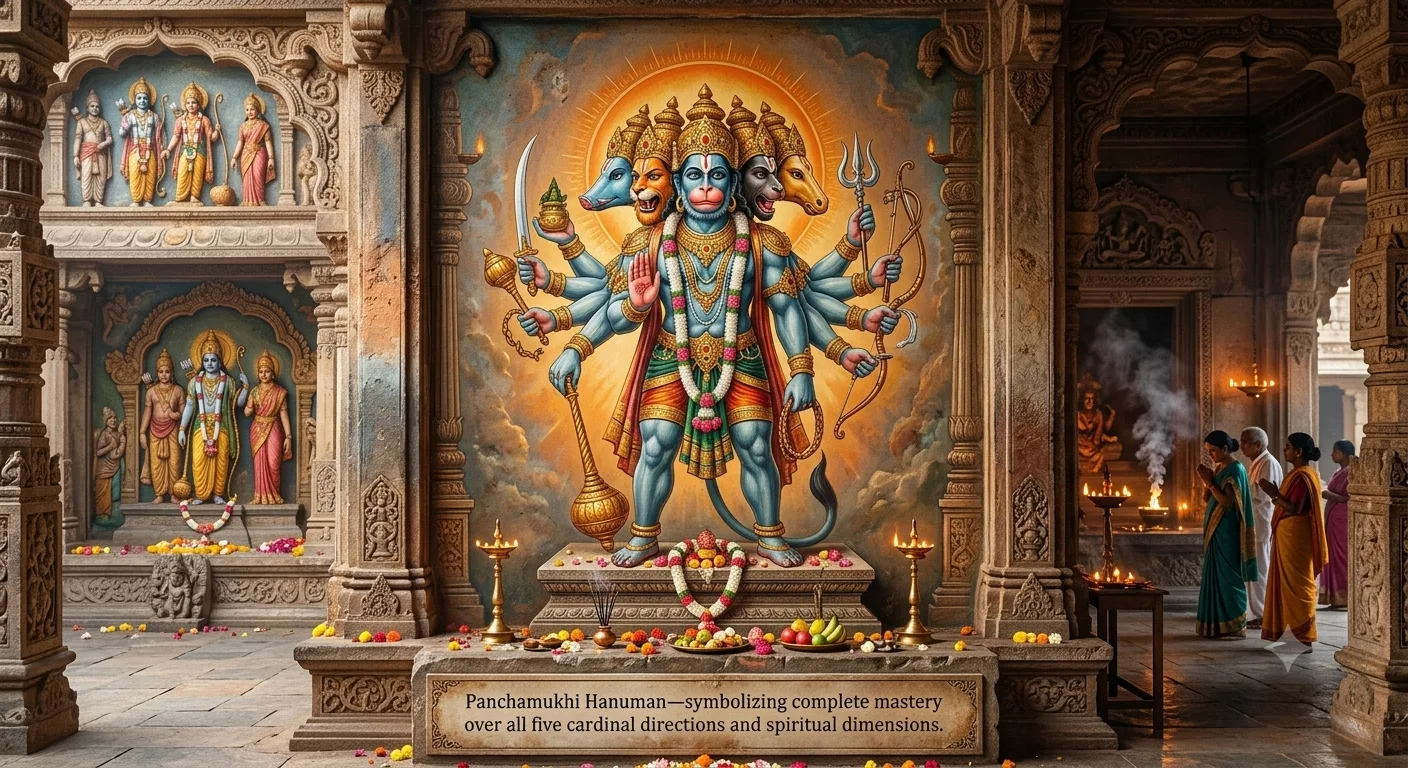
The Five Faces and Their Cardinal Significance
- Anjaneya (East - Monkey): Grants purity of mind, focus, and destruction of sin.
- Narasimha (South - Lion): Grants fearlessness, victory over enemies, and protection from danger.
- Garuda (West - Eagle): Grants protection against negative energies, toxins, and physical ailments.
- Varaha (North - Boar): Grants material recovery, stability, and relief from planetary distress.
- Hayagriva (Upward - Horse): Grants divine knowledge, wisdom, speech, and creative intellect.
Mastery Over the Ashta Siddhi and Nava Niddhi
In the Hanuman Chalisa, Tulsidas writes: "Aṣṭa siddhi nava nidhi ke dātā" ("You are the bestower of the eight supernatural powers and nine divine treasures").
These eight classical yogic achievements (Ashta Siddhis) include:
- Animā: Ability to shrink to atomic size.
- Mahimā: Ability to expand to cosmic proportions.
- Laghimā: Ability to become weightless.
- Garimā: Ability to become infinitely heavy.
- Prāpti: Ability to access any place in the universe.
- Prākāmya: Ability to fulfill any legitimate desire.
- Īśitva: Absolute mastery over natural forces.
- Vaśitva: Ability to control the senses and minds of self and others.
What makes Hanuman unique in Hindu philosophy is not that he possesses these immense powers, but that he has zero personal ego (Ahamkara) attached to them. He uses these siddhis exclusively in the service of Dharma, making him immune to spiritual corruption.
The Neuro-Psychology of Bhakti (Self-Transcendence)
Modern psychology identifies several core pillars of resilience: social support, cognitive reframing, and emotional regulation. However, humanistic psychiatrist Viktor Frankl noted in Man's Search for Meaning that those who survived extreme crises were almost always those anchored in self-transcendence—living for a cause, a person, or a divine ideal outside themselves.
   ┌──────────────────────────────────────────────────┐
   │                EGO-DRIVEN MOTIVATION             │
   │  "I must succeed so everyone praises me."        │
   │  → Fragile, prone to anxiety, quick to burn out. │
   └────────────────────────┬─────────────────────────┘
                            │
                            ▼
   ┌──────────────────────────────────────────────────┐
   │             PURPOSE-DRIVEN DEVOTION (BHAKTI)     │
   │  "I am an instrument for a higher cause."        │
   │  → Fearless, indefatigable, resilient to failure.│
   └──────────────────────────────────────────────────┘
Neuro-theological research demonstrates that devotional practices (Bhakti Yoga) quiet the brain's default mode network (DMN)—the neural network responsible for self-referential rumination, social anxiety, and ego-defensiveness.
When your focus shifts from "What will happen to me?" to "How can I serve through this moment?", heart-rate variability stabilizes, cortisol levels drop, and cognitive clarity returns.
The 4-Step Hanuman Resilience Framework
When facing severe life storms, you can translate these spiritual insights into daily practice using this structured method:
Acknowledge the Ocean (Grounding)
Step 1: Face Reality Without Denial
Step back from emotional panic. Document the full scope of your crisis in objective terms without catastrophic exaggeration or naive minimization.
Invoke Your Inner Jambavan (Reframing)
Step 2: Break Learned Helplessness
Identify three past crises where you felt completely helpless but ultimately survived. Remind yourself of the skills, courage, and unexpected help that carried you through then.
Audit Your Oceanic Obstacles (Strategy)
Step 3: Recognize Your Traps
Ask yourself: Am I being seduced by temporary comfort (Mainaka)? Do I need to adapt flexibly (Surasa)? Am I being dragged down by shadow fears (Simhika)? Am I intimidated by outer gatekeepers (Lankini)?
Offer the Effort Upward (Action)
Step 4: Shift to Self-Transcendence
Reframe your effort from personal survival to sacred service. Perform your duties with 100% commitment while surrendering anxiety over the final outcome to the Divine.
The Hanuman Chalisa as a Daily Practice
Composed in forty verses (chaupais) by Saint Tulsidas in the 16th century while imprisoned, the Hanuman Chalisa is recited by millions worldwide.
Beyond its devotional sanctity, reciting the Chalisa serves as a somatic and psychological anchor:
- Somatic Regulation: The rhythmic Awadhi poetic meter (Chhanda) regulates breath rate, slowing nervous system arousal.
- Cognitive Re-wiring: Verses systematically replace fear with affirmations of courage, health, and spiritual protection.
- Anchoring Courage: The verse "Sankaṭa se Hanumānam chhuḍāvai" reinforces that aligning mind, speech, and actions with selfless devotion delivers freedom from suffering.
Interlinking & Deepening Your Journey
Explore how Hanuman's teachings connect across our wisdom library:
- Path of devotion and love: Bhakti Yoga: How Devotion Heals Loneliness
- Unshakable action under stress: The Bhagavad Gita's Guide to Anxiety
- Lessons from ancient epics: The Ramayana: 12 Timeless Life Lessons
- Connecting with guides: Meet the Gurus
Conclusion: The Unshakeable Spirit
Hanuman shows us that true strength is not ego-driven aggression; it is devotion, humility, and purpose in action.
When you face impossible storms, remember: your courage is not missing—it is simply waiting for you to remember who you are.
Ready to cultivate spiritual resilience? Start My Transformation and explore AI guidance trained on authentic sacred scriptures and world traditions.