The Question That Makes Hinduism Look More Complicated Than It Is
A person walks into a bookshop looking for the Hindu holy book.
They expect to find one definitive volume containing the complete religion.
Instead, they encounter the Vedas, Upanishads, Bhagavad Gita, Ramayana, Mahabharata, Puranas, Yoga Sutras, Dharma Shastras, Agamas, Tantras and thousands of devotional works and commentaries.
The natural question is:
Which one is the real Hindu holy book?
The answer is that Hinduism does not have one book that performs exactly the same role as the Bible in Christianity or the Quran in Islam.
Hinduism is built around an entire scriptural library.
Different texts serve different purposes.
Some preserve ancient hymns and sacred sounds.
Some investigate consciousness and the nature of reality.
Some teach through conversations between a teacher and student.
Some place spiritual wisdom inside family conflict, political crisis and war.
Some tell sacred stories about Shiva, Vishnu, Devi, Krishna, Rama and other divine forms.
Some explain temple worship, mantra and meditation.
Some discuss duty, ethics, social responsibility and law.
This can initially feel confusing. But it also reveals something important about Sanatan Dharma:
Human beings do not all reach wisdom through the same doorway.
One person learns through philosophy.
Another learns through a story.
Another through devotion.
Another through ritual.
Another through disciplined meditation.
Another through the moral consequences faced by a character whose life resembles their own.
Hindu scripture developed as a vast conversation between these different approaches.
The goal of this article is to give you a clear map of that conversation.
The Direct Answer: Does Hinduism Have a Bible?
No Hindu text is universally accepted as the single and exclusive book containing the whole of Hinduism.
The Vedas hold the highest foundational authority in many traditional classifications.
The Upanishads contain some of Hinduism's most influential philosophical teachings.
The Bhagavad Gita is probably the most widely read single Hindu scripture around the world.
The Ramayana and Mahabharata have shaped Hindu ethics, culture and imagination for generations.
The Puranas preserve many of the sacred stories and devotional traditions associated with Hindu deities.
The Agamas and Tantras guide much of Hindu temple worship, mantra, meditation and ritual practice.
The Dharma Shastras discuss conduct, responsibility, law and social order within particular historical contexts.
None of these alone contains every aspect of Hindu thought and practice.
The Bhagavad Gita may be the best single starting point for many readers, but it is not a Hindu equivalent of the Bible in the sense of being the only recognised scripture.
The most accurate answer is:
Hinduism has a sacred library, not one compulsory book.
A Simple Map of Hindu Scriptures
The following diagram provides a beginner-friendly map.
It is not the only possible classification. Different traditions may place particular texts differently, especially the Agamas and Tantras.
HINDU SCRIPTURAL TRADITIONS
│
├── SHRUTI — "That Which Is Heard"
│   │
│   └── THE FOUR VEDAS
│       ├── Rig Veda
│       ├── Sama Veda
│       ├── Yajur Veda
│       └── Atharva Veda
│
│       Each Vedic collection contains or is associated with:
│       Samhita → Brahmana → Aranyaka → Upanishad
│
├── SMRITI — "That Which Is Remembered"
│   │
│   ├── ITIHASA — Sacred Epics
│   │   ├── Ramayana
│   │   └── Mahabharata
│   │       └── Bhagavad Gita
│   │
│   ├── PURANAS
│   │   ├── 18 Mahapuranas
│   │   └── Numerous Upapuranas and regional texts
│   │
│   ├── DHARMA LITERATURE
│   │   ├── Dharma Sutras
│   │   └── Dharma Shastras and later commentaries
│   │
│   └── OTHER TRADITIONAL LITERATURE
│       ├── Philosophical Sutras
│       ├── Commentaries
│       ├── Devotional poetry
│       └── Regional sacred literature
│
└── AGAMAS AND TANTRAS
    ├── Shaiva traditions
    ├── Vaishnava traditions
    └── Shakta traditions

    Their authority and classification vary by lineage.
    Many traditions regard them as revealed and foundational.
This map becomes easier to understand once we examine the two central categories: Shruti and Smriti.
Shruti and Smriti: Two Ways Sacred Knowledge Is Preserved
Hindu literature is traditionally discussed through the categories Shruti and Smriti.
The distinction concerns authority, origin and transmission.
It does not simply mean that one group is valuable and the other is unimportant.
Shruti: That Which Was Heard
Shruti means "that which is heard."
It refers primarily to the Vedic revelation received or "heard" by the ancient rishis.
Traditional Hindu understanding does not treat the rishis as ordinary authors who invented the Vedas. They are described as seers who perceived truths and sacred sounds that already existed.
The Vedas were preserved orally for generations through highly disciplined systems of recitation.
The Shruti collection includes:
- The four Vedas
- Their Samhitas
- Brahmanas
- Aranyakas
- Upanishads
In many orthodox schools, Shruti possesses the highest scriptural authority.
Smriti: That Which Was Remembered
Smriti means "that which is remembered."
Smriti includes sacred teachings transmitted through recognised authors, sages, poets, storytellers and traditional communities.
It includes:
- Ramayana
- Mahabharata
- Bhagavad Gita as part of the Mahabharata
- Puranas
- Dharma Sutras
- Dharma Shastras
- Philosophical and devotional literature
- Many commentaries and later teachings
In classical theory, Smriti is interpreted consistently with Shruti.
But this does not mean Smriti has had little influence.
In everyday Hindu life, many people are far more familiar with the Bhagavad Gita, Ramayana, Hanuman Chalisa, Bhagavata Purana or regional devotional poetry than with the complete Vedic texts.
Shruti provides foundational revelation.
Smriti translates sacred principles into stories, conversations, duties, practices and situations that people can recognise within their own lives.
One reveals the roots.
The other shows how those roots grow through human history and culture.
The Four Vedas
The Sanskrit word Veda means knowledge.
The four Vedas are:
- Rig Veda
- Sama Veda
- Yajur Veda
- Atharva Veda
They are not four volumes written in the style of modern books.
Each represents a large collection associated with particular forms of recitation, ritual, reflection and spiritual knowledge.
Rig Veda: The Veda of Sacred Hymns
The Rig Veda is the oldest of the four Vedic collections.
It contains hymns addressed to divine powers such as Agni, Indra, Soma, Varuna, Ushas, Savitr and others.
The hymns explore:
- Fire and sacrifice
- Dawn and light
- Rain and cosmic order
- Creation
- Human mortality
- Prayer
- Gratitude
- The relationship between visible nature and invisible sacred power
Some hymns praise a particular deva.
Others ask profound philosophical questions.
The famous Nasadiya Sukta, often called the Hymn of Creation, does not present creation as a simple story. It asks whether anyone can know with certainty how existence began.
This willingness to preserve a question rather than force an easy answer is one of the remarkable qualities of Vedic thought.
The Rig Veda introduces an important Hindu habit:
The universe is not only something to use. It is something to contemplate.
Fire is not merely fuel.
Dawn is not merely a change in atmospheric light.
Rain is not merely weather.
Each can awaken awareness of dependence, order and mystery.
Sama Veda: The Veda of Chants and Melody
The Sama Veda is closely connected with musical recitation.
Many of its verses also appear in the Rig Veda, but the Sama Veda arranges them for chanting in ritual settings.
Its importance lies not only in the words but in the way the words are sung.
This reminds us that sacred knowledge is not always communicated through silent reading.
Sound can shape attention.
Rhythm can discipline breathing.
Melody can gather a community into one shared act of worship.
The Sama Veda represents the transformation of sacred language into sacred music.
Its influence can be felt in the continuing importance of chanting, kirtan, bhajan and mantra throughout Hindu traditions.
Yajur Veda: The Veda of Ritual Action
The Yajur Veda contains formulas, prayers and instructions connected with Vedic sacrifice.
It exists in important recensional traditions commonly described as:
- Shukla, or White Yajur Veda
- Krishna, or Black Yajur Veda
The Yajur Veda is concerned with the correct performance of sacred action.
At first, ritual instructions may seem distant from modern life. But their underlying principle remains relevant:
Intention alone does not complete an action. The way an action is performed matters.
A promise requires fulfilment.
A responsibility requires attention.
A ceremony requires preparation.
A good intention performed carelessly can still produce harm.
The ritual discipline of the Yajur Veda teaches precision, responsibility and the transformation of action into offering.
Atharva Veda: The Veda of Everyday Human Concerns
The Atharva Veda contains hymns, prayers, reflections, blessings and rites connected with a broad range of human concerns.
These include:
- Health
- Protection
- Family life
- Social harmony
- Kingship
- Healing
- Anxiety
- Prosperity
- Domestic rituals
- Spiritual knowledge
Its contents remind us that sacred life is not restricted to grand temple ceremonies or philosophical debate.
People pray when they are ill.
They seek protection for children.
They worry about relationships and security.
They ask for peace within the home.
The Atharva Veda brings sacred attention into these ordinary human experiences.
The Four Layers of Vedic Literature
Each Veda is connected with several kinds of literature.
The structure is often explained through four broad layers:
- Samhita
- Brahmana
- Aranyaka
- Upanishad
These layers developed through long traditions and do not always fit into perfectly separated modern categories.
The framework is nevertheless useful.
Samhitas: Hymns and Mantras
The Samhitas are the core collections of hymns, verses, chants and ritual formulas.
When people speak of the Rig Veda, Sama Veda, Yajur Veda or Atharva Veda, they are often referring especially to these collections.
Brahmanas: Ritual Meaning and Explanation
The Brahmanas explain the performance and significance of Vedic rituals.
They discuss:
- Sacred offerings
- Priestly roles
- Ritual sequences
- Symbolic connections
- The meaning attributed to sacrificial actions
To a modern reader, these texts can appear highly technical.
They reveal, however, a worldview in which ritual was understood as connecting human action with cosmic order.
Aranyakas: Reflection Beyond Outer Ritual
The word Aranyaka is connected with the forest.
These texts are often described as forest teachings associated with a movement away from public ritual towards contemplation and symbolic interpretation.
The external sacrifice increasingly becomes an internal question.
What does the fire represent within the human being?
What is the deeper meaning of an offering?
Can ritual action become meditation?
The Aranyakas form an important bridge between the ritual world of the Brahmanas and the philosophical inquiry of the Upanishads.
Upanishads: The Search for Ultimate Reality
The Upanishads investigate the deepest questions of existence:
- What is the Self?
- What is Brahman?
- What survives death?
- What causes bondage?
- What is consciousness?
- How can a person become free?
- Is the individual separate from ultimate reality?
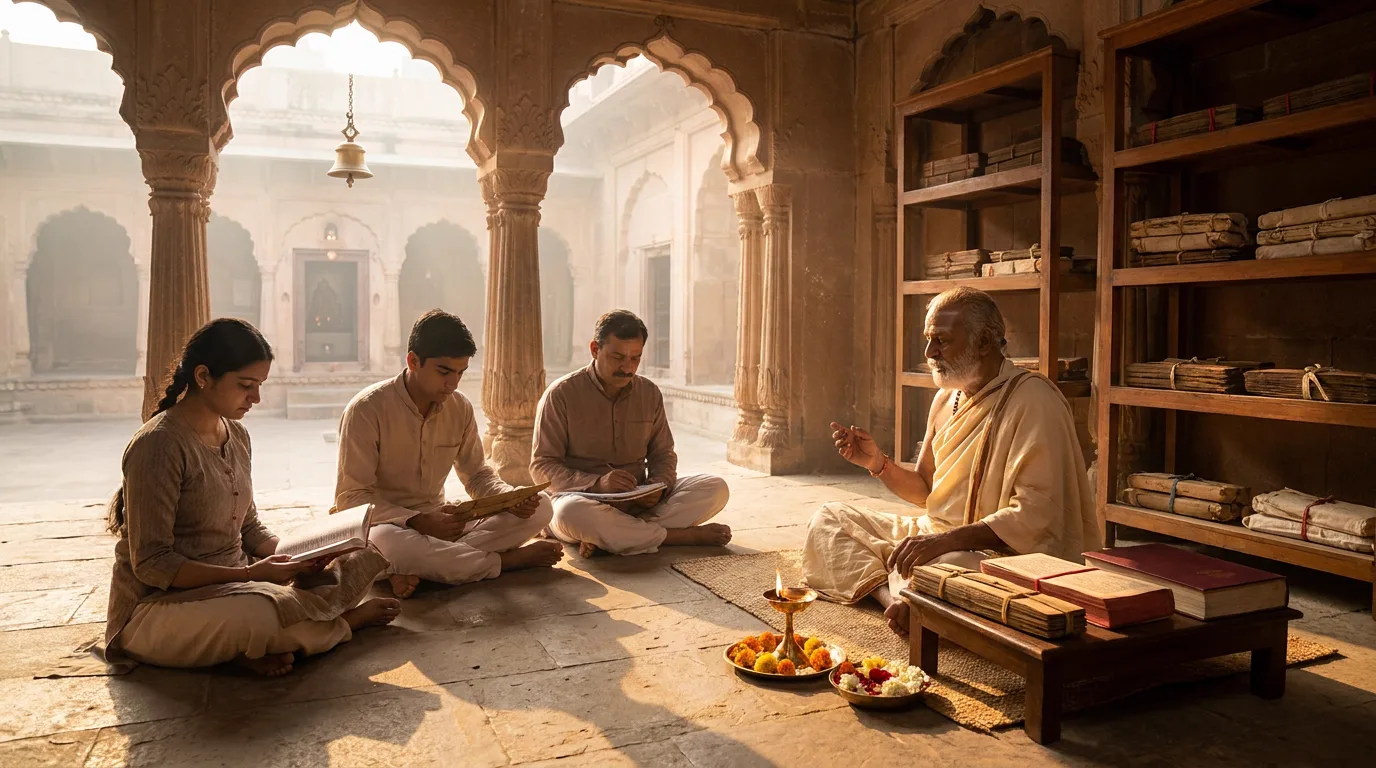
The word Upanishad is often connected with sitting near a teacher to receive spiritual instruction.
Many Upanishads unfold as conversations.
A child questions Death.
A student asks what powers the mind.
A king learns from a sage.
A teacher leads a disciple from the visible world towards the consciousness by which the visible world is known.
The movement from the earlier Vedic layers towards the Upanishads is not necessarily a rejection of ritual.
It is a deepening inquiry:
What is the reality to which ritual, prayer and meditation ultimately point?
The Principal Upanishads
Hindu tradition recognises a large number of Upanishads.
The Muktika Upanishad presents a collection of 108, while traditional commentators and modern scholars commonly identify a smaller group of principal or early Upanishads.
Lists may contain ten, eleven, twelve or thirteen texts.
A commonly recognised group of thirteen includes:
-
Isha Upanishad Explores renunciation, action and seeing the divine presence within existence.
-
Kena Upanishad Asks what power enables the mind to think, the eye to see and the ear to hear.
-
Katha Upanishad Presents the young seeker Nachiketa questioning Yama, the lord of death, about the Self and what lies beyond mortality.
-
Prashna Upanishad Organised around six questions concerning life, breath, meditation and consciousness.
-
Mundaka Upanishad Distinguishes ordinary knowledge from the higher knowledge through which ultimate reality is known.
-
Mandukya Upanishad A very short but influential examination of Om and the states of waking, dreaming, deep sleep and transcendent awareness.
-
Taittiriya Upanishad Explores layers of human existence, ethics, education, bliss and Brahman.
-
Aitareya Upanishad Investigates creation, consciousness and the nature of the Self.
-
Chandogya Upanishad Contains influential teachings on meditation, sacred sound, being and the relationship between the individual and ultimate reality.
-
Brihadaranyaka Upanishad One of the largest and most philosophically significant Upanishads, addressing the Self, karma, rebirth and liberation.
-
Shvetashvatara Upanishad Includes teachings on God, devotion, yoga, nature and the Supreme Lord.
-
Kaushitaki Upanishad Examines consciousness, breath and the journey of the soul.
-
Maitri or Maitrayaniya Upanishad Discusses the mind, meditation, rebirth and liberation.
The Upanishads do not all teach one simple doctrine in identical language.
They contain different voices and methods of inquiry.
Later schools of Vedanta developed different interpretations of their teachings.
Advaita Vedanta emphasises the non-dual identity of Atman and Brahman.
Vishishtadvaita teaches unity within a reality in which real distinctions remain.
Dvaita maintains an eternal distinction between the individual soul and the Supreme Lord.
The same scriptural passages can therefore produce rich philosophical debate.
This is not evidence that the Upanishads have no meaning.
It shows that their questions are deep enough to sustain centuries of serious interpretation.
Read The Upanishads on Fear, Death and What Lies Beyond for a focused exploration of mortality and the Self.
The Bhagavad Gita: Wisdom in the Middle of a Crisis
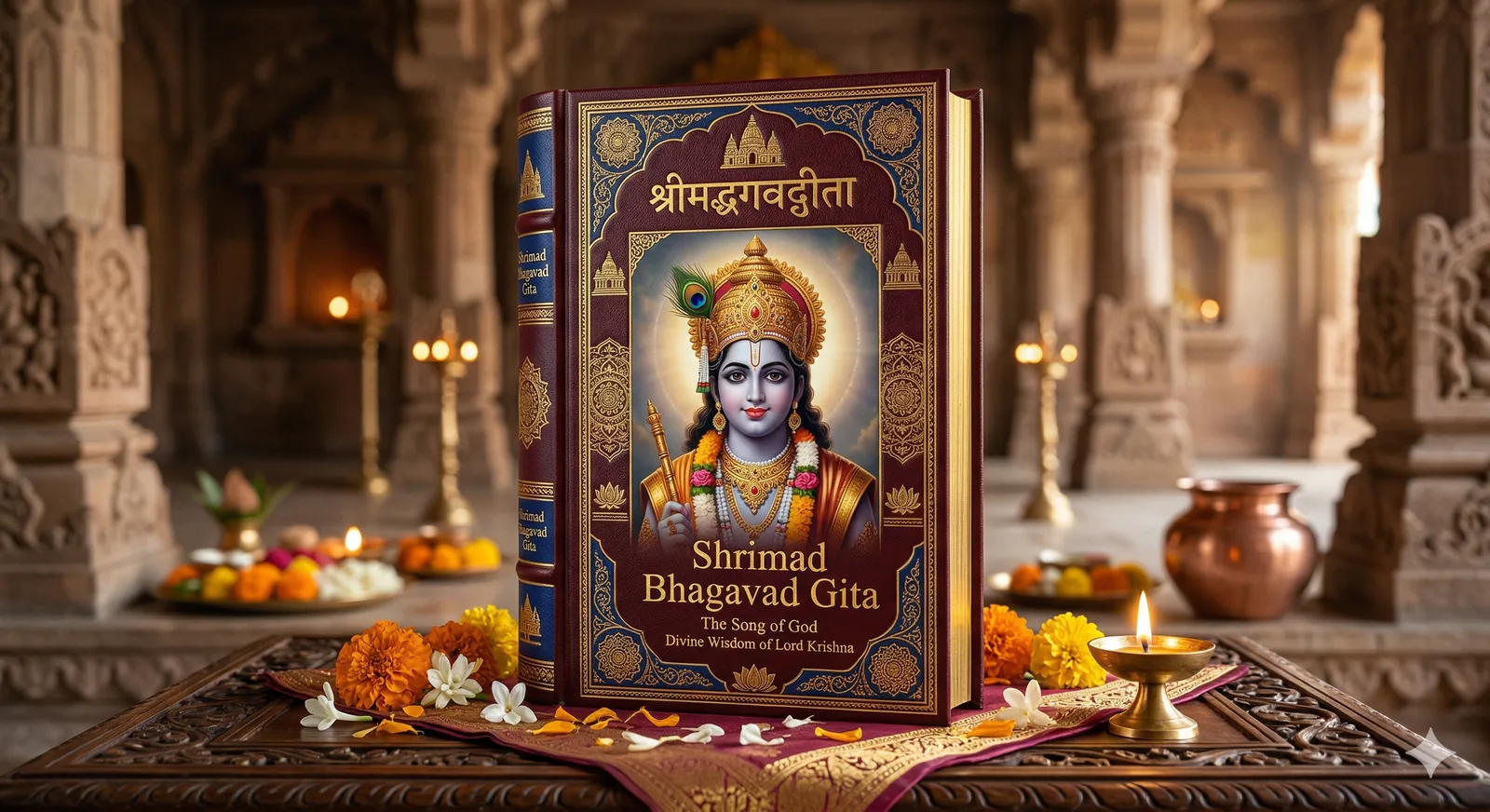
The title Bhagavad Gita means "The Song of the Lord" or "The Divine Song."
It is a dialogue between Krishna and the warrior Arjuna.
The Gita is not a separate epic. It appears within the Mahabharata.
Its setting is the battlefield of Kurukshetra.
Arjuna sees teachers, relatives and friends standing on both sides of an approaching war. His confidence collapses. He questions the purpose of victory, the morality of fighting and the meaning of duty when every available choice carries suffering.
Krishna responds with teachings on:
- Atman
- Dharma
- Karma
- Rebirth
- Meditation
- Selfless action
- Knowledge
- Devotion
- Divine nature
- Surrender
- Liberation
The power of the Bhagavad Gita lies partly in its setting.
Krishna does not wait until Arjuna's life becomes peaceful.
The teaching arrives when Arjuna is overwhelmed, morally confused and unable to act.
This makes the Gita deeply relevant to modern readers.
Most people do not seek wisdom because everything is going well.
They seek it when:
- A career decision affects a family
- Loyalty conflicts with integrity
- Responsibility becomes painful
- Success begins to feel empty
- Anxiety prevents action
- Every available option appears imperfect
The Gita does not promise a life without difficult decisions.
It teaches how to act without surrendering the mind to fear, ego or obsession with results.
For many beginners, it is the most accessible entrance into Hindu philosophy because it brings together several spiritual paths within one human crisis.
Read The Bhagavad Gita's Guide to Anxiety and Stress in Modern Life.
The Ramayana: Dharma Told Through a Human Story
The Ramayana is one of the two great Sanskrit epics of Hindu tradition.
The foundational Sanskrit version is traditionally attributed to the sage Valmiki.
Its central story follows Rama, Sita and Lakshmana through exile, separation, conflict and return.
Hanuman becomes one of its most beloved figures through his courage, intelligence, devotion and service.
The Ramayana asks what dharma requires when life does not unfold according to plan.
Its characters face questions involving:
- Duty
- Marriage
- Loyalty
- Leadership
- Sacrifice
- Temptation
- Exile
- Grief
- Courage
- The responsible use of power
Rama is revered in Vaishnava traditions as an avatar of Vishnu and as an embodiment of dharma.
Sita represents far more than passive endurance. Across different traditions, she is remembered through strength, dignity, devotion, suffering and moral courage.
Hanuman demonstrates that spiritual power reaches its highest expression when strength serves love rather than ego.
The Ramayana is not preserved in only one cultural form.
India and Southeast Asia contain many regional retellings, performances and devotional interpretations.
These versions do not reproduce every event identically. Each community has engaged the epic through its own language, theology and social experience.
This means readers should avoid assuming that one television adaptation or simplified retelling represents every Ramayana tradition.
The epic remains alive because each generation recognises its own questions within it:
What does loyalty require?
When should a leader sacrifice personal happiness?
Can obedience become morally complicated?
How should strength respond to injustice?
What happens when public responsibility conflicts with private love?
These are not ancient questions only.
They appear in governments, workplaces, marriages and families today.
Read Hanuman's Path to Courage and Resilience.
The Mahabharata: What Is Right When Every Choice Is Difficult?
The Mahabharata is the second great Sanskrit epic and one of the most extensive works in world literature.
It centres on a conflict between two branches of a royal family:
- The Pandavas
- The Kauravas
The conflict eventually leads to the devastating war at Kurukshetra.
But the Mahabharata is much more than a war story.
It contains:
- Philosophy
- Political thought
- Family drama
- Devotional teaching
- Moral debate
- Stories within stories
- Teachings on leadership
- Reflections on death and destiny
- The Bhagavad Gita
- The Vishnu Sahasranama
The Ramayana often presents powerful models of dharma.
The Mahabharata repeatedly shows how difficult dharma becomes when duties conflict.
A person may owe loyalty to family and justice to society.
A ruler may need to protect peace while preparing for war.
A promise may be honourable when made and destructive when followed without wisdom.
A person may act from a good intention and still create suffering.
The Mahabharata rarely allows the reader to remain morally comfortable.
Its characters are not divided into perfectly good people and completely evil people.
Wise characters make serious mistakes.
Powerful warriors carry emotional wounds.
Loyalty becomes both a virtue and a trap.
Silence in the face of humiliation produces consequences across generations.
This is why the Mahabharata remains so relevant.
Modern life often presents choices in which every option carries a cost.
The epic asks us to move beyond the shallow question:
"How do I appear righteous?"
It asks:
"What action protects dharma when pride, loyalty, fear and self-interest are all influencing me?"
What Is Itihasa?
The Ramayana and Mahabharata are traditionally classified as Itihasa.
The word is often explained as meaning:
"So indeed it was."
Traditional Hindu communities frequently understand these epics as sacred history.
Modern academic study generally discusses them as epic literature containing long layers of composition, transmission and interpretation.
A respectful reader does not need to begin by forcing the texts into only one modern category.
Their spiritual significance does not depend solely on whether every event can be reconstructed through contemporary historical methods.
The more immediate question is:
What truth about human conduct is the text revealing?
A story can preserve historical memory, theological meaning, moral teaching and sacred symbolism at the same time.
The Puranas: Sacred Truth Through Story
The Sanskrit word Purana carries the meaning of something ancient or belonging to former times.
The Puranas contain an enormous range of material, including:
- Stories of gods, goddesses and avatars
- Creation and dissolution
- Cosmic cycles
- Genealogies
- Sacred geography
- Pilgrimage sites
- Festivals
- Ritual practices
- Devotional teachings
- Duties and ethics
- Temple traditions
- Accounts of kings and sages
The Puranas helped bring complex theological ideas into memorable stories.
A philosophical statement may be difficult to remember.
A story about Krishna protecting devotees, Shiva destroying pride or Devi confronting destructive power can remain in a person's imagination for life.
The stories should not always be read as though they were modern journalism.
Puranic narratives may operate through theology, sacred symbolism, moral teaching, cosmology, devotion and traditional memory.
Different traditions disagree about how literally particular passages should be understood.
It is equally careless to insist that every passage must function as modern history or to dismiss the entire Puranic tradition as meaningless fiction.
The right question is:
What kind of truth is this passage attempting to communicate?
The Eighteen Mahapuranas
Hindu tradition commonly recognises eighteen Mahapuranas, or major Puranas.
A widely used list includes:
- Brahma Purana
- Padma Purana
- Vishnu Purana
- Shiva Purana
- Bhagavata Purana
- Narada or Naradiya Purana
- Markandeya Purana
- Agni Purana
- Bhavishya Purana
- Brahmavaivarta Purana
- Linga Purana
- Varaha Purana
- Skanda Purana
- Vamana Purana
- Kurma Purana
- Matsya Purana
- Garuda Purana
- Brahmanda Purana
Readers should be aware that traditional lists are not completely uniform.
Some lists include the Vayu Purana in the position occupied by the Shiva Purana. Other textual traditions handle these titles differently.
It is therefore more accurate to describe the list above as a common enumeration rather than the only list ever preserved.
Several Puranas are especially influential within particular devotional traditions.
Bhagavata Purana
The Bhagavata Purana, also called the Srimad Bhagavatam, is deeply influential in Vaishnava devotion.
It is especially known for its accounts of Krishna and its teachings on bhakti.
Vishnu Purana
The Vishnu Purana presents cosmology, genealogies, avatars and teachings centred on Vishnu.
Shiva and Linga Puranas
These texts are important within Shaiva traditions and contain teachings, stories and practices associated with Shiva.
Markandeya Purana
The Markandeya Purana contains the celebrated Devi Mahatmya, a foundational text for worship of the Divine Mother.
Skanda Purana
The Skanda Purana is an extensive collection strongly connected with pilgrimage, sacred geography and traditions associated with Shiva and Skanda.
Garuda Purana
The Garuda Purana contains a wide variety of subjects.
It is popularly associated with death and after-death teachings, but reducing the entire text to funeral material gives an incomplete picture of its contents.
The Puranas are not interchangeable.
A person drawn towards Krishna, Shiva, Devi or pilgrimage traditions may naturally begin with different texts.
Agamas and Tantras: The Texts Behind Temple Practice
A person can read the Vedas and epics without fully understanding how Hindu temples are constructed, how a murti is consecrated, how daily worship is performed or how particular mantras and meditations are transmitted.
Much of this knowledge is preserved through the Agamas and Tantras.
These traditions are especially important within:
- Shaivism
- Vaishnavism
- Shaktism
They address subjects such as:
- Temple design
- Sacred architecture
- Murti construction
- Consecration
- Daily worship
- Mantra
- Yantra
- Meditation
- Yoga
- Initiation
- Theology
- Festivals
- The relationship between divine consciousness and power
Their classification is not uniform.
Some people place them broadly within post-Vedic sacred literature.
Many Agamic traditions regard their own texts as revealed and possessing an authority comparable to Shruti.
It would therefore be inaccurate to dismiss them merely as optional later manuals.
Much of living Hindu temple practice would be impossible to understand without them.
The word Tantra is also widely misunderstood.
Modern popular culture frequently reduces Tantra to sexuality.
This is highly misleading.
Tantric literature covers broad systems of philosophy, ritual, mantra, meditation, sacred geometry, subtle-body practice, deity worship and liberation.
Some historical Tantric traditions contain transgressive or sexual practices, but these represent only a portion of a much larger and more complex field.
Dharma Sutras and Dharma Shastras
The Dharma Sutras and Dharma Shastras discuss conduct, responsibility, law, custom and social order.
Texts commonly associated with this category include:
- Gautama Dharma Sutra
- Apastamba Dharma Sutra
- Baudhayana Dharma Sutra
- Manusmriti
- Yajnavalkya Smriti
- Narada Smriti
They address areas such as:
- Duties at different stages of life
- Family responsibilities
- Inheritance
- Dispute resolution
- Atonement
- Kingship
- Social customs
- Religious observance
- Ethics
These texts must be read with historical awareness.
They were composed within particular social, political and cultural settings.
They do not all agree with one another.
Hindu societies did not apply every instruction uniformly across every region or century.
Later commentators, local customs, royal laws, reform movements and changing ethical understanding all influenced practice.
It is therefore inaccurate to take one verse from one Dharma Shastra and declare that it represents the eternal and unchangeable position of every Hindu tradition.
Some passages contain insights into responsibility and ethical discipline.
Other passages reflect social hierarchies and historical assumptions that have been strongly challenged.
A responsible modern reader should distinguish between:
- Universal ethical principles
- Context-dependent legal rules
- Historical social customs
- Later interpretation
- Practices that conflict with human dignity and contemporary law
Sanatan Dharma should not become an excuse for preserving injustice merely because an old text records a particular social rule.
Scripture requires interpretation, conscience and dharmic discernment.
The Vedangas: Tools for Understanding the Vedas
The Vedangas, or limbs of the Veda, are disciplines developed to support correct preservation and interpretation.
The six Vedangas are:
- Shiksha — pronunciation and phonetics
- Vyakarana — grammar
- Chandas — poetic metre
- Nirukta — explanation and etymology of words
- Kalpa — ritual procedure
- Jyotisha — calendrical and astronomical calculation connected with ritual timing
These disciplines show how seriously Vedic learning treated language.
A change in pronunciation could alter a mantra.
A failure to understand grammar could distort meaning.
An incorrect ritual sequence could undermine the action being performed.
The Vedangas remind modern readers of an important principle:
Sacred enthusiasm does not replace careful study.
Sutras, Commentaries and Philosophical Traditions
Many Hindu teachings are preserved in concise texts called sutras.
A sutra compresses an idea into a short formula intended to be memorised and explained by a teacher.
Important examples include:
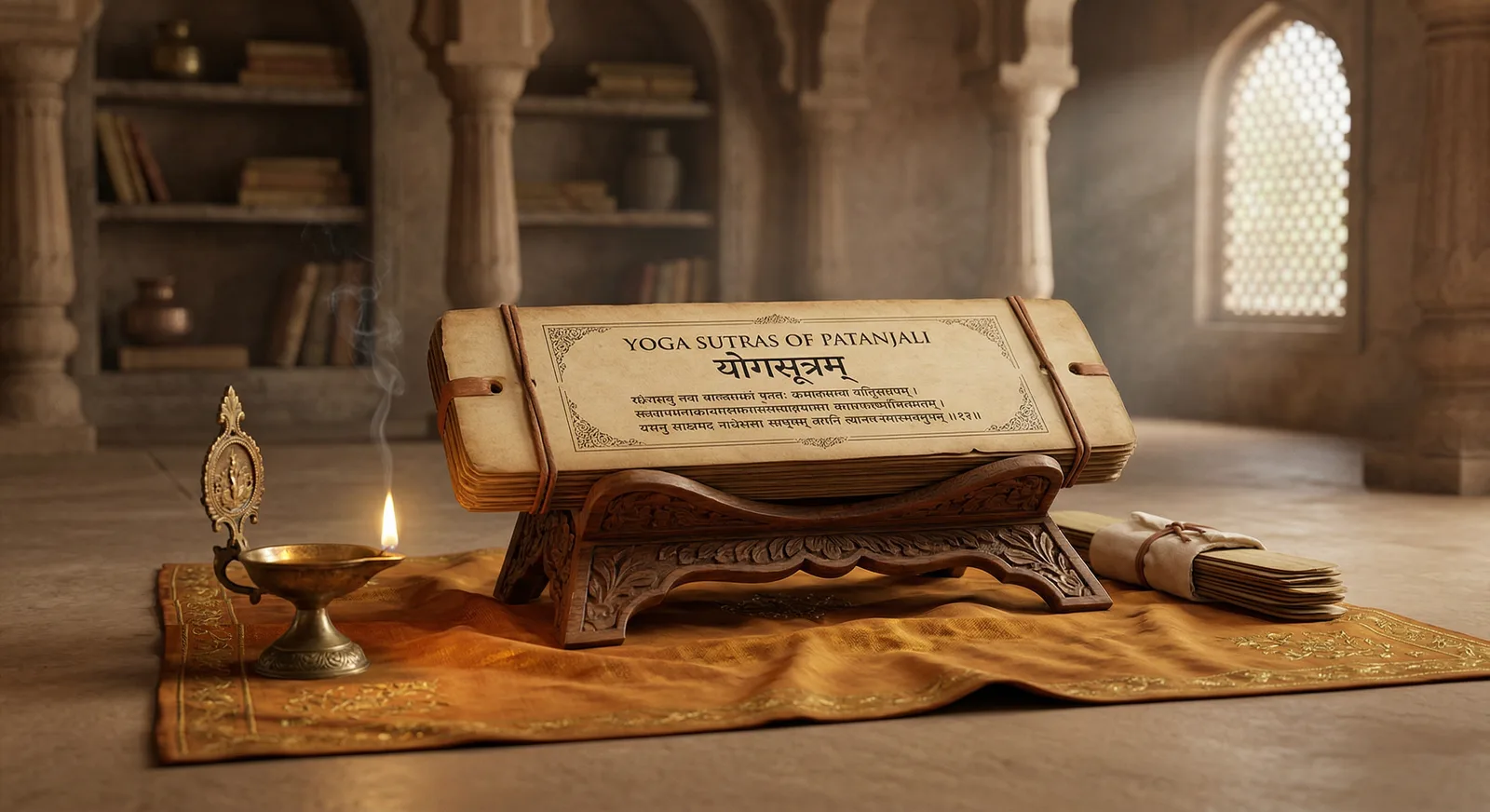
- Yoga Sutras
- Brahma Sutras
- Nyaya Sutras
- Vaisheshika Sutras
- Mimamsa Sutras
A sutra can be so concise that reading it without commentary may create more confusion than understanding.
This led to extensive traditions of bhashya, or commentary.
Great teachers interpreted foundational texts from different philosophical viewpoints.
For example, Shankara, Ramanuja and Madhva wrote influential Vedantic commentaries while reaching different conclusions about:
- Brahman
- The individual soul
- The universe
- Devotion
- Liberation
This is why two people can read the same Upanishadic passage and explain it differently.
In Hindu traditions, scripture rarely exists without interpretation.
The question is not whether interpretation occurs.
The question is whether the interpretation is informed, honest and consistent with its lineage.
Regional and Devotional Scriptures
Hindu sacred literature does not exist only in Sanskrit.
Tamil, Hindi, Bengali, Marathi, Telugu, Kannada, Malayalam, Gujarati and many other languages contain major devotional traditions.
Examples include:
- Ramcharitmanas
- Tirumurai
- Divya Prabandham
- Tevaram hymns
- Abhangas of Maharashtra
- Songs of Mirabai
- Poetry of Surdas
- Works of Tulsidas
- Teachings of regional saints
- Temple hymns and oral traditions
Some communities experience these texts as more immediate than Sanskrit works because they are connected with family language, local temples and living devotional practice.
A person may first encounter Rama through the Ramcharitmanas, Krishna through devotional songs or Shiva through Tamil hymns.
This does not make the experience less authentically Hindu.
Sanatan Dharma has survived partly because sacred wisdom continued entering the languages people actually spoke.
Are Hindu Scriptures Contradictory?
Sometimes they appear to be.
One text may praise ritual.
Another may emphasise meditation.
One passage may describe the divine without form.
Another describes a beautiful personal form.
One school teaches that the soul and Brahman are one.
Another teaches eternal distinction between the soul and God.
One narrative may differ from another account of the same event.
These differences arise for several reasons.
Different Texts Serve Different Purposes
A ritual manual and a philosophical dialogue are not trying to do the same job.
A devotional hymn speaks differently from a legal text.
A Purana communicates differently from an Upanishad.
Teachings Address Different Seekers
A beginner, householder, renunciate, devotee and philosopher may require different instruction.
The path appropriate for one stage of life may not be identical to another.
Hinduism Contains Multiple Schools
Vaishnava, Shaiva, Shakta, Smarta, Vedantic, Yogic and other traditions preserve real theological differences.
These should not be hidden behind the claim that every text says exactly the same thing.
Texts Developed Across Long Periods
Hindu literature emerged through many centuries, regions and communities.
Social customs, language and methods of expression changed.
A responsible reader looks for both continuity and development.
The presence of different voices does not mean that truth is irrelevant.
It means that interpretation requires patience.
How to Read Hindu Scripture Responsibly
Reading sacred literature is not the same as collecting attractive quotations.
A verse removed from its chapter can be made to support almost anything.
A translation may hide important Sanskrit meanings.
A social-media image may attribute a sentence to Krishna, Shiva or the Vedas even when no such passage exists.
Use the following principles.
Read the Surrounding Passage
Do not judge a verse without understanding the conversation, speaker and situation.
The Bhagavad Gita is a dialogue, not a collection of isolated motivational slogans.
Know What Kind of Text You Are Reading
Ask whether the text is:
- A hymn
- A philosophical dialogue
- A sacred story
- A ritual manual
- A legal text
- A devotional poem
- A commentary
Different genres require different methods of interpretation.
Compare More Than One Translation
Every translation involves decisions.
A Sanskrit term such as dharma, yoga, atman or Brahman may not have one exact English equivalent.
Comparing translations can reveal where interpretation has entered the wording.
Use a Reliable Commentary
A good commentary explains:
- Historical context
- Grammar
- Philosophical tradition
- Alternative interpretations
- Connections with other scriptures
Read traditional commentaries and responsible modern scholarship rather than assuming only one perspective exists.
Distinguish Scripture From Viral Content
Before sharing a quotation, check:
- The text
- Chapter
- Verse
- Translation
- Context
"Ancient Hindu wisdom says" is not a source.
Do Not Use Scripture to Avoid Responsibility
A religious quotation should not be used to justify abuse, discrimination, dishonesty or neglect.
An interpretation that repeatedly protects the powerful while silencing the vulnerable deserves serious examination.
The purpose of scripture is not to make the ego impossible to question.
It is to expose the ego to truth.
Which Hindu Scripture Should a Beginner Read First?
There is no single answer for every reader.
The best starting text depends upon what you are seeking.
For Practical Guidance in a Difficult Life: Bhagavad Gita
Begin with the Bhagavad Gita if you are facing:
- Anxiety
- Responsibility
- Career pressure
- Moral confusion
- Attachment to results
- Questions about purpose
Choose a translation with explanatory notes and read slowly.
Do not try to complete it as quickly as possible.
One chapter understood is more valuable than eighteen chapters rushed.
For Story, Character and Dharma: Ramayana
Begin with a reliable, accessible Ramayana translation or abridgement if you learn most naturally through characters and stories.
Notice how each character responds to:
- Duty
- Temptation
- Loyalty
- Power
- Exile
- Grief
Avoid assuming that every modern adaptation presents the complete epic.
For Moral Complexity: Mahabharata
Begin with a respected abridged Mahabharata before attempting a complete translation.
The number of characters and stories can overwhelm a new reader.
Focus first on:
- The origins of the conflict
- Draupadi's humiliation
- Bhishma's vows
- Karna's loyalty
- Yudhishthira's dilemmas
- Krishna's role
- The consequences of silence and pride
For Philosophical Inquiry: Katha or Isha Upanishad
The Katha Upanishad is an excellent starting point because it presents philosophy through the compelling conversation between Nachiketa and Yama.
The Isha Upanishad is short and powerful, although its compact verses require commentary.
The Brihadaranyaka and Chandogya Upanishads are foundational but may be difficult for a first reading without guidance.
For Krishna Bhakti: Bhagavata Purana
Readers drawn towards Krishna may begin with selected portions of the Bhagavata Purana under a reliable teacher or commentary.
It combines story, theology and devotion.
For Shiva or Devi Traditions
Choose a text recognised within the particular tradition you wish to understand.
For Devi worship, the Devi Mahatmya is foundational.
For Shaiva traditions, the best text may depend on whether your interest is devotional, philosophical, Agamic or Puranic.
For the Vedas: Begin With Guidance
The Vedas should not be approached as though they were a modern self-help book.
A reliable introduction, selected hymns, proper context and, where possible, guidance from someone trained in Vedic tradition will make the study far more meaningful.
A Recommended Reading Path for Beginners
A practical sequence could be:
Step 1: Understand the Map
Begin with a broad introduction to Hinduism and its central concepts.
Read What Is Hinduism? A Complete Guide to Sanatan Dharma for Modern Life.
Step 2: Read the Bhagavad Gita
Read one chapter at a time.
Keep notes on:
- What Arjuna asks
- What Krishna answers
- What you find difficult
- What applies to your current life
Step 3: Read One Accessible Upanishad
Choose the Katha, Isha or Kena Upanishad with commentary.
Allow questions to remain open.
Step 4: Enter the Epics
Read an accessible Ramayana, followed by an abridged Mahabharata.
Do not only ask who was right or wrong.
Ask what each person's choices created.
Step 5: Follow Your Devotional Interest
If you feel drawn towards Krishna, Shiva, Devi, Rama, Ganesha or another sacred form, explore the scripture and lineage connected with that devotion.
Step 6: Compare Interpretations
Once you understand a text's basic structure, compare commentaries from different traditions.
You will begin to see the richness of Hindu philosophical debate.
How Scripture Can Help Modern Life
The value of scripture is not measured only by its age.
It is measured by whether it helps us see life more truthfully.
The Vedas Teach Reverence
Modern culture often treats nature only as a resource.
Vedic hymns encourage gratitude towards the powers supporting life.
The Upanishads Challenge False Identity
We are trained to identify completely with profession, appearance, success and social approval.
The Upanishads ask who remains beneath every changing identity.
The Bhagavad Gita Teaches Action Without Inner Slavery
The Gita shows how to work seriously without allowing results to define personal worth.
The Ramayana Teaches That Character Matters in Exile
Values are easy to display when life is comfortable.
Character becomes visible when plans collapse.
The Mahabharata Warns Against Moral Silence
Many disasters grow because good people remain passive while humiliation, greed and injustice become normal.
The Puranas Make Spiritual Qualities Memorable
Divine stories give form to courage, devotion, wisdom, protection and transformation.
The Agamas Turn Space and Action Into Worship
They teach that architecture, sound, image, movement and daily practice can direct attention towards the sacred.
The Dharma Texts Force Difficult Ethical Discussion
Even when modern readers reject historical rules, these texts remind us that society must continually ask what duties make communal life possible.
Scripture does not remove the need to think.
It teaches us how seriously human beings have always needed to think.
A Library for Every Stage of the Human Journey
The Vedas begin with sacred sound, gratitude and wonder before the cosmos.
The Upanishads turn inward and ask who is experiencing that cosmos.
The Bhagavad Gita places philosophy inside a moral crisis.
The Ramayana shows dharma tested through exile, loyalty and loss.
The Mahabharata reveals what happens when pride, silence and conflicting duties tear a family and kingdom apart.
The Puranas transform theology into stories that can be remembered across generations.
The Agamas shape temples, worship and disciplined spiritual practice.
The Dharma texts record the continuing human effort to organise responsibility and communal life.
No single volume contains all of this.
That is not a weakness.
It reflects the size of the human search.
A child may need a story.
A grieving person may need the Katha Upanishad.
A professional facing burnout may need Karma Yoga.
A devotee may need the Bhagavata Purana.
A meditator may need the Upanishads or Yoga Sutras.
A temple community may depend upon an Agama.
A society facing injustice may need to re-examine what dharma truly demands.
Hindu scripture does not ask every person to begin on the same page.
It asks every person to begin sincerely.
You do not need to read the entire library before one verse can transform you.
But you should know that no single quotation, book or interpretation can honestly claim to contain the whole tradition.
Approach the texts with curiosity.
Read them in context.
Respect their differences.
Question responsibly.
Seek knowledgeable guidance.
Most importantly, allow what you read to confront the way you live.
A scripture has not fulfilled its purpose merely because it has been placed on an altar.
Its purpose begins to be fulfilled when truth becomes stronger than convenience, duty becomes stronger than ego, devotion becomes stronger than fear and wisdom becomes visible in action.
The real question is therefore not only:
"Which book is the Hindu holy book?"
It is:
"Which teaching do I need to begin living today?"