Key Takeaways
- The Complete Manifestation (Svayam Bhagavan): Krishna is revered across traditions as the embodiment of all divine dimensions—child (Makhan Chor), divine lover, strategist, king, and supreme spiritual guide.
- The Teacher of the Gita: On the battlefield of Kurukshetra, Krishna imparted the Bhagavad Gita, synthesizing Karma Yoga (selfless action), Jnana Yoga (wisdom), and Bhakti Yoga (devotion).
- Joy & Duty in Harmony: Krishna demonstrates that spirituality is not the abandonment of life, but living with joy (Ananda) while fulfilling worldly responsibility (Dharma).
- Scriptural Authority: As proclaimed in the Bhagavata Purana (1.3.28): "Ete cāṁśa-kalāḥ puṁsaḥ kṛṣṇas tu bhagavān svayam" ("All other avatars are portions or expansions, but Krishna is the Supreme Lord Himself").
The God Who Grew Up With Humanity
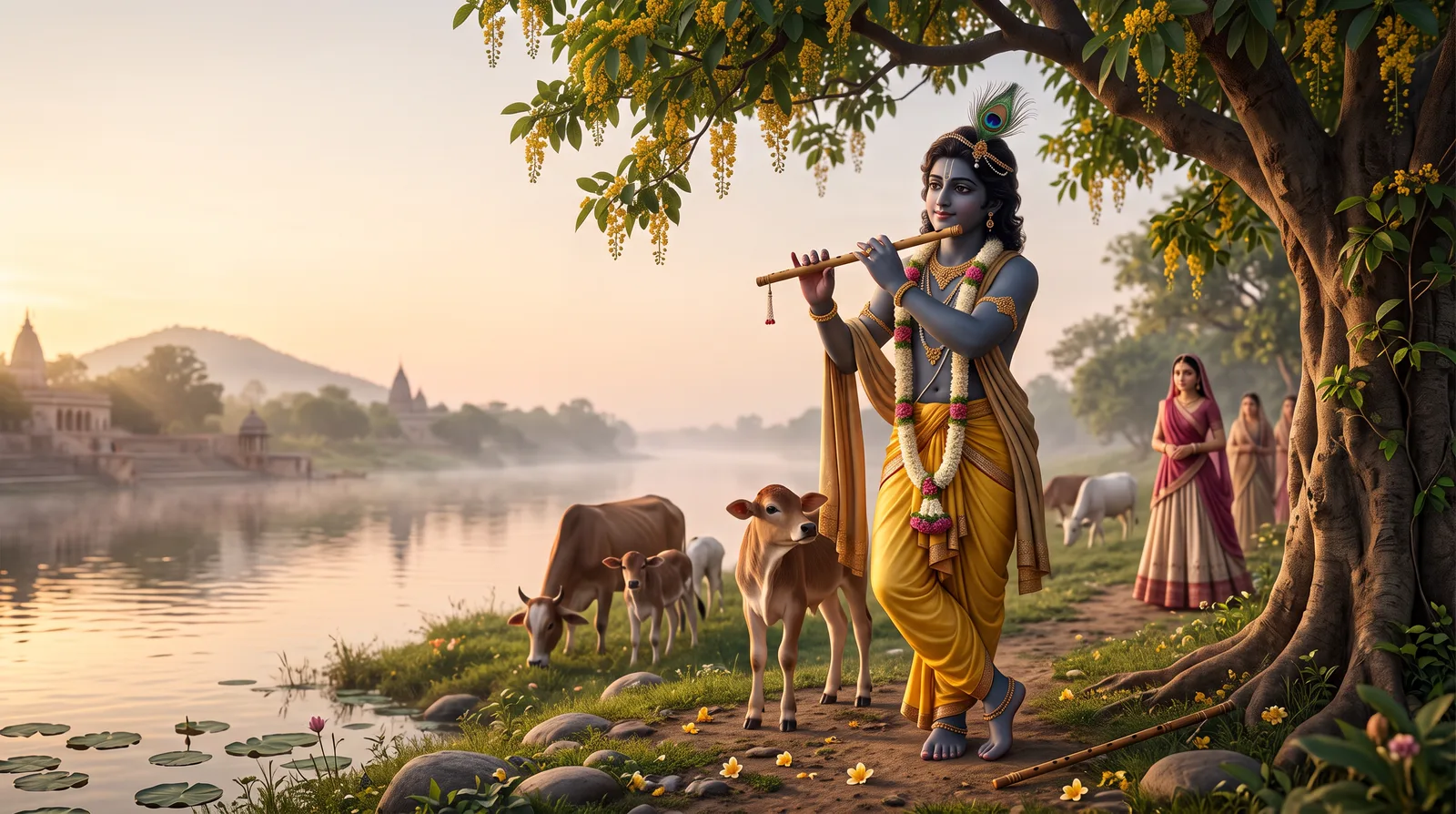
Many divine figures are remembered through one defining image. Krishna refuses to remain inside one. He appears as a newborn carried across a flooded river. He becomes the playful child of Gokul, stealing butter and testing the patience of his mother. He grows into the flute player of Vrindavan, drawing people towards him through love rather than fear. He protects an entire community beneath Govardhan Hill.
He confronts a tyrant in Mathura. He becomes a ruler, diplomat, friend and strategist. And on the battlefield of Kurukshetra, he serves as Arjuna's charioteer and reveals the teachings of the Bhagavad Gita. Krishna can be approached as a child, friend, beloved, teacher, protector, king or Supreme Lord. This is one reason his presence feels so personal to millions of devotees. He does not remain distant from ordinary human experience.
He enters family life, friendship, danger, responsibility, politics, grief, love and moral conflict. Yet he is never completely defined by any one role. The playful child and the teacher of the Gita are not two different Krishnas. They reveal two dimensions of the same spiritual message:
Life should be lived with love, but love must be guided by wisdom.
Responsibility should be taken seriously, but the soul must not become imprisoned by results.
Power should protect, not dominate.
Spirituality should deepen life, not make us afraid of living it.
To understand Krishna is therefore to explore more than the biography of a Hindu deity. It is to ask how joy and duty, love and freedom, action and surrender can exist within one complete life.
Who Is Lord Krishna?
As stated in the Bhagavata Purana (1.3.28):
"Ete cāṁśa-kalāḥ puṁsaḥ kṛṣṇas tu bhagavān svayam" "All other avatars are portions or expansions, but Krishna is the Supreme Lord Himself."
┌─────────────────────────────────────────────────────────┐
│              THE DUAL DIMENSIONS OF KRISHNA             │
└────────────────────────────┬────────────────────────────┘
                             │
            ┌────────────────┴────────────────┐
            ▼                                 ▼
┌───────────────────────┐         ┌───────────────────────┐
│ MADHURYA (DIVINE LOVE)│         │ AISVARYA (DIVINE POWER│
│ • Child of Gokul      │────►    │ • Teacher of Gita     │
│ • Flute in Vrindavan  │         │ • King of Dwarka      │
│ • Love for Radha      │         │ • Upholder of Dharma  │
└───────────────────────┘         └───────────────────────┘
                                              │
                                              ▼
┌───────────────────────┐         ┌───────────────────────┐
│ COMPLETE HARMONY      │         │ TOTAL SELF-SURRENDER  │
│ • Joy & Duty United   │◄────    │ • Bhagavad Gita 18.66 │
│ • Lila & Wisdom       │         │ • Liberation (Moksha) │
└───────────────────────┘         └───────────────────────┘
Krishna is one of the most widely worshipped deities in Hinduism and a central figure in Vaishnava traditions. His sacred life is narrated across several important texts, including:
- The Mahabharata
- The Harivamsha
- The Vishnu Purana
- The Bhagavata Purana
- The Brahma Vaivarta Purana
- The Bhagavad Gita
- Later devotional poetry and regional traditions
These texts do not always present every event in exactly the same way. They developed through different periods, communities and theological traditions. For many Hindus, Krishna is the eighth avatar of Vishnu, the divine preserver who descends when dharma is threatened. Krishna himself explains the principle of divine descent in the Bhagavad Gita:
Whenever dharma declines and adharma rises, I manifest myself. — Bhagavad Gita 4.7, paraphrased
In Krishna-centred traditions, however, he is not regarded as merely one avatar among others. Several Vaishnava sampradayas worship Krishna as Svayam Bhagavan — the original and complete form of the Supreme from whom other divine manifestations arise. Other Hindu traditions may approach Krishna as:
- A manifestation of Vishnu
- Saguna Brahman, the Supreme known through qualities and form
- A divine teacher
- The indwelling Lord within every being
- The embodiment of love, wisdom and dharma
These interpretations should not be collapsed into one compulsory formula. A balanced explanation is:
Krishna is widely worshipped as an avatar of Vishnu and, within several major devotional traditions, as the Supreme Divine Reality himself.
To understand how different divine forms relate to ultimate reality, read Do Hindus Really Worship 33 Crore Gods?.
A Note on Sacred Narrative and History
Krishna is a living object of faith, worship and personal relationship for millions of devotees. Traditional Hindu communities understand the events of his life as sacred history and divine lila — the purposeful play of the divine within the world. Modern historians study the development of Krishna traditions through texts, inscriptions, archaeology, art and religious communities. They do not agree on how every event in the sacred narratives should be reconstructed historically.
This article does not claim that every episode has been independently verified through modern archaeological methods. It also does not reduce the narratives to meaningless fiction. Sacred stories may communicate theology, moral insight, collective memory and spiritual experience even when they do not function like modern journalism. The most respectful approach is to be clear about the type of claim being made:
- "The Bhagavata Purana teaches"
- "The Mahabharata narrates"
- "Vaishnava traditions understand"
- "Devotees worship"
- "A modern symbolic interpretation suggests"
This allows faith and intellectual honesty to remain together.
Krishna's Birth: Hope Appears Inside a Prison
Krishna's birth story begins under oppression. The ruler Kamsa learns through a divine warning that the eighth child of his sister Devaki will cause his downfall. Driven by fear, Kamsa imprisons Devaki and her husband, Vasudeva. He kills their children as they are born, attempting to prevent the prophecy from being fulfilled. Krishna is born at midnight as Devaki's eighth child. The sacred narratives describe the prison becoming miraculously accessible: the guards fall asleep, the chains and doors release, and Vasudeva carries the infant through the night.
He crosses the Yamuna and reaches the home of Nanda and Yashoda in Gokul. Krishna is placed under their care and raised within the cowherd community, beyond Kamsa's immediate reach. The child who will later guide kings and warriors begins life without a palace. He is born inside confinement and carried to safety by a father willing to cross dangerous waters. For devotees, this is not merely the beginning of a supernatural biography.
It reveals a spiritual pattern:
Dharma can appear in the very place where adharma believes it has complete control.
Kamsa possesses political authority, soldiers and weapons. Yet fear governs him. Vasudeva appears powerless and imprisoned. Yet love gives him the courage to act. The story asks a question that remains relevant today:
Who is truly powerful — the person who controls others through fear, or the person who protects what is right despite fear?
Janmashtami: Celebrating the Divine Birth
Krishna's birth is celebrated during Krishna Janmashtami. Customs vary by region and tradition, but common observances include:
- Fasting
- Singing devotional songs
- Reading Krishna's birth narratives
- Temple worship
- Re-enactments of his childhood
- Decorating a small cradle
- Midnight prayer
- Offering food after the birth celebration
The midnight setting carries symbolic meaning. Krishna is born during darkness, but his birth announces that darkness is not final. Janmashtami therefore celebrates more than an event in the distant past. It asks whether divine awareness can be born within the places in us that have become imprisoned by fear, resentment or despair.
The Child of Gokul: A God Who Allows Himself to Be Loved
Krishna grows up in the home of Nanda and Yashoda among the cowherds of Gokul and Vrindavan. His childhood stories are among the most loved passages of Hindu devotional literature. He plays with other children. He cares for calves. He steals butter. He breaks pots. He teases the people who adore him. He is corrected by Yashoda and protected by the community. At the same time, the narratives reveal extraordinary divine power.
He survives attempts on his life. He subdues dangerous forces. He protects children, animals and villagers. He reveals the universe within his mouth, yet moments later returns to being Yashoda's little boy. This combination of divinity and intimacy is essential to Krishna bhakti. The Supreme is not only approached through fear, distance or formal ceremony. The divine may be loved as one's own child.
Why Does Krishna Steal Butter?
Krishna's butter-stealing stories are playful, but devotional traditions also find deeper meaning within them. Butter is produced by patiently churning milk. In later spiritual interpretation, the milk represents ordinary human experience, while the butter represents the refined love produced when the heart is repeatedly churned through remembrance and devotion. Krishna steals the butter because pure love already belongs to him.
This is a devotional interpretation rather than the only possible meaning of the story. At its simplest level, the narrative also makes Krishna emotionally accessible. He is not presented only as a remote cosmic ruler. He becomes the child whose mischief fills a home with frustration, laughter and affection.
Damodara: The Infinite Bound by Love
In one famous narrative, Yashoda attempts to tie Krishna with a rope after his mischief. The rope repeatedly appears too short. Eventually, through her persistence and affection, Krishna allows himself to be bound. This gives rise to the name Damodara, commonly associated with the Lord whose waist was bound by a cord. The theological message is striking:
The infinite cannot be captured through power. Yet the infinite willingly becomes bound by sincere love. Bhakti is therefore not about controlling God through ritual. It is about forming a relationship in which ego gradually gives way to affection, trust and surrender. Read Bhakti Yoga: How Devotion Heals Loneliness and Opens the Heart.
Vrindavan: Where the Divine Becomes Intimate
Vrindavan is more than the setting of Krishna's childhood stories. For many devotees, it represents a sacred state of relationship in which formality falls away and love becomes direct. The residents of Vraja do not primarily relate to Krishna as a distant monarch. Yashoda loves him as her son. The cowherd boys love him as their friend. The gopis love him with complete devotional longing. The cows gather around him naturally.
The landscape itself — its forests, riverbanks, flowers and paths — becomes part of the relationship. This is one reason Krishna devotion has inspired so much poetry, music, dance and painting. Philosophy explains the nature of the divine. Vrindavan asks what it feels like to love the divine.
Krishna and the Cowherd Boys
Krishna's friendship with the cowherd boys expresses a form of devotion known as sakhya bhava, the mood of friendship. A friend does not always stand at a distance with folded hands. A friend walks beside you, shares food, laughs, argues, plays and trusts. For devotees drawn towards sakhya bhava, Krishna is not only the ruler of the cosmos. He is the companion who remains close during ordinary life.
This changes the emotional language of spirituality. Prayer no longer has to be performed only through formal words. A person may speak honestly:
"I am confused." "I am angry." "I am frightened." "I do not understand what you are asking of me." Arjuna later speaks to Krishna with this same honesty. Spiritual relationship becomes genuine when it no longer depends on pretending.
Kaliya: Courage Without Unnecessary Destruction
One childhood narrative describes the serpent Kaliya poisoning part of the Yamuna. Krishna enters the water, subdues the serpent and dances upon its many hoods. Yet he does not simply destroy Kaliya. After the serpent's wives appeal for mercy, Krishna orders Kaliya to leave the river. The episode is interpreted in different ways. Devotionally, it displays Krishna's protection of the people and environment of Vraja.
Symbolically, the poisoned river may represent consciousness contaminated by anger, envy or destructive desire. Krishna does not deny that poison exists. He enters the place others fear and restores balance. The modern lesson is not that every conflict should end through domination. It is that courage must confront what is harmful while remaining capable of restraint. Power becomes dharmic when it protects life without becoming addicted to punishment.
Govardhan Hill: Protection, Humility and the Sacredness of Nature
One of Krishna's most celebrated childhood acts is the lifting of Govardhan Hill. The residents of Vraja are preparing an offering connected with Indra, the deva associated with rain and storms. Krishna questions the ritual and encourages the community to honour the land, cows and Govardhan Hill that directly sustain their lives. Indra becomes angry and sends destructive rain. Krishna lifts Govardhan Hill and shelters the villagers and animals beneath it until the storm ends.
The episode contains several layers of meaning.
Leadership Means Becoming Shelter
Krishna does not protect the community from a distant throne. He stands among them and holds the burden above them. Modern leadership is often measured through status, visibility and control. Govardhan offers another measure:
When difficulty arrives, do people become safer because you are present?
A parent becomes shelter. A responsible employer becomes shelter. A truthful public servant becomes shelter. A friend who remains during crisis becomes shelter. Leadership is not only the right to make decisions. It is the willingness to carry responsibility.
Ritual Should Not Replace Understanding
Krishna's questioning of the established ritual is not a rejection of all worship. It is a challenge to mechanical action performed without reflection. The story asks:
- Do we understand why we perform a tradition?
- Has fear replaced devotion?
- Are we honouring distant power while neglecting what sustains us directly?
- Has ritual become more important than compassion and responsibility?
Tradition remains alive when it is practised with understanding. Without understanding, it can become habit protected by fear.
Nature Is Not Spiritually Empty
Govardhan, the cows, rain, soil and community are inseparable within the narrative. A modern ecological reading sees the story as a reminder that spiritual life cannot be separated from care for land, animals and natural systems. This is a contemporary application, not the only traditional interpretation. Yet it follows a deeply Hindu intuition:
The natural world is not merely raw material. It participates in sacred relationship.
Power Must Learn Humility
Indra possesses enormous cosmic authority, but pride distorts his judgment. Krishna's protection of Vraja eventually brings Indra to humility. The story does not teach that power itself is evil. It teaches that power without self-awareness becomes dangerous. The higher a person's position, the more urgently they need the ability to question themselves.
Radha and Krishna: When Love Becomes a Spiritual Path
No discussion of Krishna is complete without Radha. Yet her place within the scriptural tradition should be explained carefully. The Bhagavata Purana celebrates Krishna's relationship with the gopis and describes a specially favoured companion, but Radha is not named directly in its famous rasa narrative. Radha becomes increasingly explicit and central in later devotional literature and Vaishnava traditions.
Jayadeva's twelfth-century Gita Govinda gave magnificent poetic expression to the love, separation and reunion of Radha and Krishna. Later poets, saints, commentators and sampradayas developed profound theologies around their relationship. For millions of devotees, Radha is not merely a village woman involved in a human romance. She is understood as:
- The highest devotee
- The embodiment of pure bhakti
- Krishna's eternal beloved
- The divine feminine power of love
- The soul's longing for the Supreme
- In some traditions, Krishna's own internal spiritual energy
Different Vaishnava schools describe her theological status differently.
Love Without Possession
Radha's love is often interpreted as devotion free from calculation. She does not love Krishna because the relationship gives her social status, financial security or control. Her love is directed towards Krishna because she experiences him as the centre of her being. This does not mean ordinary relationships should ignore boundaries, commitments or ethics. Radha-Krishna theology should not be used to excuse deception or harmful behaviour in human relationships.
Its spiritual meaning operates at another level:
Can love exist without reducing the beloved to a possession?
Human love often carries an unspoken demand:
"You must behave as I expect, or I will withdraw my love." Bhakti asks whether love can become less controlling and more capable of reverence.
Viraha: Presence Discovered Through Separation
Radha's longing for Krishna is frequently expressed through viraha, the pain of separation. In devotional poetry, separation does not always weaken love. It can intensify remembrance until the beloved is present within every thought. This is not an encouragement to romanticise abandonment or emotional suffering. Its spiritual meaning is that longing itself may become prayer. A person may feel distant from God.
Meditation may feel empty. Prayer may appear unanswered. Yet the desire for divine connection can itself reveal that the relationship remains alive. Radha represents the heart that refuses to become indifferent. Her longing is not spiritual failure. It is devotion stripped of comfort. Read Bhakti Yoga: How Devotion Heals Loneliness and Opens the Heart.
The Rasa Lila: The Divine Responds to Every Soul
The Rasa Lila describes Krishna dancing with the gopis of Vrindavan. It has inspired centuries of sacred poetry, temple traditions, music, painting and classical dance. The narrative should be approached within its devotional and theological setting rather than reduced to an ordinary social event. In many Vaishnava interpretations:
- Krishna represents the Supreme.
- The gopis represent souls drawn entirely towards the divine.
- The dance represents complete participation in divine love.
- Krishna's presence with each devotee expresses the infinite capacity of God to respond personally to every soul.
At the same time, the poetry of Krishna devotion often uses the language of human romance. That language is intentionally powerful. Human longing is one of the strongest emotions people experience. Bhakti poets transform it into a language for spiritual longing. The purpose is not to make the divine relationship ordinary. It is to allow ordinary human emotion to become a doorway towards the sacred.
From Vrindavan to Mathura: Love Does Not Remove Responsibility
Krishna's life does not remain forever inside the protected beauty of Vrindavan. He eventually travels to Mathura and confronts Kamsa. The ruler who attempted to prevent Krishna's birth is defeated, and order is restored. This movement from Vrindavan to Mathura marks an important transition. The flute-playing youth must now enter public responsibility. Love does not become less important. But love alone cannot protect society if injustice is never confronted.
Krishna's life therefore refuses two incomplete forms of spirituality:
- Tenderness without courage
- Power without tenderness
In Vrindavan, he reveals intimacy. In Mathura, he confronts tyranny. Later, in the Mahabharata, he attempts diplomacy before supporting necessary action. A spiritually mature life requires knowing which quality a situation demands. There are moments to comfort. There are moments to negotiate. There are moments to forgive. There are also moments to set a boundary and stop harm.
Krishna at Dwaraka: The Divine as Ruler and Householder
Later sacred narratives describe Krishna establishing his life in Dwaraka and taking on responsibilities as a ruler, statesman and householder. He is associated especially with Rukmini, who is revered in many traditions as a principal queen and manifestation of Lakshmi. The Dwaraka narratives reveal a different Krishna from the child of Gokul, but not an unrelated one. He continues to protect, guide and maintain relationships while managing complex political and social responsibilities.
This matters because Hindu spirituality does not always present household life as inferior to spiritual life. A person can pursue dharma while:
- Raising a family
- Managing resources
- Leading an organisation
- Participating in society
- Making difficult practical decisions
The question is not whether you possess responsibility. It is whether responsibility possesses you. Krishna remains active in the world without losing awareness of his deeper nature.
Krishna in the Mahabharata: Power Used Through Wisdom
In the Mahabharata, Krishna is not merely a warrior. He appears as a relative, friend, diplomat, strategist and moral guide. He repeatedly attempts to prevent destructive conflict. Before the Kurukshetra war, he undertakes a peace mission to the Kaurava court. The attempt fails because pride, greed and refusal to compromise have already hardened the conflict. Krishna's role shows that commitment to dharma does not mean rushing towards violence.
Diplomacy, persuasion and peaceful resolution should be attempted where possible. But peace cannot be sustained when one side uses every negotiation only to preserve injustice.
Krishna's Army or Krishna Himself?
Before the war, both Arjuna and Duryodhana seek Krishna's support. Krishna offers a choice:
- One side may have his powerful army.
- The other may have Krishna himself, unarmed and not personally fighting.
Duryodhana chooses the army. Arjuna chooses Krishna. The story offers a timeless contrast. Duryodhana chooses visible resources. Arjuna chooses wisdom and presence. Modern life repeatedly presents the same temptation. We may choose:
- Money without integrity
- Influence without discernment
- Technology without purpose
- Information without wisdom
- A large team without trustworthy leadership
Resources matter. But resources guided by a distorted mind can accelerate destruction. Arjuna's choice asks:
What is the value of possessing more power if we do not know how to use it?
The Bhagavad Gita: Krishna Speaks to a Person Who Cannot Continue
On the battlefield of Kurukshetra, Arjuna asks Krishna to position the chariot between the two armies. When he sees teachers, relatives and friends on both sides, his certainty collapses. He lowers his bow. He questions the value of victory. He fears the consequences of action and wishes to withdraw. Krishna does not shame Arjuna for asking difficult questions. He leads him through an extended examination of:
- The Self
- Death
- Dharma
- Action
- Attachment
- Meditation
- Knowledge
- Devotion
- Divine nature
- Surrender
- Liberation
The Bhagavad Gita is therefore not Krishna giving easy encouragement to a confident warrior. It is Krishna guiding a person whose moral world has broken apart. Our article The Bhagavad Gita's Guide to Anxiety and Stress in Modern Life explores Arjuna's crisis in depth. The following teachings focus instead on the larger message Krishna offers humanity.
Krishna's Central Teachings
You Are More Than the Changing Body
Krishna teaches that the embodied Self passes through childhood, adulthood and old age, and that bodily death does not destroy the deepest spiritual identity. This does not mean the body is unimportant. It means the body is not the complete Self. Modern people often attach identity to:
- Appearance
- Age
- Health
- Profession
- Social approval
- Financial success
All these can change. Krishna asks whether there is something deeper than the roles through which the world currently recognises us. This insight gives courage during transition. A lost job can change your circumstances without erasing your worth. Ageing can change the body without making consciousness meaningless. Failure can expose a strategy without proving that your entire life is a failure.
Perform Your Dharma
Krishna does not advise Arjuna to imitate another person's path. He asks him to understand and perform his own dharma. Dharma is not simply personal preference. It includes truth, responsibility, moral order and the demands created by one's position and circumstances. Your dharma may involve:
- Caring for a child
- Protecting someone vulnerable
- Speaking honestly to a powerful person
- Completing difficult work
- Leaving an unethical situation
- Accepting responsibility for a mistake
Dharma is often clearest when it is convenient. Its real test comes when doing the right thing costs something. Read Dharma: Discovering Your True Purpose in the 21st Century.
Act Without Becoming Possessed by Results
Krishna's teaching of Karma Yoga asks a person to act wholeheartedly while reducing attachment to the outcome. This does not mean that results are irrelevant. Results matter in practical life. A doctor must care whether treatment helps. A business must care whether it survives. A parent must care whether a child is safe. Non-attachment means that you do not allow one result to become the final definition of the Self.
Your responsibility is to:
- Prepare
- Act ethically
- Apply your abilities
- Learn from feedback
- Correct mistakes
- Remain steady through success and failure
You influence outcomes. You do not control every factor producing them. Read Karma Yoga: The Path of Selfless Action.
Devotion Is Measured by Love, Not Wealth
In Bhagavad Gita 9.26, Krishna says that he accepts even a leaf, flower, fruit or water when it is offered with devotion. The value of the offering is not determined by its price. It is determined by the consciousness through which it is given. This teaching makes devotion accessible. A person does not need wealth, status or elaborate objects to approach Krishna. Sincerity cannot be purchased. A simple offering made with love may possess greater spiritual meaning than an expensive ceremony performed for public recognition.
See the Divine Within All Beings
Krishna repeatedly teaches a vision that moves beyond selfish identity. The spiritually mature person does not see only social labels, external differences and personal usefulness. They learn to recognise the same spiritual reality present within different beings. This vision does not require pretending that every action is equally good. A harmful action should still be resisted. But resistance does not require hatred of the soul performing it.
This is an extremely difficult form of vision:
To protect justice without becoming consumed by contempt. To disagree without denying another person's humanity. To hold boundaries without allowing anger to become identity.
Control the Mind Through Practice
Krishna acknowledges that the mind is restless and difficult to control. He does not offer instant spiritual perfection. He teaches abhyasa and vairagya — consistent practice and non-attachment. The mind becomes what it repeatedly practises. If it rehearses comparison, comparison becomes automatic. If it rehearses resentment, resentment becomes familiar. If it rehearses prayer, gratitude or concentration, those pathways become more available.
Krishna's teaching is therefore practical:
Do not wait for the mind to become peaceful before practising. Practice is how the mind gradually becomes peaceful.
Surrender Is Not Helplessness
Near the conclusion of the Gita, Krishna calls Arjuna to take refuge in him. Surrender is sometimes misunderstood as abandoning thought, responsibility or personal effort. Krishna does not teach Arjuna for eighteen chapters and then ask him to stop thinking. He gives Arjuna knowledge, allows him to question and then tells him to reflect before deciding. Spiritual surrender means releasing the illusion that the isolated ego is the ultimate controller.
You still act. You still make decisions. But action is offered to something higher than pride, fear and personal reward. Surrender says:
"I will do what is mine to do, but I will not pretend that the universe belongs to my control."
Why Krishna Is Blue
Krishna is commonly depicted with blue or blue-black skin. The Sanskrit word Krishna is associated with darkness, blackness or a very dark colour. Older artistic traditions may represent him as dark, black, deep blue or blue-black. Blue became one of the most recognisable visual conventions in Krishna art. Several symbolic explanations are commonly offered:
- Blue suggests the vastness of the sky.
- Blue recalls the depth of the ocean.
- It represents a reality that appears within the world but cannot be contained by it.
- It visually connects Krishna with Vishnu, who is also frequently shown with blue skin.
These symbolic interpretations are meaningful, but they should not be presented as one universally stated scriptural explanation. Krishna's blue form is sacred iconography. It is not a scientific claim about ordinary human skin colour. The restrained blue-black colour communicates divine identity while allowing artists to show the dark-complexioned Krishna described by his name and traditions.
Krishna's Flute: The Call the Heart Recognises
The flute, or venu, is one of Krishna's most recognisable symbols. In the Vrindavan traditions, Krishna's music draws the gopis, cowherd boys, animals and natural world towards him. The flute represents attraction without coercion. Krishna does not force the heart towards devotion. He calls. The person remains free to listen or continue walking.
The Empty Flute
A beloved later devotional interpretation compares the human being to Krishna's flute. A flute produces music because it is hollow. When ego, pride and self-importance become quieter, divine purpose can move through a person more freely. This should be understood as poetic spiritual symbolism rather than the only canonical meaning of the instrument. Its practical message is valuable:
We often want our work to serve something meaningful while insisting that everything be performed according to our ego. The flute asks:
Can you become skilful, disciplined and open enough for something greater than self-promotion to move through your life?
Music Beyond Argument
Krishna teaches Arjuna through philosophical reasoning. In Vrindavan, he draws hearts through music. Both approaches matter. Some people awaken through ideas. Others awaken through beauty. Music can reach places that argument cannot. This is why Krishna devotion has produced such rich traditions of:
- Bhajan
- Kirtan
- Classical music
- Dance
- Poetry
- Temple arts
The flute represents spiritual truth becoming emotionally audible.
The Peacock Feather: Beauty Without Heaviness
Krishna is often shown wearing a peacock feather in his hair or crown. The feather connects him with the forests and natural beauty of Vrindavan. It is colourful and elegant, yet light. Unlike a heavy royal crown, it belongs to the living landscape. Traditional and later symbolic interpretations associate the feather with:
- Natural beauty
- Joy
- Grace
- Divine play
- Simplicity
- The colours and diversity of creation
There is no single meaning accepted by every Krishna tradition. The feather's visual power lies partly in its contrast. Krishna may be the Lord of the universe, yet he decorates himself with something found in nature. Greatness does not always need heaviness. Authority does not always need intimidation. Beauty does not always need excessive possession.
The Yellow Garment
Krishna is frequently portrayed wearing a yellow garment known as pitambara. Yellow and gold are associated with radiance, auspiciousness and light. The combination of Krishna's deep blue form and yellow clothing creates one of Hindu art's most recognisable visual harmonies. Some devotional interpretations see blue as the infinite and yellow as the luminous energy through which the infinite becomes present within the world.
As with his other symbols, interpretations vary. The central visual message is one of divine beauty, vitality and auspicious presence.
Krishna and the Cows
Krishna is known as Gopala, the protector of cows, and Govinda, a name with several traditional interpretations and strong associations with cows, land, senses and sacred knowledge. The cowherd identity is spiritually important. Krishna does not appear only among kings and philosophers. He grows up caring for animals and living within a rural community. Protection is part of his identity before political authority is.
The image of Krishna with cows expresses:
- Care
- Gentleness
- Responsibility
- Harmony with nature
- Protection of dependent beings
- The sacred value of nourishment
The cowherd does not merely own the herd. He watches, guides and protects it. This becomes another model of leadership.
Krishna's Relevance Beyond Sacred Story
Krishna's life continues to attract readers because it does not present spirituality as one mood. He laughs, loves, protects, negotiates, confronts and teaches. He shows that spiritual maturity is not emotional flatness. It is the ability to express the right quality at the right time.
Be Joyful Without Becoming Careless
Krishna's childhood is full of play. His adult life is full of responsibility. He does not teach that seriousness requires permanent sadness. Modern people often confuse exhaustion with commitment. They believe that looking stressed proves they are working hard. Krishna offers another possibility:
Joy can coexist with discipline. Play can restore the energy required for meaningful work. A person can carry responsibility without making heaviness their entire personality.
Love Deeply Without Turning Love Into Possession
Radha-Krishna devotion reveals love as longing, remembrance and self-offering. Modern relationships often become struggles for control. We monitor, compare, demand and fear loss. Krishna bhakti asks whether love can deepen without becoming ownership. This does not eliminate boundaries. It removes the belief that another person exists only to regulate our emotional security.
Question Tradition Without Losing Reverence
At Govardhan, Krishna questions a ritual practice. He does not reject sacred life. He restores understanding to it. This is a vital lesson for younger generations. You do not have to choose between blind obedience and complete rejection. You can ask:
- What does this practice mean?
- Does it still serve dharma?
- Is it being used compassionately?
- What principle should remain even if the outer form changes?
Reverence and inquiry can coexist.
Attempt Peace Before Conflict
Krishna's peace mission in the Mahabharata shows that force should not be the first response. A person committed to justice should still attempt dialogue, truthful negotiation and proportionate resolution. But peace should not become a slogan used to preserve abuse. Sometimes refusing to confront injustice protects the aggressor rather than peace. Krishna's example requires both diplomacy and courage.
Choose Wisdom Over Appearance
Duryodhana chooses Krishna's army. Arjuna chooses Krishna. The story remains relevant whenever we select:
- Followers instead of trustworthy counsel
- Public image instead of character
- Speed instead of direction
- Technology instead of wisdom
- More data instead of clearer judgment
The most visible advantage is not always the most valuable one.
Act Fully and Release the Ego's Claim
Karma Yoga is not only a method for reducing anxiety. It is a way of preventing success from becoming arrogance and failure from becoming self-destruction. Do the work. Care about quality. Accept consequences. Learn continuously. But remember that you are more than one result.
A Seven-Minute Krishna Practice
You do not need an elaborate ritual to begin. Sit quietly before a respectful image of Krishna, or simply close your eyes.
First Minute: Become Present
Notice the breath and body. Allow the mind to arrive where the body already is.
Second Minute: Remember Krishna as Friend
Speak inwardly with honesty. Do not perform. Name what is actually present:
Confusion, gratitude, fear, longing or joy.
Third Minute: Ask About Dharma
Ask:
What is the most truthful action available to me today?
Avoid asking for ten answers. Choose the responsibility directly in front of you.
Fourth Minute: Release the Outcome
Bring one important task to mind. Say inwardly:
"I will give this my sincere effort, but I release the belief that the result defines me."
Fifth Minute: Offer Something Simple
You may offer a flower, leaf, fruit or water. The object does not need to be expensive. Let the offering represent attention rather than transaction.
Sixth Minute: Repeat a Name or Mantra
You may slowly repeat:
Hare Krishna, Hare Krishna, Krishna Krishna, Hare Hare Hare Rama, Hare Rama, Rama Rama, Hare Hare
Or:
Om Namo Bhagavate Vasudevaya
Mantra pronunciation and formal disciplines may be learned through a trusted teacher or lineage, but sincere remembrance can begin simply.
Seventh Minute: Carry One Quality Into Action
Choose one quality associated with Krishna:
- Joy
- Courage
- Friendship
- Protection
- Wisdom
- Devotion
- Steadiness
Decide how that quality will become visible in one action today. Devotion becomes real when remembrance enters conduct.
Common Misunderstandings About Krishna
"Krishna Is Only a Mischievous Child"
Krishna's childhood stories are central to devotion, but his sacred life also presents him as a protector, ruler, diplomat, strategist and spiritual teacher.
"Every Hindu Believes Krishna Is the Supreme God"
No. Many Hindus worship Krishna as an avatar of Vishnu. Several Krishna-centred Vaishnava traditions worship him as the original Supreme Being. Other Hindu traditions understand his place differently.
"Krishna's Blue Skin Is a Scientific or Racial Claim"
No. Blue and blue-black are forms of sacred iconography connected with Krishna's dark complexion, divine identity and artistic symbolism.
"Radha and Krishna Are Only a Human Romantic Couple"
Their relationship is expressed through romantic devotional poetry, but Vaishnava traditions understand it as revealing divine love, the soul's longing and the relationship between the Supreme and the highest devotee.
"Their Story Can Justify Unethical Relationships"
No. Sacred devotional symbolism should not be used to excuse deception, coercion, exploitation or betrayal in ordinary human relationships. Human conduct remains subject to consent, responsibility, dharma and law.
"Krishna Teaches That Results Do Not Matter"
Karma Yoga does not teach carelessness. It teaches responsible action without allowing personal worth and inner stability to depend entirely on results beyond complete control.
"The Bhagavad Gita Justifies Any War"
No. The Gita occurs within a specific epic conflict after prolonged injustice and failed attempts at resolution. Its teachings should not be removed from context to justify personal aggression, political violence or hatred.
"Surrender Means Obeying a Human Authority Without Question"
Krishna encourages Arjuna to listen, question, understand and reflect. Spiritual surrender to the divine should not be used by individuals or organisations to demand unquestioning control over another person.
"Every Krishna Story Must Be Read as Modern Journalism"
Hindu traditions regard Krishna's narratives as sacred and real, but the texts also communicate theology, symbolism and devotional meaning. Modern historical claims require methods different from scriptural faith.
The Complete Message of Krishna
Krishna's life begins in a prison and unfolds into freedom. He is carried through a storm before he can walk. He grows among cowherds rather than princes. He steals butter yet gives wisdom. He plays the flute yet speaks on a battlefield. He dances with devotees yet negotiates with kings. He offers love without weakness and power without permanent anger. He teaches action without attachment, devotion without expensive barriers and surrender without the destruction of intelligence.
Every stage of his life reveals a different spiritual need. The child Krishna teaches that the divine can be loved intimately. Gopala teaches protection and care. Govardhan-dhari teaches leadership and shelter. The flute player teaches attraction through beauty rather than force. Radha-Krishna reveals the transforming power of devotion. The statesman of Dwaraka teaches responsibility. The peace messenger teaches that dialogue should be attempted before conflict.
The charioteer teaches that wisdom can guide power without needing to sit upon the throne. The teacher of the Gita asks us to act while remembering who we truly are. This is why Krishna remains relevant beyond one place, century or cultural setting. Modern life contains the same human struggles:
We want success but fear failure. We want love but try to control it. We want peace but avoid difficult truth. We want spiritual freedom but remain attached to approval. We collect information but struggle to act wisely. Krishna does not ask us to withdraw from all these experiences. He asks us to transform the consciousness through which we enter them. Work — but do not become your job. Love — but do not turn love into ownership.
Lead — but become shelter. Question — but do not lose reverence. Enjoy life — but remember what is eternal. Act — but offer the result. Seek God — but do not assume the divine is far away. The flute of Vrindavan and the teaching at Kurukshetra carry the same invitation. One calls the heart. The other clarifies the mind. Together, they reveal a path in which love becomes wise and wisdom becomes loving.
The final question is therefore not only:
"Who is Lord Krishna?"
It is:
"What would my life become if I acted with his wisdom, loved with greater freedom and stopped allowing fear of the result to prevent my dharma?"