The Question Waiting Behind Every Human Life
At some point, every person encounters a question that cannot be avoided forever.
What happens when the body dies?
Does consciousness simply disappear?
Does a soul continue?
Do we meet those we loved?
Are we born again?
And if there is another life, what determines where and how it begins?
These questions often remain distant while life feels secure. Then someone dies. A diagnosis arrives. An accident changes a family. A parent grows old. A child asks where a grandparent has gone. Suddenly, death is no longer an abstract philosophical subject.
Hindu traditions have explored these questions for thousands of years through the Vedas, Upanishads, Bhagavad Gita, philosophical schools, Puranas and devotional teachings.
They do not all describe the journey after death in exactly the same way.
Yet many share a broad framework:
- The physical body dies.
- The deepest spiritual Self is not destroyed with the body.
- Unresolved karma, desire and ignorance sustain continued embodiment.
- The cycle of birth and death is called samsara.
- Spiritual liberation from that cycle is called moksha.
This article explains that framework as Hindu religious and philosophical teaching.
It does not claim that reincarnation has been scientifically established. Nor does it claim that a person can examine someone else's suffering and confidently identify what they supposedly did in a previous life.
Karma is meant to deepen responsibility and compassion.
It should never become a weapon for blaming the vulnerable.
The Direct Answer: What Happens After Death in Hinduism?
There is no single description accepted by every Hindu tradition.
A broad answer is that when the physical body dies, the embodied individual does not necessarily cease to exist. According to many Hindu schools, the jiva — the individual living being associated with mind, tendencies, desires and karma — continues beyond the death of the body.
Depending on the person's karma, spiritual understanding, desires and relationship with the divine, Hindu traditions describe several possibilities:
- Rebirth in another physical body
- Experience in a heavenly or difficult non-earthly realm
- Continued spiritual development
- Attainment of a divine abode
- Liberation from the cycle of rebirth
The Bhagavad Gita compares bodily death to changing worn-out garments. The body is left behind, while the embodied being continues its journey.
But Hinduism does not teach reincarnation merely to satisfy curiosity about a future life.
Its more urgent message is:
The way you think, choose and act today is shaping what you are becoming.
The teaching begins with karma.
What Karma Actually Means
The Sanskrit word karma means action, work or deed.
In everyday speech, karma is often reduced to:
"What goes around comes around."
That phrase captures only a small part of the idea.
Karma is not merely an invisible force waiting to punish someone who behaved badly. It refers to action and to the consequences, tendencies and impressions created through action.
Hindu teachings commonly consider karma at several levels:
- Physical actions
- Spoken words
- Intentions
- Deliberate choices
- Habits of thought
- Actions performed through others
- Responsibilities accepted or avoided
The Brihadaranyaka Upanishad expresses the principle simply:
As one acts, so one becomes. — Brihadaranyaka Upanishad 4.4.5
Every action affects the outer world, but it also affects the person acting.
Tell one lie, and you have performed an action.
Repeat the lie, and you begin forming a habit.
Protect the habit, and it gradually shapes your character.
Character influences future decisions.
Future decisions help shape the direction of a life.
Karma therefore operates not only as an external consequence but as an inner process of becoming.
A compassionate action makes compassion easier to express again.
Repeated anger makes anger more automatic.
Generosity weakens possessiveness.
Dishonesty strengthens the fear of being exposed.
Attention becomes concentration.
Repeated distraction becomes restlessness.
The future is not shaped only by dramatic moments. It is also built through small actions repeated until they become part of who we are.
Karma Is Not Fate
One of the most damaging misunderstandings is that karma means everything has already been decided.
If that were true, ethical effort would be meaningless.
Why practise self-control if every choice is fixed?
Why serve another person if suffering cannot be changed?
Why study, pray, apologise, forgive or reform?
Hindu teachings preserve a tension between conditions inherited from the past and freedom exercised in the present.
You do not choose every circumstance into which you are born.
You do not control every event that happens around you.
You may inherit a body, family situation, culture, economy and social environment you did not consciously select.
Other people also possess freedom, and their choices can affect you.
Natural events, collective systems and unpredictable conditions influence human life.
Yet within these limitations, the present still contains the power of response.
Karma does not say:
"Nothing can be changed."
It says:
"Actions have consequences, so choose with awareness."
Your past may help explain your current tendencies.
It does not have to become a permanent command over your future.
The Three Kinds of Karma
Later Vedantic teachers commonly organise karma into three categories:
- Sanchita karma
- Prarabdha karma
- Agami or Kriyamana karma
Terminology varies between teachers. Some use agami and kriyamana interchangeably, while others distinguish the action being performed now from the future result it produces.
The threefold framework remains a useful way to understand the relationship between past conditions and present freedom.
Sanchita Karma: The Accumulated Store
Sanchita means accumulated or gathered together.
Sanchita karma refers to the vast store of karmic potential associated with actions from previous experience and, within traditions accepting rebirth, previous lives.
Not all accumulated karma is believed to produce results at once.
A useful analogy is a field containing many seeds.
Some seeds may never sprout.
Some may remain dormant.
Some may grow only when the right conditions appear.
Sanchita karma represents this accumulated field of potential causes.
It should not be imagined as a simple financial account in which every action receives a fixed number of positive or negative points.
Karma is described through moral, psychological and spiritual causation, not merely cosmic bookkeeping.
Prarabdha Karma: What Has Begun to Bear Fruit
Prarabdha means begun or already set in motion.
Prarabdha karma is traditionally understood as the portion of accumulated karma producing the circumstances of the present embodiment and life.
Teachers often compare it to an arrow that has already left the bow.
Once released, its movement cannot be recalled as easily as an arrow still resting in the quiver.
Prarabdha may help explain why human beings begin life with different bodies, tendencies and circumstances within the karmic framework.
However, this teaching must be handled with humility.
It does not give anyone permission to say:
- "You are ill because of a past-life sin."
- "You are poor because you deserve it."
- "Your child suffered because of previous karma."
- "You should remain in an abusive situation because it is your karma."
Such claims are usually impossible to verify and can become spiritually cruel.
Even when a circumstance cannot immediately be changed, your response to it can still create new direction.
You may not control the storm.
You can still learn how to steer.
Agami or Kriyamana Karma: What You Are Creating Now
Kriyamana karma refers to action being performed in the present.
Agami karma generally refers to consequences that present action will bring in the future.
This is where moral freedom becomes visible.
Your present choices may:
- Strengthen an old tendency
- Interrupt a harmful pattern
- Repair damage
- Create a new relationship
- Protect someone vulnerable
- Deepen attachment
- Develop wisdom
- Produce future consequences
Suppose you inherited a quick temper.
That tendency may be deeply established. But each time anger appears, a choice remains.
You can justify it.
You can act through it.
You can suppress it until it explodes later.
Or you can learn to recognise it, regulate it and respond more wisely.
The inherited tendency belongs to your present condition.
The way you train it becomes part of your future.
That is the meeting point of karma and freedom.
What Is Samsara?
Samsara is the continuing cycle of birth, death and rebirth.
The word carries the sense of wandering or flowing through repeated existence.
Samsara is sometimes imagined as an exciting opportunity to experience countless lives. Hindu scriptures more often describe it as a condition of bondage.
Why?
Because whatever is born must change.
Whatever is gained can be lost.
Bodies age.
Relationships separate.
Pleasure passes.
Achievements fade.
Even heavenly enjoyment, in many Hindu accounts, remains temporary.
This does not mean that earthly life has no beauty.
It means that no temporary experience can provide permanent security.
A person seeks fulfilment through possessions, praise, pleasure, power or identity. For a time, one of these may satisfy the mind. Then conditions change, the satisfaction fades, and desire searches for another object.
The cycle continues externally through repeated birth and internally through repeated craving.
In that sense, samsara is not only something that may happen across lifetimes.
It can be observed in one afternoon:
Desire arises.
The object is obtained.
Pleasure appears.
Pleasure fades.
Fear of loss begins.
Another desire takes its place.
Hindu spiritual practice aims to free the person not from life itself, but from ignorance and compulsive attachment.
What Is Reincarnated?
This is one of the most difficult questions in Hindu philosophy.
The quick answer — "the soul is reborn" — is useful but incomplete.
Different Hindu schools explain the process differently.
The Physical Body Does Not Continue
The physical body, or sthula sharira, returns to the elements.
It is not believed to travel intact from one life to another.
Memories stored through the physical brain are also not generally expected to remain available in an ordinary, conscious form.
This is one reason Hindu teachings do not assume that everyone should remember previous lives.
The Jiva Continues
Many Hindu traditions teach that the jiva, the individual embodied being, continues through death and rebirth.
The jiva is associated with:
- Mind
- Ego-sense
- Desires
- Tendencies
- Karmic impressions
- Subtle faculties
- The continuing sense of individuality
Vedantic explanations frequently speak of a subtle body, or sukshma sharira, that carries impressions and tendencies when the physical body dies.
These impressions are called samskaras and vasanas.
A samskara is a mental or psychological impression formed through experience and repeated action.
A vasana is a latent tendency, inclination or desire.
They help explain why people may appear with different temperaments, attractions, fears and spiritual tendencies.
This does not mean every personality trait must come from a previous life. Genetics, upbringing, culture, trauma, education and current experience also shape human behaviour.
The karmic explanation operates within a religious framework; it should not replace responsible psychological, medical or social understanding.
Atman Is Changeless
The Atman is the deepest spiritual Self.
The Bhagavad Gita describes it as unborn and not destroyed when the body dies.
Here an important philosophical distinction appears.
In many devotional schools, the individual spiritual self continues as an eternal person through different embodiments.
In Advaita Vedanta, the pure Atman is never truly born, altered or carried from place to place. What appears to transmigrate is the jiva associated with ignorance, mind and subtle body.
From the highest non-dual perspective, the Self does not travel because it is not confined to one location.
The sun reflected in many bowls of water may appear to move when a bowl is carried.
The actual sun has not travelled with the reflection.
This distinction helps explain why Hindu texts can speak both of rebirth and of an eternal Self that neither comes nor goes.
What Determines the Next Birth?
Hindu traditions do not usually reduce rebirth to one single factor.
Several influences are commonly described.
Karma
Actions create consequences and tendencies that shape future experience.
The Katha Upanishad says that embodied beings enter different conditions according to their actions and knowledge.
Karma is therefore central, but it is not merely a system of reward and punishment.
It includes the kind of consciousness a person has cultivated.
Desire
Desire binds attention to objects, identities and experiences.
The Brihadaranyaka Upanishad connects desire, intention and action: what a person deeply desires influences what they will and do, and action shapes what they become.
Unfulfilled desire is therefore often described as one force sustaining samsara.
This does not mean every ordinary wish immediately creates another lifetime.
It means that deep attachment to separate identity and worldly fulfilment keeps consciousness directed towards further embodied experience.
Mental and Spiritual Tendencies
Repeated thoughts become powerful patterns.
A lifetime spent cultivating compassion, devotion or meditation is not treated as spiritually wasted if perfection has not been reached.
The Bhagavad Gita reassures Arjuna that sincere spiritual effort can continue bearing fruit and may reappear as favourable spiritual inclination in a future life.
Consciousness at the Time of Death
The Bhagavad Gita teaches that the state remembered at death influences the state attained thereafter.
This is sometimes misunderstood as though one random final thought overrides an entire lifetime.
The verse is better understood alongside the life that preceded the final moment.
What fills the mind at death is likely to reflect what the mind repeatedly loved, feared, practised and remembered while living.
A person cannot spend decades feeding greed and expect one hurried spiritual thought to erase every tendency.
The final direction of the mind is connected with the direction in which the mind has been trained.
Knowledge, Devotion and Divine Grace
Different Hindu schools place different emphasis on spiritual knowledge, selfless action, meditation, devotion and divine grace.
Advaita Vedanta emphasises liberating knowledge of the identity of Atman and Brahman.
Vaishnava traditions emphasise devotion and surrender to the Supreme Lord.
Shaiva and Shakta traditions contain paths of knowledge, yoga, ritual, devotion and grace.
The next condition of the soul is therefore not always explained as a mechanical calculation.
For many devotees, Ishvara is not absent from karma. Divine justice, compassion and grace operate beyond the limits of human understanding.
Is Karma a Punishment?
Karma is often imagined as a cosmic judge declaring:
"You did something bad, so suffering must now be inflicted upon you."
This is too simplistic.
Karma is more closely connected with cause, consequence, character and spiritual learning.
Some consequences are direct.
If you speak cruelly, a relationship may break.
If you misuse money, trust may disappear.
If you repeatedly overindulge, your health may be affected.
Other consequences are indirect, delayed or difficult to understand.
Hindu traditions also recognise that human beings live within shared worlds.
One person's action can harm many others.
A corrupt institution can produce suffering across generations.
War, discrimination, environmental destruction and exploitation cannot be responsibly explained by saying every victim individually deserved what happened.
The doctrine of karma should increase the urgency to resist injustice.
If actions create consequences, then social actions matter.
Laws matter.
Business decisions matter.
How societies treat children, workers, animals, minorities and the natural environment matters.
Karma is not a reason to walk past suffering.
It is a reason to understand that walking past is also an action.
Why Karma Must Never Become Victim-Blaming
A person may look at someone else's tragedy and say:
"It must be their past-life karma."
This statement may sound religious, but it often conceals indifference.
Ordinary human beings do not possess complete knowledge of another person's karmic history.
We cannot see every cause operating across nature, society, family, personal choice and other lives.
Even if one accepts past-life karma, identifying the precise reason for a particular tragedy is normally beyond us.
The appropriate response to suffering is therefore not speculation.
It is compassion.
If someone is hungry, feed them.
If someone is abused, help them reach safety.
If someone is ill, support appropriate care.
If a system is unjust, work to change it.
If you have caused harm, accept responsibility and repair what you can.
Karma asks:
"What action will you take now?"
It does not ask you to become the judge of a life you cannot fully understand.
Heaven and Hell in Hindu Traditions
Hinduism contains concepts often translated as heaven and hell, but they do not always match the idea of one eternal destination assigned immediately after a single earthly life.
Svarga and Other Heavenly Realms
Svarga is a celestial realm associated with pleasure and the results of meritorious action.
The Bhagavad Gita explains that those who seek heavenly rewards may reach celestial worlds, enjoy the results of their merit, and later return when that merit is exhausted.
Heaven is therefore not always the final spiritual goal.
It is still part of samsara.
A luxury hotel may be more pleasant than an ordinary home, but it remains temporary accommodation.
Similarly, heavenly enjoyment may be extraordinary without providing moksha.
Naraka and Difficult Realms
Naraka refers to painful states or realms described in various Hindu texts.
The Puranas preserve detailed accounts of different consequences associated with harmful actions. These descriptions vary between texts and traditions.
Some Hindus understand them as literal realms.
Others read them symbolically or morally — as vivid descriptions of the suffering created by destructive actions.
Many traditions regard such states as temporary rather than eternal.
Their purpose is connected with experiencing or exhausting particular karmic consequences, after which the jiva continues its journey.
Pitru Loka and Ancestral Realms
Some scriptures and rituals refer to Pitru Loka, a realm associated with ancestors.
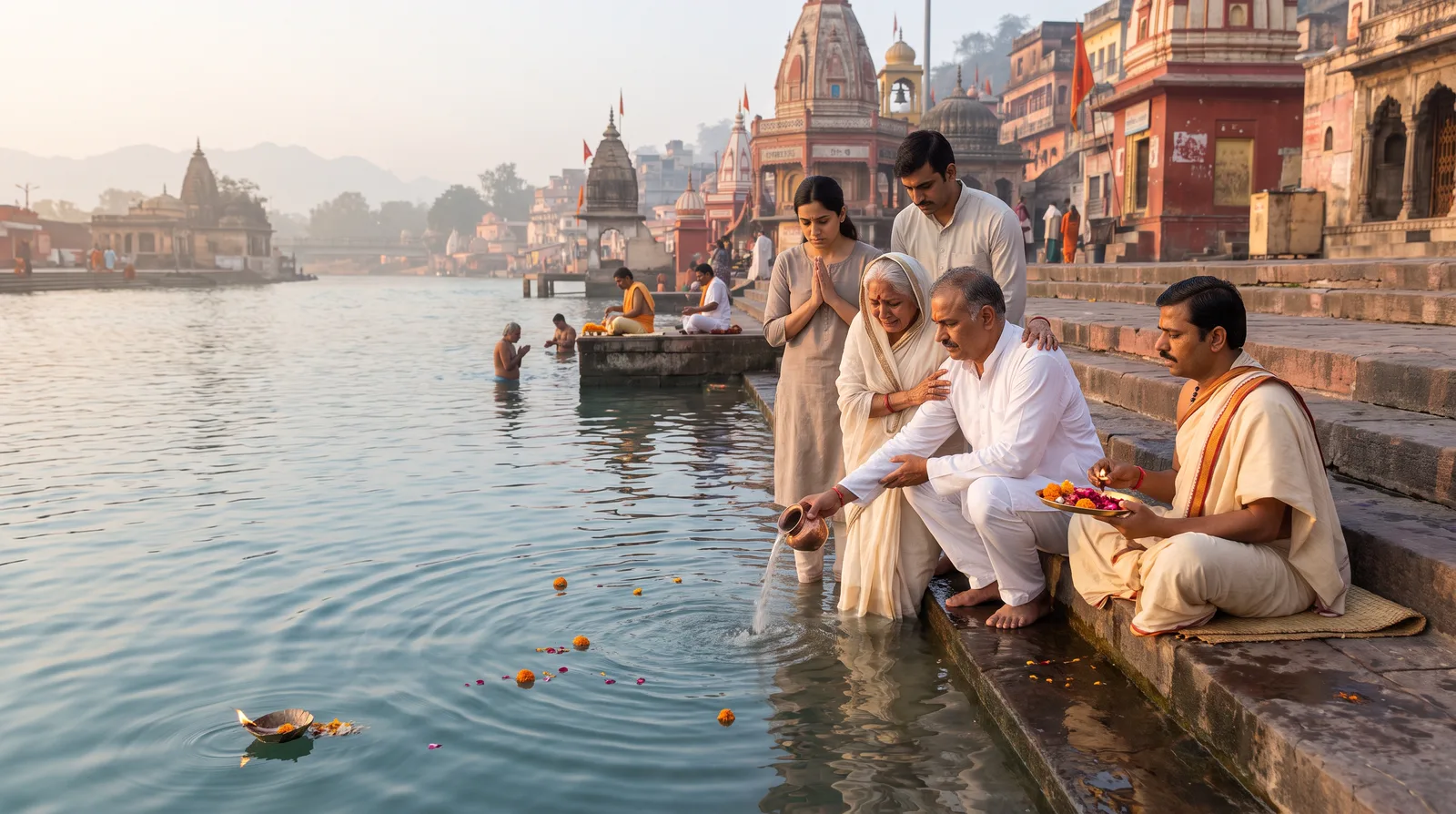
Hindu funeral and ancestral rites express gratitude, continuity and responsibility between generations.
Practices differ significantly by family, region and sampradaya.
It would therefore be inaccurate to claim that every Hindu tradition teaches one identical sequence of events, one fixed number of days between death and rebirth, or one universal map of the afterlife.
The broad principle is more consistent than the details:
Actions have consequences, temporary realms remain within samsara, and moksha lies beyond the cycle.
Does Rebirth Happen Immediately?
Hindu scriptures and traditions offer different descriptions.
Some accounts suggest relatively direct movement towards another embodiment.
Others describe intermediate states, ancestral realms, heavenly worlds or periods in which karmic results are experienced before rebirth.
The timing is not universally agreed.
It may be unhelpful to speak with certainty about exact intervals unless discussing one specific scripture or lineage.
The more important teaching is not how many days pass between bodies.
It is whether ignorance, attachment and karma remain active.
Where those causes remain, samsara continues.
Where they are fully overcome through liberating knowledge, devotion, divine grace or another recognised path, rebirth ends.
Can Present Actions Change Karma?
Yes — but Hindu traditions do not usually claim that every consequence can be instantly erased.
Some conditions may already be in motion.
You cannot always undo a word after it has wounded someone.
You cannot recover every lost year.
You cannot guarantee that disciplined living will prevent all illness or misfortune.
But present action still matters.
You may not be able to change what occurred.
You can change what you learn from it.
You can apologise.
You can make restitution.
You can stop repeating the pattern.
You can seek help.
You can cultivate a different response.
You can prevent your pain from becoming pain inflicted on someone else.
Hindu traditions recommend several ways of transforming the karmic direction of life.
Ethical Action
Truthfulness, non-harming, generosity, self-restraint and responsible conduct reduce the creation of harmful karma.
Ethics is not merely preparation for spirituality.
It is spirituality expressed through choices.
Karma Yoga
Karma Yoga means acting with dedication while loosening attachment to personal reward.
The goal is not inactivity. It is action without constant egoic possession.
Read Karma Yoga: The Path of Selfless Action.
Devotion
Prayer, remembrance, mantra, worship and surrender direct the mind towards the divine.
Bhakti traditions teach that divine grace can free the devotee from karmic bondage in a way that cannot be reduced to personal effort alone.
Meditation and Self-Discipline
Meditation reveals thoughts and tendencies before they become automatic actions.
The gap between impulse and response is one of the places where future karma is transformed.
Self-Knowledge
Vedanta teaches that bondage depends upon ignorance of the true Self.
When the Self is known as distinct from the body-mind — or, in non-dual traditions, as Brahman itself — the mistaken identity sustaining karmic bondage is destroyed.
Atonement and Repair
Hindu traditions include forms of prayaschitta, or atonement.
True atonement is not merely performing a ritual while continuing the same harmful behaviour.
It requires recognition, restraint, correction and transformation.
A ritual may support repentance.
It cannot replace honesty.
Why Human Life Is Considered Precious
Many Hindu traditions regard human birth as an especially valuable spiritual opportunity.
This does not mean humans possess permission to exploit other beings.
It means human life offers a distinctive combination of:
- Self-awareness
- Moral responsibility
- Capacity for disciplined practice
- Ability to reflect on death
- Power to redirect behaviour
- Opportunity to seek liberation
Animals experience pleasure, fear, attachment and pain.
Humans also possess an unusual ability to ask:
"What is the nature of the one having this experience?"
A human being can live entirely for consumption and status.
But a human being can also investigate consciousness, choose self-restraint, serve another person and seek freedom from samsara.
The value of human life lies not only in what humans can possess.
It lies in what they can realise.
What Is Moksha?
Moksha means liberation or release.
It is freedom from the ignorance, desire and karmic bondage sustaining samsara.
Moksha is not simply a longer stay in heaven.
Heaven remains a condition that can begin and end.
Moksha is freedom from compulsory rebirth itself.
Different Hindu schools describe liberation differently.
Advaita Vedanta
Advaita teaches that the deepest Self, Atman, is not separate from Brahman.
Bondage arises through ignorance and mistaken identification with the body-mind.
Liberation is the direct knowledge of one's true nature as non-dual reality.
From this perspective, the Self was never actually bound. Ignorance created the experience of bondage.
Vishishtadvaita and Devotional Vedanta
Vishishtadvaita teaches that souls and the universe are real and exist in inseparable dependence upon the personal Supreme.
Liberation does not erase individuality. The liberated soul experiences eternal relationship with and service to God.
Dvaita Vedanta
Dvaita maintains an eternal distinction between the individual soul and the Supreme Lord.
Moksha is liberation through true knowledge, devotion and divine grace, culminating in blessed relationship with God.
Shaiva and Shakta Traditions
Shaiva and Shakta schools describe liberation through different combinations of knowledge, yoga, devotion, ritual, recognition and grace.
Some teach identity with divine consciousness.
Others preserve a relationship between the soul and the Supreme.
Despite these differences, moksha means that ignorance and karma no longer force the being through repeated birth and death.
The Bhagavad Gita describes those who attain the highest divine state as no longer returning to rebirth.
Moksha Does Not Require Hating Life
Samsara contains suffering, but Hindu spirituality does not always teach rejection of the world.
The problem is not that flowers are beautiful.
The problem begins when the mind demands that no flower ever fade.
The problem is not love.
It is possessiveness that treats another person as property.
The problem is not work.
It is allowing status and results to define the entire Self.
The problem is not pleasure.
It is expecting temporary pleasure to provide permanent fulfilment.
Moksha is not emotional numbness.
It is freedom from the ignorance that turns changing experiences into absolute identity.
A liberated perspective can participate in life without being inwardly imprisoned by it.
What Karma and Rebirth Teach Us About Life Today
You do not have to remember a previous life to understand the practical power of karma.
The teaching becomes visible every day.
You Are Becoming Through Repetition
Every repeated choice trains the person who will face tomorrow.
The food you eat, media you consume, words you repeat, people you imitate and thoughts you encourage all shape the future mind.
In that sense, you are continually creating the person into whom you will be "reborn" tomorrow.
Freedom Begins Before the Reaction
You may not control the first appearance of anger, fear or jealousy.
You can learn not to obey it automatically.
The moment between impulse and action is spiritually important.
That is where inherited tendency can become conscious choice.
Death Clarifies What Matters
Awareness of death is not necessarily pessimistic.
It can expose false priorities.
Arguments that seemed enormous become small.
Unspoken gratitude becomes urgent.
Time with loved ones becomes precious.
Dharma becomes more important than appearance.
The knowledge that life ends can help us finally begin living honestly.
Unseen Actions Still Matter
Karma teaches that an action does not become meaningless merely because no one applauded or discovered it.
Private honesty matters.
Anonymous kindness matters.
The intention behind an action matters.
Who you become when no one is watching may be more spiritually significant than the image you successfully display.
Compassion Is Safer Than Judgment
You rarely know the complete story behind another person's behaviour or suffering.
Karma should make you cautious about judgment.
The person you condemn may be fighting a battle you cannot see.
The person you envy may be living with pain hidden from public view.
Respond to what is harmful, but do not pretend to possess complete knowledge of another soul.
Five Practices for Changing Your Karmic Direction
1. Pause Before One Repeated Reaction
Choose one recurring pattern — anger, gossip, avoidance, dishonesty or impulsive spending.
When it appears, pause for three breaths before acting.
The purpose is not perfection.
It is interruption.
2. Repair One Unfinished Harm
Identify one situation in which your action harmed someone.
Where it is safe and appropriate, acknowledge it without excuses.
Apologise.
Replace what was damaged.
Change the behaviour that created the harm.
3. Perform One Action Without Recognition
Help someone without announcing it.
Allow the action to remain unknown.
This weakens the ego's demand to turn every good deed into public identity.
4. Examine What Your Mind Rehearses
For seven evenings, write down the thoughts your mind repeated most often.
Were they shaped by fear, resentment, comparison, gratitude, love or purpose?
The mind at death is trained by the mind in daily life.
5. Remember Impermanence
At the end of each day, reflect:
- This day will not return.
- The people I love will not always be physically present.
- My body is changing.
- My choices are becoming my character.
- What deserves my attention tomorrow?
This practice is not meant to create anxiety.
It is meant to end unconscious postponement.
Common Misunderstandings
"Karma Means Instant Revenge"
No.
Karmic consequences may be immediate, delayed, psychological, social, spiritual or associated with a future life within traditions accepting rebirth.
Karma is not always dramatic or publicly visible.
"Everything That Happens Is Your Fault"
No.
Human life is influenced by personal choices, other people's actions, social systems, natural events and conditions beyond individual control.
Karma should not be used to erase injustice or responsibility for helping others.
"People Who Suffer Must Have Been Bad"
This is an unjustified conclusion.
Ordinary people cannot identify the precise karmic cause of another person's suffering.
Compassion is a more appropriate response than speculation.
"Good People Should Never Experience Difficulty"
Hindu teachings do not promise that ethical living will remove every hardship immediately.
Past causes may still produce effects, and living in a shared world means being affected by the actions of others.
Spiritual maturity is not measured only by what happens to a person, but by how that person responds.
"One Final Thought Can Cancel an Entire Life"
The state of mind at death is important in the Bhagavad Gita, but the final state is connected with lifelong habits of attention, desire and devotion.
Spiritual preparation is a way of living, not a last-second trick.
"Heaven Is the Final Goal"
In many Hindu traditions, heavenly realms are temporary and remain within samsara.
The highest goal is moksha, liberation from compulsory rebirth.
"The Atman Travels Like a Physical Object"
The language of travel is useful but philosophically limited.
Many traditions speak of the jiva and subtle body continuing through rebirth. Advaita Vedanta teaches that the pure Atman itself is changeless and never truly travels.
"Belief in Reincarnation Has Been Scientifically Proven"
Reincarnation is a religious and philosophical teaching accepted by many Hindu traditions.
Claims of scientific evidence remain debated and should not be presented as settled fact.
The Life Before the Next Life
People are naturally fascinated by previous lives.
Who was I?
Where did I live?
Did I know the people I love now?
But Hindu wisdom directs attention towards a more urgent mystery:
Who are you becoming in this life?
Past-life curiosity can easily become another distraction.
The present is where karma is being created, character is being formed and spiritual freedom is being approached or postponed.
You may never know the precise story of a previous birth.
You can know whether you acted honestly today.
You may not know what body comes next.
You can know what habits you are strengthening now.
You may not know exactly what happens in the first moments after death.
You can decide what deserves your life before death arrives.
The teaching of reincarnation is not meant to make this life less important.
It makes this life profoundly important.
Every action matters because it leaves something behind.
Every habit matters because it trains consciousness.
Every relationship matters because another living being is affected by the way you choose to act.
Every moment of awareness matters because it creates the possibility of freedom.
The body will change.
Possessions will pass to other hands.
Titles will be forgotten.
Even memories may fade.
What remains spiritually significant is the direction in which consciousness has been moving.
Karma asks you to take responsibility for that direction.
Reincarnation teaches that unfinished tendencies do not simply disappear because a body ends.
Samsara reveals the exhaustion of endlessly seeking permanence in temporary things.
Moksha offers the possibility that the cycle can end.
The final question is therefore not only:
"What happens to me after death?"
It is:
"What am I doing with the life that is here before me now?"