Key Takeaways
- Visible Metaphysics: Hindu symbols (Sanketa) are not mere decorations; they make invisible philosophical concepts (knowledge, purity, auspiciousness, and divine presence) visible and tangible.
- The Primordial Syllable (Om / AUM): As expounded in the Mandukya Upanishad, Om represents the totality of existence across waking, dreaming, deep sleep, and transcendent consciousness (Turiya).
- Purity in the World (The Lotus): The lotus flower (Padma) symbolizes spiritual detachment—remaining pure and beautiful despite rooted in muddy waters, as taught in Bhagavad Gita 5.10.
- Respect and Humility (Namaste & Pradakshina): Everyday actions like placing hands together (Namaste) or circling a shrine (Pradakshina) physically embody honoring the Divine within others and placing God at the center of life.
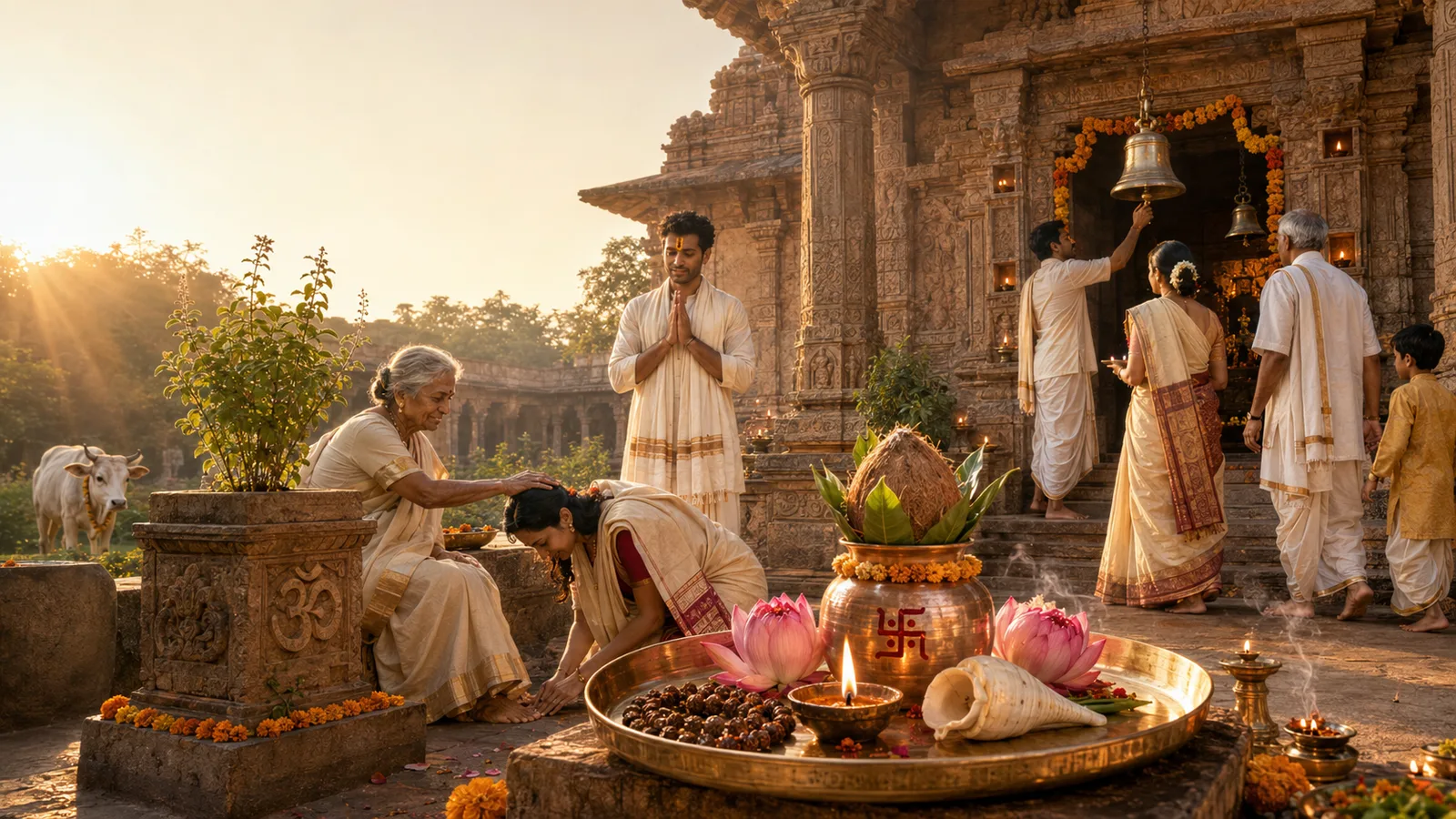
A glowing oil lamp, a bell at a temple entrance, folded hands in Namaste and a small mark on the forehead may appear simple from the outside. Within Hindu traditions, however, these familiar sights can carry layers of spiritual meaning. Hindu symbols often make philosophical ideas visible. Light can represent knowledge. A lotus can express purity and spiritual growth. Walking around a shrine can remind a devotee to place the Divine at the centre of life.
These symbols and traditions are not governed by one universal interpretation. Hinduism includes many philosophies, regional cultures, family customs and devotional lineages. A practice may therefore have one meaning in a Vaishnava temple, another in a Shaiva community and a more cultural meaning in an ordinary household. This guide explains 15 widely recognised Hindu symbols and traditions while respecting that their meanings and uses can differ among communities.
Important context: Hinduism is internally diverse. Not every Hindu follows every tradition described here, and no single explanation represents all Hindu communities.
Hindu Symbols and Traditions at a Glance
As stated in the Bhagavad Gita (5.10) regarding the lotus symbol:
"Brahmany ādhāya karmāṇi saṅgaṁ tyaktvā karoti yaḥ | Lipyate na sa pāpena padma-patram ivāmbhasā ||"
"One who performs duty without attachment, surrendering results to the Supreme, is untouched by sin, just as a lotus leaf is untouched by water."
┌─────────────────────────────────────────────────────────┐
│               METAPHYSICAL ROLE OF SYMBOLS              │
└────────────────────────────┬────────────────────────────┘
                             │
            ┌────────────────┴────────────────┐
            ▼                                 ▼
┌───────────────────────┐         ┌───────────────────────┐
│ UNMANIFEST REALITY    │         │ VISIBLE SACRED SYMBOL │
│ • Infinite Brahman    │────►    │ • Om, Diya, Lotus     │
│ • Unseen Energy       │         │ • Murti, Trishula     │
└───────────────────────┘         └───────────────────────┘
                                              │
                                              ▼
┌───────────────────────┐         ┌───────────────────────┐
│ DAILY SPIRITUAL LIFE  │         │ HUMAN MIND & INTELLECT│
│ • Reverence & Peace   │◄────    │ • Focus & Devotion    │
│ • Ethical Alignment   │         │ • Meditative Anchor   │
└───────────────────────┘         └───────────────────────┘
The 15 symbols and practices covered in this guide are:
- Om
- Swastika
- Lotus
- Tilak
- Bindi
- Kalash
- Diya
- Conch
- Rudraksha
- Tulsi
- Temple bells
- Touching elders' feet
- Namaste
- The sacred cow
- Pradakshina
1. Om: The Sacred Sound of Hinduism
The Om symbol, written as ॐ, represents one of the most sacred sounds in Hindu tradition. Om is more than a decorative symbol or a word associated with yoga. It is a sacred syllable used in prayer, meditation, mantra recitation, ritual worship and the study of spiritual texts. It may be chanted by itself or placed at the beginning of mantras such as Om Namah Shivaya and Om Namo Narayanaya.
The Mandukya Upanishad presents Om as a profound symbol of consciousness and ultimate reality. Its sounds — often explained as A, U and M — have received different interpretations across Hindu schools. They may represent states of consciousness, stages of existence or the relationship between the individual self and Brahman, the ultimate reality. For many practitioners, chanting Om helps mark the transition from ordinary activity to prayerful awareness.
Om should therefore be understood as both:
- a sacred sound that is chanted;
- and a visual symbol representing spiritual reality.
Harvard University's Center for the Study of World Religions describes Om as a sacred syllable used across ritual, meditation, worship and prayer, with meanings that have developed across Vedic and later Hindu traditions.
What does the Om symbol mean?
In its broadest sense, Om represents the sacred, the totality of existence and the underlying reality connecting life and consciousness. Its exact philosophical meaning depends on the tradition interpreting it.
2. Swastika: An Ancient Hindu Symbol of Auspiciousness
The swastika is an ancient sacred symbol found in Hinduism, Buddhism, Jainism and several other cultures. Its name comes from the Sanskrit word svasti, associated with well-being, good fortune and auspiciousness. In Hindu homes and ceremonies, the symbol may be drawn near an entrance, on a kalash, in a place of worship or at the beginning of an important undertaking. It may be created with kumkum, turmeric, sandalwood paste, rice flour or flower petals. It is also used during festivals, weddings, house blessings and business openings.
In Hindu devotional settings, the swastika commonly represents ideas such as:
- auspicious beginnings;
- prosperity and well-being;
- stability and harmony;
- divine protection;
- the continuing movement of life;
- and the presence of sacred order.
The Hindu swastika and the Nazi emblem are not the same in meaning
The ancient Hindu swastika must be clearly distinguished from the symbol appropriated by the Nazi Party in twentieth-century Europe. The Nazi Party formally adopted a black hooked-cross emblem in 1920 and placed it prominently on a white circle against a red background. Through the crimes of Nazi Germany and the Holocaust, that emblem became associated with antisemitism, racial hatred and genocide.
The sacred Hindu swastika existed for thousands of years before Nazism and continues to be used by Hindu, Buddhist and Jain communities as a religious symbol. In many Hindu settings, the design is shown upright and may include four dots. The Nazi emblem was commonly rotated diagonally. However, orientation alone is not always a reliable test, because traditional forms vary and extremist imagery may also appear in different orientations. Cultural setting, colour, presentation and intended meaning must all be considered.
The United States Holocaust Memorial Museum confirms that the symbol was used by many cultures for thousands of years before Hitler made it central to the Nazi flag. The Anti-Defamation League also cautions that sacred Hindu, Buddhist and Jain uses should not automatically be treated as expressions of hate.
Respectful clarification: The Hindu swastika is an auspicious religious symbol. The Nazi emblem represents a twentieth-century ideology of hatred. Confusing the two erases both the swastika's ancient sacred history and the suffering caused by Nazism.
3. Lotus: Purity, Beauty and Spiritual Growth
The lotus grows from muddy water yet rises above the surface with clean and beautiful petals. This natural quality has made it a powerful symbol of spiritual development. In Hindu philosophy, the lotus commonly represents:
- purity in an imperfect world;
- spiritual awakening;
- beauty arising from difficulty;
- detachment from selfish desire;
- divine creation;
- and the unfolding of consciousness.
Several Hindu deities are depicted standing, sitting or being born upon a lotus. Goddess Lakshmi is frequently shown on a blooming lotus, connecting the flower with prosperity, grace and spiritual abundance. Brahma is traditionally depicted emerging from a lotus associated with Vishnu. The lotus is also an important philosophical metaphor. Bhagavad Gita 5.10 compares a person who acts without attachment to a lotus leaf that remains untouched by water.
The message is not that spiritual life requires escaping the world. It teaches that a person can live, work and serve within the world without being inwardly controlled by greed, ego or attachment.
What does the lotus teach?
The lotus reminds devotees that their surroundings do not have to determine their inner character. Wisdom and compassion can grow even through difficulty.
4. Tilak: A Sacred Forehead Mark
A tilak is a sacred mark placed on the forehead or, in some traditions, on other parts of the body. Tilak may be applied during puja, after visiting a temple, before a ceremony or as part of a person's daily devotional practice. It can be made from sandalwood paste, sacred ash, clay, turmeric, kumkum or other ritually significant materials. The shape and material may indicate a particular devotional lineage.
Common examples include:
- Vaishnava tilak: Usually formed with vertical lines and associated with Vishnu or one of his avatars.
- Shaiva tripundra: Three horizontal lines, traditionally made with sacred ash and associated with Shiva.
- Shakta marks: Frequently use red kumkum and are connected with the worship of Devi.
- Ceremonial tilak: Applied to guests, family members or participants during festivals, weddings and blessings.
A tilak may represent devotion, spiritual identity, the blessing of a deity or a reminder to keep one's thoughts directed towards dharma. The exact form varies considerably between communities. It should not be assumed that all people wearing similar marks belong to the same sect. References on Hindu forehead markings note that tilak materials and designs vary among Vaishnava, Shaiva, Shakta and other traditions.
5. Bindi: Cultural Identity, Beauty and Sacred Awareness
A bindi is usually a small dot or decorative mark placed between or slightly above the eyebrows. The word is related to the Sanskrit bindu, meaning a point, dot or drop. In philosophical and yogic symbolism, this central point may be associated with concentration, insight and inward awareness. Historically, the bindi has carried religious, social and cultural meanings. Today it may be worn:
- as a devotional mark;
- as part of traditional clothing;
- as a symbol of cultural identity;
- during festivals and ceremonies;
- or simply as an item of personal adornment.
What is the difference between a tilak and a bindi?
A tilak is generally a ritual or devotional mark made from substances such as sandalwood, ash, clay or kumkum. Its shape may identify a religious lineage or mark the receipt of a blessing. A bindi is usually a dot or decorative mark worn primarily on the forehead. Modern bindis may be made from kumkum or supplied as reusable decorative stickers. The distinction is not absolute. Regional practices overlap, and some people use the terms differently.
A red bindi is sometimes associated with marriage, but this is not universal. Bindis are worn by married and unmarried women, and their meaning can be religious, cultural, fashionable or a combination of these.
6. Kalash: The Sacred Vessel of Life and Abundance
A kalash, also called kalasha, kumbha or purna kalasha, is a sacred vessel used in Hindu rituals. It is commonly made from copper, brass, silver or clay. During a ceremony, it may be filled with water and decorated with mango leaves, a coconut, sacred thread, flowers or a swastika. The completed arrangement is often treated as a sign of divine presence and auspiciousness. The kalash may symbolise:
- the source of life;
- abundance and fertility;
- purity;
- hospitality;
- the universe as a sacred vessel;
- and the presence of divine energy.
A kalash may be placed at the beginning of a puja, wedding, housewarming, festival or temple ceremony. In some rituals, a deity is ceremonially invoked into the vessel for the duration of the worship. The term purna kalasha means a full or complete vessel, reinforcing its connection with fullness, nourishment and prosperity.
7. Diya: The Light of Knowledge
A diya is a small lamp traditionally made from clay, brass or another metal. It usually contains oil or ghee and a cotton wick. Diyas are lit in home shrines, temples, ceremonies and festivals. During aarti, a flame may be moved before a deity as an offering of light. The diya commonly symbolises:
- knowledge overcoming ignorance;
- hope overcoming despair;
- goodness overcoming harmful action;
- spiritual awareness;
- and the presence of the sacred.
Lighting a diya can also create a deliberate pause. The person lighting it leaves ordinary activity behind and enters a space of prayer, gratitude or reflection. During Diwali, rows of lamps illuminate homes, temples and public spaces. Although Diwali traditions differ across regions, the light broadly communicates renewal, hope and the triumph of dharma. Academic descriptions of Hindu worship identify the oil-lamp offering, or aarti, as an important act in which light is offered before the deity.
8. Conch: The Sacred Sound of the Shankha
The Hindu conch shell is called a shankha. It is blown during worship, aarti, festivals and important ceremonies. Its powerful sound may announce the beginning of a ritual, gather the attention of worshippers and mark the space as sacred. The conch is particularly associated with Lord Vishnu, who is often depicted holding a shankha along with the discus, mace and lotus. In the Mahabharata and Bhagavad Gita, warriors blow their individual conches before the Kurukshetra battle. Krishna's conch is named Panchajanya, while Arjuna's is called Devadatta.
The conch can represent:
- sacred sound;
- divine authority;
- courage;
- awakening;
- the beginning of purposeful action;
- and the call of dharma.
Conches may also be used as ritual vessels for offering water. The Metropolitan Museum of Art identifies the conch-shell trumpet and discus as major attributes used to recognise Vishnu in Hindu art.
9. Rudraksha: Prayer Beads Associated With Shiva
Rudraksha commonly refers to the dried seed of trees belonging to the Elaeocarpus genus.
The beads are strongly associated with Lord Shiva and are used in malas for prayer, mantra repetition and meditation. Devotees may wear rudraksha around the neck or wrist, or use a mala to count repetitions of a mantra such as Om Namah Shivaya. The Sanskrit name is traditionally interpreted as the "eye of Rudra," Rudra being a Vedic name associated with Shiva.
A rudraksha bead has natural divisions known as mukhis, or faces. Different numbers of mukhis have received different ritual and devotional interpretations. The central spiritual purpose of rudraksha is not decoration or the pursuit of supernatural power. For many devotees, the beads represent:
- remembrance of Shiva;
- discipline in spiritual practice;
- simplicity;
- renunciation;
- and continuous awareness of the Divine.
Claims that particular beads can cure diseases or guarantee wealth should not be presented as established medical or scientific facts. Their primary significance is religious and devotional. Rudraksha seeds have a documented history as Hindu prayer beads, especially within Shaiva traditions.
10. Tulsi: The Sacred Plant of Devotion
Tulsi, also called Tulasi or holy basil, is one of the most revered plants in Hindu households.
The plant is especially important in Vaishnava traditions and is associated with Vishnu, Krishna and the goddess Tulasi or Vrinda. Tulsi leaves may be offered during worship, and many homes maintain a Tulsi plant in a courtyard, garden or specially constructed planter. Tulsi represents:
- purity;
- devotion;
- loving service;
- household spirituality;
- protection and care for life;
- and the presence of sacred nature within the home.
Devotees may water the plant, light a lamp nearby, offer prayers or walk around it as part of daily worship. Tulsi Vivaha is a ceremonial observance in which Tulsi is ritually united with Vishnu, often represented by Shaligram or another sacred form. Tulsi should not be reduced to a claim that keeping the plant automatically produces wealth, healing or "positive energy." Its deepest significance comes from devotion, sacred relationship and the integration of worship into daily life.
Traditional accounts identify Tulsi as a sacred plant closely connected with Vishnu worship and cultivated for religious purposes.
11. Why Do Hindus Ring Temple Bells?
Many Hindu temples have a bell, or ghanta, near the entrance or within the worship area. A devotee may ring it before approaching the shrine. Bells are also sounded during aarti and other temple ceremonies. The bell serves several practical and spiritual purposes:
- it announces the devotee's arrival;
- it marks the beginning of worship;
- it gathers the mind's attention;
- it helps separate sacred time from ordinary activity;
- and it contributes to the soundscape of the ritual.
In common devotional interpretation, ringing the bell is also understood as inviting auspiciousness and directing the mind towards the deity. Some online explanations make exact scientific claims about bell frequencies, brain hemispheres, chakras or the destruction of harmful microorganisms. These claims should not be repeated as proven facts unless supported by reliable scientific research. The clearest explanation is also the most meaningful: the sound asks the worshipper to become fully present.
Traditional descriptions of temple-bell practice connect the bell with the beginning of worship, the invocation of divine presence and focused devotional attention.
12. Why Do Hindus Touch Elders' Feet?
The practice of touching the feet of parents, grandparents, teachers, spiritual guides and respected elders is known as charan sparsh or pranama. A younger person may bend down to touch an elder's feet during:
- festivals;
- weddings;
- birthdays;
- family gatherings;
- the beginning of a journey;
- before an examination or important undertaking;
- or after a long period of separation.
The elder commonly responds by placing a hand on the younger person's head or offering words of blessing. The gesture represents:
- humility;
- respect;
- gratitude;
- acknowledgement of experience;
- and a request for blessings.
Touching feet should ideally be a voluntary expression of respect, not a demand for unquestioning obedience. Hindu teachings also place moral responsibilities on elders, parents and teachers. Respect is meaningful when accompanied by wisdom, compassion and good conduct. Contemporary discussions of charan sparsh consistently describe the gesture as an expression of humility, gratitude and respect for an elder's experience and guidance.
13. Namaste: "I Bow to You"
Namaste is a respectful greeting traditionally accompanied by a slight bow and the joining of both palms.
The hand gesture is known as anjali mudra. Related greetings include namaskar, namaskaram and regional variations used throughout India and neighbouring cultures. The word is formed from Sanskrit elements commonly explained as:
- namas — bow, reverence or respectful salutation;
- te — to you.
Its direct sense is therefore "I bow to you" or "salutations to you." Namaste can express:
- respect;
- welcome;
- gratitude;
- humility;
- and recognition of another person's dignity.
The popular translation "the Divine in me bows to the Divine in you" is a beautiful spiritual interpretation, but it is not the most literal grammatical translation. Namaste is used differently across regions. It may be formal, devotional or part of everyday etiquette. It is not exclusively a closing phrase for modern yoga classes. Historical and linguistic descriptions identify Namaste as a reverential salutation accompanied by anjali mudra, with the basic meaning of bowing or offering respect to another person.
14. Why Are Cows Sacred in Hinduism?
The statement that "Hindus worship cows" is an oversimplification. Many Hindus revere the cow as a symbol of nourishment, motherhood, gentleness, generosity and nonviolence. The cow is often respectfully called Gau Mata, meaning Mother Cow. Cattle were historically important to agricultural and household life. They provided milk, curd, ghee, labour and materials used in traditional rural communities and rituals. This life-supporting role contributed to the cow's association with care and abundance.
Cows are also connected with several Hindu deities and sacred stories:
- Krishna is remembered as a cowherd in Vrindavan.
- Shiva is accompanied by Nandi, the sacred bull.
- Kamadhenu is described as a divine cow of abundance.
- Cow protection is frequently associated with ahimsa, the principle of non-harm.
Some Hindus perform puja involving cows, particularly during festivals such as Govardhan Puja or Gopashtami. Others express reverence by feeding, caring for or protecting them. Practices and dietary customs differ among Hindu communities, regions and individuals. It is therefore more accurate to say that cows hold a highly respected and sacred position in many Hindu traditions than to claim that every Hindu worships cows in the same manner.
Oxford Reference notes that cattle and their products were associated with wealth and religious life from early periods in India. Academic discussions also connect cow reverence with motherhood, agrarian fertility and nonviolence.
15. Pradakshina: Walking Around the Sacred
Pradakshina is the practice of walking around a deity, shrine, temple, sacred plant, fire, mountain or another revered object.
It is normally performed clockwise so that the sacred centre remains on the devotee's right side. Pradakshina may be performed:
- after viewing a deity;
- during a temple visit;
- around a Tulsi plant;
- around a sacred fire during a wedding;
- around a holy mountain;
- or as part of a vow or pilgrimage.
The practice transforms physical movement into prayer. Symbolically, the devotee is no longer treating the personal ego as the centre of existence. The Divine, dharma or sacred reality is placed at the centre, while the individual moves around it with humility. Pradakshina may also encourage mindfulness. Each step can be accompanied by a mantra, prayer or silent remembrance. The number of circumambulations varies according to the deity, temple, region and purpose of the ritual. Visitors should follow local temple customs rather than assuming that one number applies everywhere.
Descriptions of pradakshina identify it as clockwise circumambulation in which the sacred object remains on the worshipper's right as an expression of reverence.
What Do Hindu Symbols Have in Common?
Although these symbols appear very different, several shared ideas connect them.
They turn spiritual ideas into daily actions
A diya makes the movement from ignorance to knowledge visible. Namaste turns respect into a physical gesture. Pradakshina expresses devotion through walking.
They engage the senses
Hindu worship frequently involves sight, sound, fragrance, touch and movement:
- the light of a diya;
- the sound of a bell or conch;
- the fragrance of incense and sandalwood;
- the touch of sacred ash or tilak;
- and the movement of pradakshina.
This makes worship an embodied practice rather than a purely intellectual exercise.
They connect home, temple and nature
A kalash may be placed in a home. Tulsi may grow in a courtyard. The lotus and cow connect spiritual thought with the natural world. Sacred life is therefore not limited to the interior of a temple.
They encourage remembrance
A rudraksha mala, forehead tilak or image of Om can remind a devotee to return to prayer, self-discipline and dharma throughout the day.
Understanding Hindu Traditions With Respect
Hindu symbols are not simply decorative objects. They are part of living traditions that connect philosophy, devotion, family life, community and the natural world. Om invites the mind towards sacred awareness. The lotus teaches purity without withdrawal from life. The diya makes knowledge visible as light. Namaste transforms respect into a gesture. Pradakshina places the Divine at the centre of movement.
Even familiar traditions can have different meanings in different communities. The most respectful approach is therefore to learn both the broad symbolism and the local context. When understood carefully, Hindu symbols reveal a central insight of Sanatana Dharma: ordinary actions, natural objects and daily relationships can become pathways to spiritual remembrance.
Exploring Related Sacred Wisdom
- Hindu Scriptures Explained: Vedas, Gita & Puranas: Understanding the foundational texts of Indian wisdom.
- How to Perform Hindu Puja at Home: Step-by-step beginner's guide to daily worship and offerings.
- Sanatan Dharma: The Eternal Truth: The timeless cosmic order and spiritual philosophy.
- Lord Shiva's Symbols & Metaphysical Meaning: Understanding Shiva's trident, crescent moon, and third eye.
- Search Scriptures, Gurus & Sacred Texts: Search our complete interactive wisdom database.