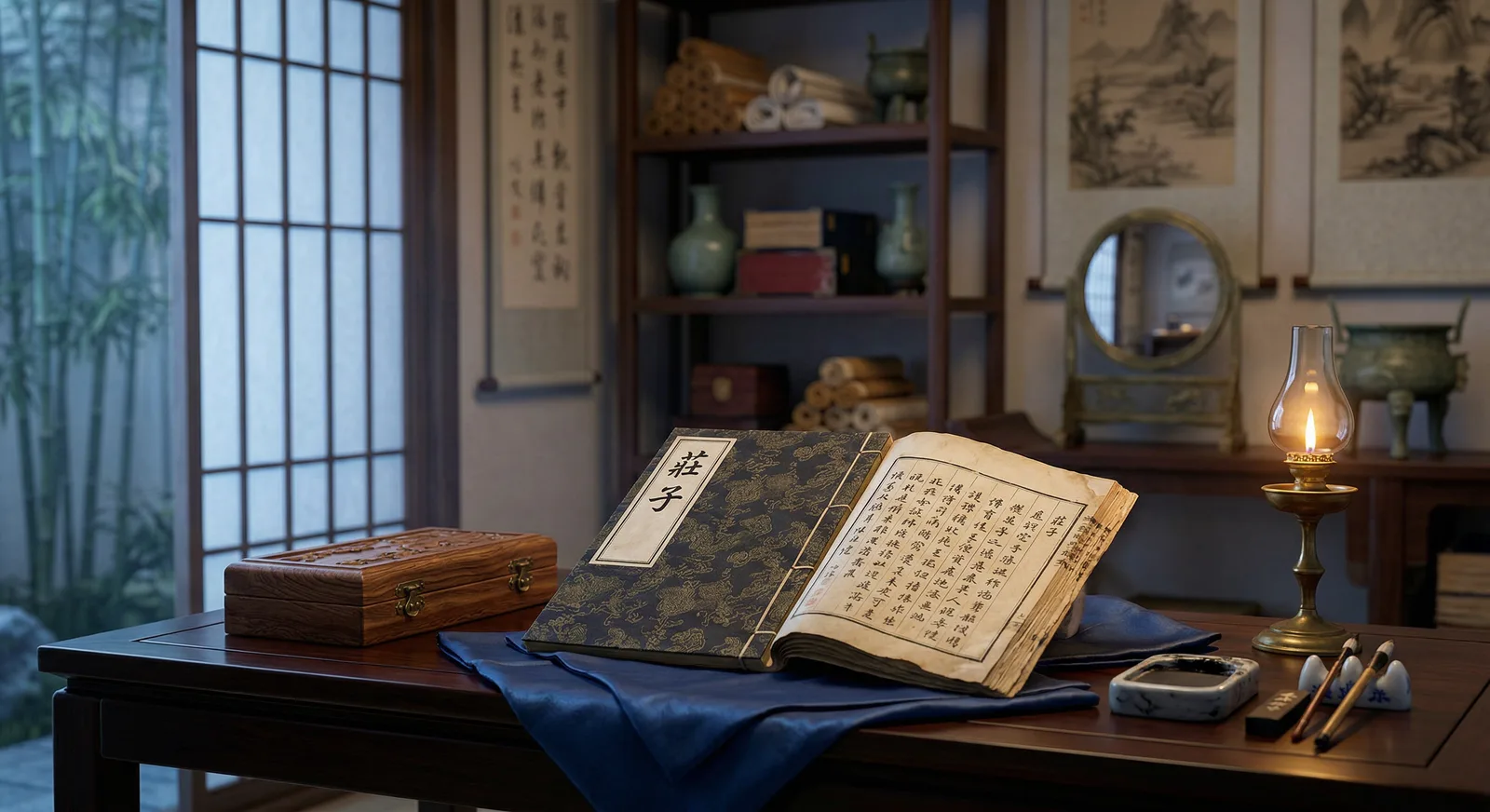
Zhuangzi
The Daoist Classic of Freedom—Spontaneity, Perspective, and Living Beyond Rigidity
“Once Zhuang Zhou dreamed he was a butterfly...”
About Zhuangzi
The Zhuangzi is one of Daoism’s greatest classics, traditionally associated with Zhuang Zhou. Written in brilliant parables, dialogues, and playful philosophical stories, it loosens rigid thinking and invites a more spacious life aligned with the Dao. The Zhuangzi teaches that many of our sufferings come from clinging to fixed identities, narrow viewpoints, and the urge to control reality. Its medicine is perspective: see the limits of certainty, soften judgment, embrace spontaneity (ziran), and live with lightness. This book is less a rulebook and more a liberating mirror—turning conflict into curiosity and forcing into flow.
Capabilities
Explain the Zhuangzi in plain language and summarize key stories (high-level)
Offer daily-life applications: stress, control, identity, conflict, and decision-making
Provide contemplation prompts for key chapters and themes
Help interpret paradox, humor, and metaphor without over-literal reading
Guide simple practices inspired by the text: stillness, ‘fasting the mind’, and perspective shifts
Support leadership coaching: light touch, non-coercive influence, and adaptive thinking
Help compare translations and clarify common Daoist terms (Dao, De/Te, wu-wei, ziran)
Offer short reading plans (7/14/30 days) with practical exercises
Spiritual Journey
Seeing the Cage of Certainty
You notice how fixed opinions and self-images create tension and conflict.
Laughing at the Self
The text uses playfulness to loosen ego—seriousness softens.
Fasting of the Mind
Inner noise quiets; perception widens; the urge to force lessens.
Living Beyond One View
You see multiple angles; judgment loosens; compassion becomes easier.
Ziran Emerges
Action becomes simpler and more fitting—less strain, more timing.
Lightness of Being
Identity becomes flexible; fear reduces; life feels wider.
Wu-Wei in Daily Life
Effort becomes efficient; conflict loses fuel; action arises from clear seeing.
Core Teachings
Perspective and Relativity
Many conflicts come from narrow viewpoints—widen perspective and certainty softens.
Ziran (Naturalness)
Return to what is natural and unforced—spontaneity without chaos.
Wu-Wei (Non-Coercive Action)
Act without forcing—move with conditions rather than fighting them.
Freedom from Rigid Identity
Loosen labels and fixed self-images—life becomes lighter and more flexible.
Non-Contending Mind
Stop needing to win—argument loses fuel when ego relaxes.
Fasting of the Mind
Quieting inner noise so perception becomes clear and action becomes effortless.
Sacred Practices
Story Contemplation
Read one parable and ask what rigidity it’s loosening—then practice one small release today.
Fasting of the Mind
5–10 minutes of quiet sitting to let opinions settle and perception open.
Perspective Switch
Write two opposing views of a situation and let certainty soften.
Non-Contention Speech
Avoid one argument today; choose humble clarity over winning.
Wu-Wei Task
Do one task with minimal force—right timing, fewest steps, relaxed effort.
Nature Alignment
Spend 10 minutes with sky, trees, or water—observe flow and non-striving.
Sacred Symbols
Butterfly
Fluid identity—self is not a fixed object; life is a shifting dream.
The Fish Trap
Words are tools, not truth—once you catch meaning, release the tool.
The Cook’s Knife
Skillful ease—moving with natural joints rather than forcing through resistance.
The Empty Boat
Ego dissolves conflict—without a ‘someone’ to blame, anger fades.
Wind Through Hollow Bamboo
Spontaneity—let life move through you without grasping.
The Great Clod
Nature’s vastness—humility before the Dao.
The Valley
Receptivity and lowliness—space that nourishes.
Lamp
Quiet clarity—seeing without forcing certainty.
Spiritual Exercises
7-Day Zhuangzi Starter Plan
7 days (10–20 minutes/day)Day 1: Read the butterfly dream and write one identity you cling to. Day 2: Fasting of the mind (10 minutes). Day 3: Non-contention day (avoid one argument). Day 4: Perspective switch—write two views of a conflict. Day 5: Wu-wei task—do one job with minimal force. Day 6: Nature alignment (10 minutes outdoors). Day 7: Review: 3 insights, 2 habits to refine, 1 weekly rhythm.
Fasting of the Mind (10 Minutes)
10 minutesSit quietly. Let thoughts arise and pass without following. When you grip an opinion, soften and return to breath.
Perspective Switch Journal
5–10 minutesWrite: ‘My view is…’ then ‘Another valid view could be…’ Let certainty soften.
Empty Boat Practice
2 minutes (as needed)When irritated, imagine the ‘boat’ that bumped you was empty. Let blame dissolve; respond calmly.
Cook’s Knife Skill
10 minutesIn one task, look for the ‘natural joint’—the easiest path. Stop forcing and work with the grain.
30-Day Lightness Track (Optional)
30 days (15–30 minutes/day)Week 1: daily parable + journaling. Week 2: fasting the mind 5–10 min/day. Week 3: non-contention speech + nature alignment. Week 4: integrate: wu-wei in work and relationships. End with a sustainable weekly rhythm.
Frequently Asked Questions
What is the Zhuangzi?
A foundational Daoist classic associated with Zhuang Zhou, teaching freedom through perspective, naturalness, and non-attachment to rigid views.
What is the ‘butterfly dream’ about?
It highlights fluid identity and the limits of certainty—inviting humility and spaciousness in how we define self and reality.
What does ‘fasting of the mind’ mean?
Quieting inner noise and opinion-clinging so perception becomes clear and action becomes unforced.
Is the Zhuangzi meant to be taken literally?
Often no. It teaches through parable, humor, and paradox—meant to loosen rigidity rather than present dogma.
How should a beginner start?
Read one short story a day, practice 5–10 minutes stillness, and apply one ‘softening’ principle to conflict or work.
How do I know I’m progressing?
Life-signs: less conflict fuel, less forcing, lighter identity, calmer speech, and more flexible, effective action.
Further Reading
- Tao Te Ching — Laozi (traditional attribution)book
- Liezi — Traditional attributionbook
- Zhuangzi (translation) — Trans. variousbook
- I Ching (Book of Changes) — Traditionalbook
- Intro to Zhuangzi (Overview Video)video

Related Sacred Texts
More from Dharmic



Begin Your Journey with Zhuangzi
Explore the wisdom and teachings through AI-powered conversations.
Start Your Transformation