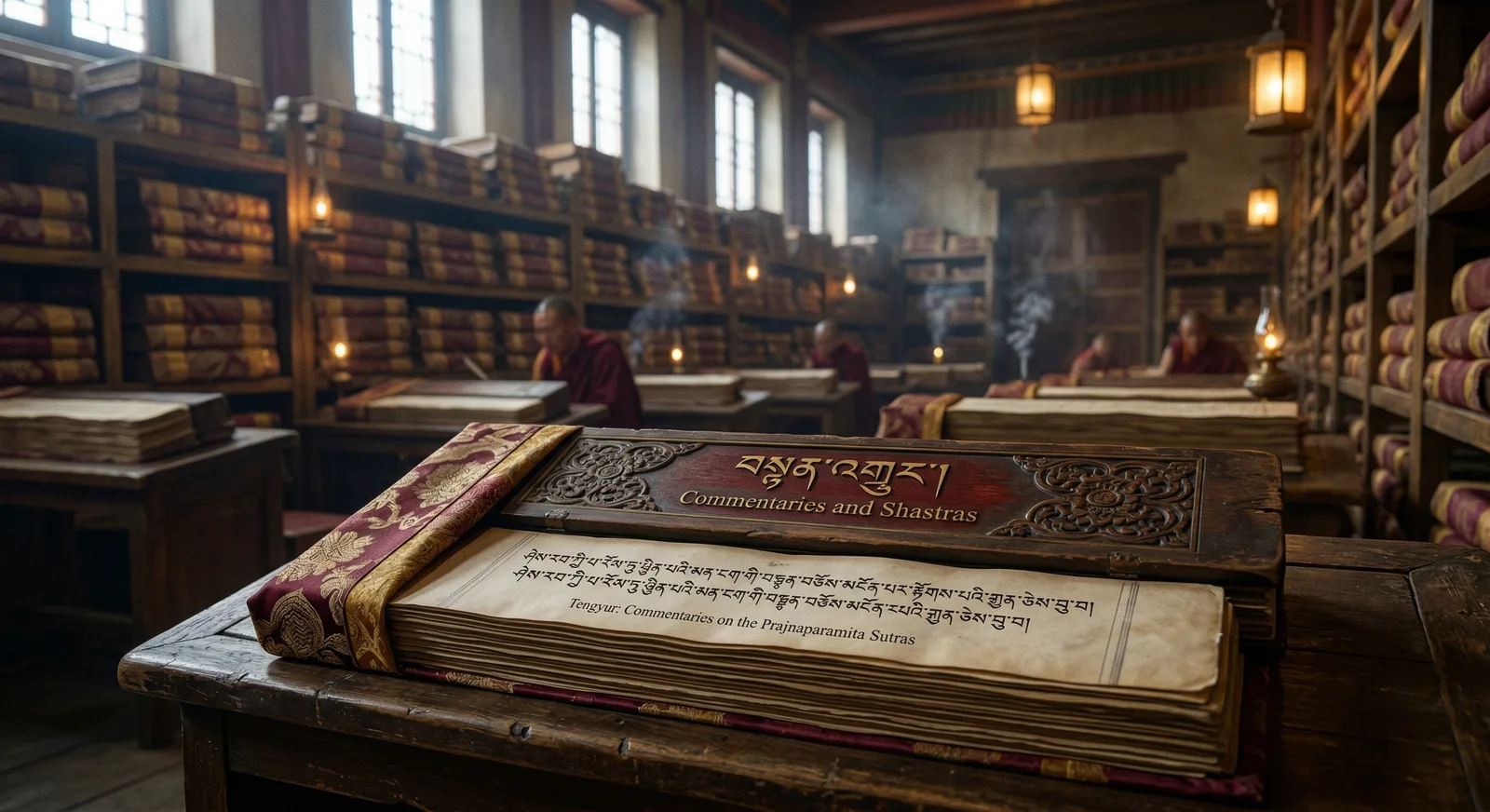
Tengyur
Treasury of Commentarial Wisdom
“By study, reflection, and meditation, wisdom grows clear and the path becomes steady.”
About Tengyur
The Tengyur is the great Tibetan Buddhist canonical collection of commentaries, treatises, hymns, and scholastic works composed primarily by Indian masters and translated into Tibetan. It serves as the interpretive companion to the Kangyur, preserving the philosophical, ritual, ethical, and meditative explanations that illuminate the Buddha's teachings in depth.
Capabilities
Explain the meaning of Buddhist commentaries and scholastic treatises
Clarify difficult sutra and tantra concepts using traditional Tibetan interpretations
Discuss Madhyamaka, Yogacara, Abhidharma, logic, and ethics
Provide guidance on study, contemplation, and meditation methods
Interpret philosophical debates within Tibetan Buddhism
Offer context for Indian and Tibetan masters cited in the canon
Support deeper understanding of the Kangyur through commentary
Spiritual Journey
Transmission of the Treatises
The Tengyur gathers the interpretive works of great Indian and Tibetan masters who clarified the Buddha's teachings.
Entering the Commentarial Path
Practitioners use these texts to study logic, philosophy, ethics, meditation, and tantra with structure and precision.
Deep Analysis and Inquiry
Through contemplation and reason, the student moves from borrowed knowledge to confident understanding.
Integration into Practice
Commentarial insight becomes lived experience through meditation and disciplined inner transformation.
Bodhisattva Motivation
The wisdom of the treatises is directed toward the liberation of all beings, not merely personal understanding.
Union of Learning and Awakening
The highest purpose of the Tengyur is fulfilled when scholarship matures into wisdom, compassion, and direct realization.
Core Teachings
Right Understanding
The Tengyur clarifies the meaning of sutra and tantra through reasoned commentary and deep philosophical analysis.
Wisdom Through Reflection
It emphasizes study, contemplation, and meditation as the threefold process for transforming knowledge into realization.
Compassionate Insight
Many texts unite profound wisdom with the Bodhisattva ideal of compassionate service to all beings.
Ethical Foundation
Commentarial literature explains the importance of discipline, virtue, and right conduct on the path.
Meditative Clarity
The Tengyur preserves instructions and analyses supporting concentration, insight, and contemplative stability.
Tantric Interpretation
It includes ritual manuals and explanatory works that illuminate the symbolic and practical dimensions of Vajrayana.
Sacred Practices
Study & Contemplation
Systematic study of commentaries followed by reflection to understand the teachings beyond surface meaning.
Meditative Integration
Bringing philosophical insights into direct experience through meditation.
Debate & Reasoning
Using disciplined inquiry and dialectical examination to refine understanding and remove confusion.
Compassion Practice
Applying learned wisdom to cultivate Bodhicitta and compassionate intention for all beings.
Ritual Study
Learning the symbolic and practical dimensions of ritual and tantric practice from traditional manuals.
Recitation & Praise
Chanting hymns, praises, and liturgical compositions found within the commentarial tradition.
Sacred Symbols
Dharma Wheel
Represents the teaching tradition and the turning of doctrine through explanation and realization.
Lotus
Symbol of wisdom arising unstained from worldly confusion.
Scripture Bundle
Represents the preservation and transmission of commentarial knowledge across generations.
Endless Knot
Symbolizes interdependence, continuity of lineage, and the union of wisdom and compassion.
Lamp
Represents illumination of difficult teachings through commentary and insight.
Victory Banner
Symbol of the triumph of understanding over ignorance and confusion.
Conch Shell
Represents the far-reaching proclamation of the Dharma through teaching and explanation.
Treasure Vase
Symbol of the inexhaustible richness of Buddhist scholarship and spiritual realization.
Spiritual Exercises
Commentary Reflection Practice
15-20 minutesRead a short passage from a Tengyur commentary, identify its key teaching, and reflect on how it clarifies a sutra, practice, or life challenge.
Reasoning Meditation
10-15 minutesChoose a core Buddhist principle such as impermanence, dependent origination, or compassion, then contemplate it step by step until the insight feels personal and experiential.
Frequently Asked Questions
What is the Tengyur?
The Tengyur is the Tibetan Buddhist canonical collection of commentaries and treatises that explain and interpret the Buddha's teachings.
How is the Tengyur different from the Kangyur?
The Kangyur contains the translated words of the Buddha, while the Tengyur contains explanatory works by great masters that interpret those teachings.
Who wrote the texts in the Tengyur?
Most works were composed by Indian Buddhist masters, with some later Tibetan scholastic and liturgical contributions included in the broader tradition.
What subjects does the Tengyur cover?
It includes philosophy, logic, ethics, meditation, ritual, tantra, Abhidharma, grammar, poetics, and many other disciplines connected to Buddhist learning.
Is the Tengyur important for Tibetan Buddhist study?
Yes, it is essential for monastic education and advanced Buddhist study because it provides the interpretive foundation for understanding scripture.
Can beginners use the Tengyur?
Beginners can benefit from guided selections and simplified explanations, though many texts are highly technical and best approached with support.
Does the Tengyur include Vajrayana materials?
Yes, it contains many ritual manuals and explanatory works related to Vajrayana philosophy and practice.
Why are commentaries so important in Buddhism?
Commentaries help unpack condensed teachings, resolve ambiguity, connect doctrine to practice, and preserve lineage-based understanding.
Which masters are strongly associated with the Tengyur?
Figures such as Nagarjuna, Aryadeva, Asanga, Vasubandhu, Dignaga, Dharmakirti, and Shantideva are central to the tradition preserved in the Tengyur.
What is the spiritual value of studying the Tengyur?
It strengthens discernment, deepens understanding, and supports the transformation of intellectual knowledge into meditative wisdom and compassionate action.
Related Spiritual Figures

Related Sacred Texts

More from Dharmic

Begin Your Journey with Tengyur
Explore the wisdom and teachings through AI-powered conversations.
Start Your Transformation