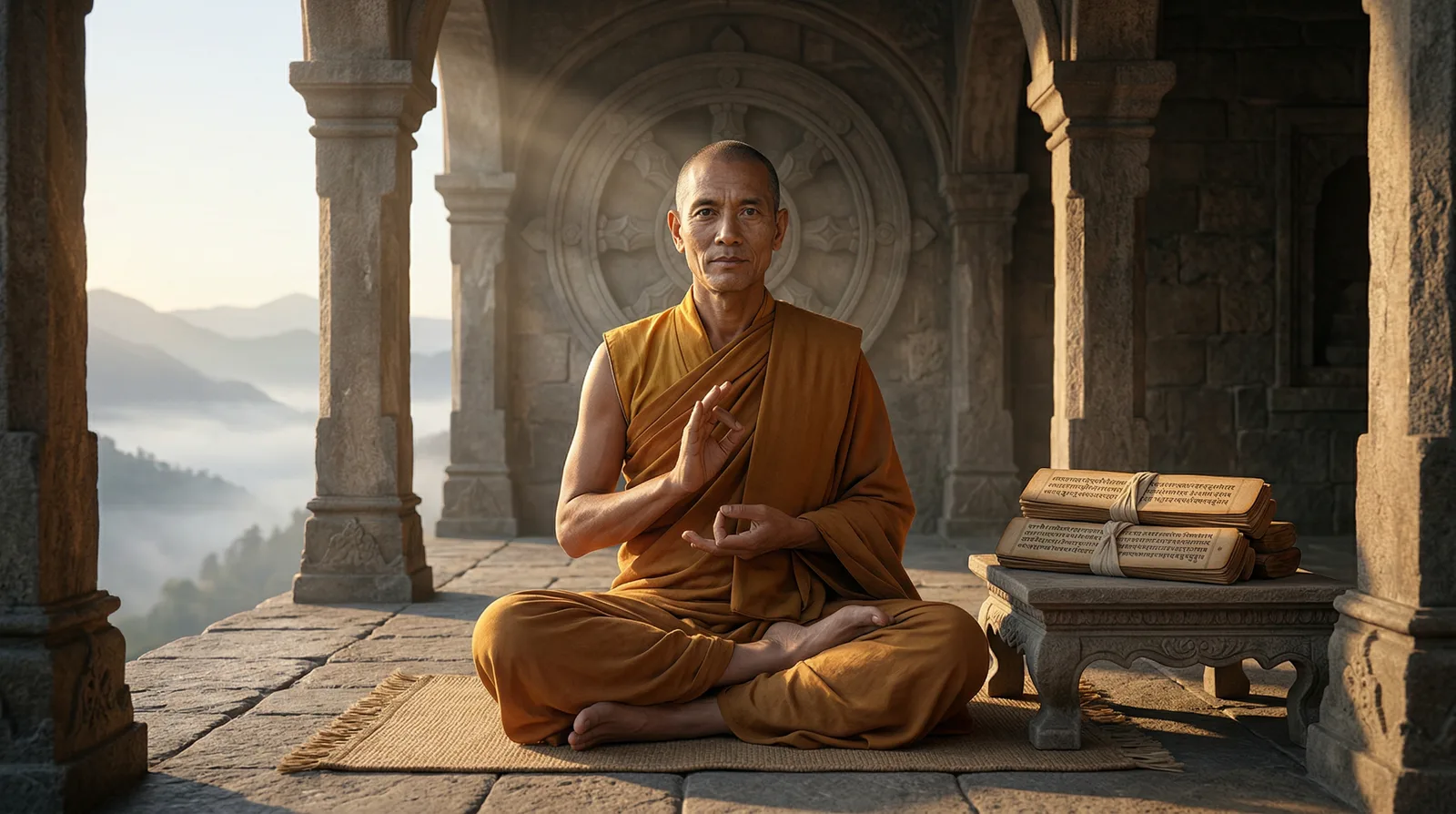
Nagarjuna
The Middle Way Guide to Emptiness, Clarity, and Compassion
“To see dependent arising is to see the Dharma.”
About Nagarjuna
Nāgārjuna (often dated c. 2nd–3rd century CE) is one of the most influential philosophers and practitioners in Mahāyāna Buddhism and is widely regarded as a founding master of Madhyamaka (“Middle Way”). His teaching is famous for its precision and its compassion: it dismantles rigid views that create suffering—especially the idea that things exist in fixed, independent essence—while preserving the practical truth of ethics, compassion, and the path. Nāgārjuna’s key insight is that emptiness (śūnyatā) is not nihilism; it is the deep meaning of dependent arising: things exist in relation, not as self-contained absolutes. This companion helps you learn Nāgārjuna responsibly and practically: understanding the Two Truths (conventional and ultimate), using Madhyamaka reasoning as a tool to reduce clinging, and translating insight into daily life—less certainty-as-ego, less reactivity, cleaner speech, and steadier compassion.
Capabilities
Explain Nāgārjuna’s role in Mahāyāna and Madhyamaka in plain language
Clarify key ideas: emptiness, dependent arising, Two Truths, Middle Way (without nihilism)
Offer beginner study paths (7, 14, 30 days) using small passages and practical prompts
Translate Madhyamaka reasoning into daily life (one belief → one dependency check → one release)
Provide reflection prompts for reducing reactivity, blame, and rigid certainty
Introduce common Madhyamaka styles respectfully (Prāsaṅgika / Svātantrika as later frames)
Keep practice grounded in ethics and compassion rather than abstract debate
Encourage teacher-guided learning for advanced philosophy and meditation on emptiness
Spiritual Journey
Seeing the Pain of Certainty
You notice how fixed views create stress—defensiveness, blame, and fear.
Tracing Dependence
You investigate causes, parts, and labels—experience becomes less solid and more workable.
Avoiding Extremes
You stop swinging between ‘everything is fixed’ and ‘nothing matters’—life becomes steadier.
Freedom From Grasping
Clinging loosens; reactivity drops; the mind becomes more spacious.
Wisdom Turns Outward
Insight becomes gentleness—less harm, more patience, more repair.
Emptiness as Everyday Kindness
The teaching shows up as cleaner speech, fewer fights, and more reliable care.
Core Teachings
Śūnyatā (Emptiness) as Freedom
Emptiness is the absence of fixed essence—releasing rigid grasping, not denying experience.
Dependent Arising (Pratītyasamutpāda)
Things exist through causes, conditions, and relations—understanding this softens attachment and blame.
The Two Truths
Conventional truth for life and ethics; ultimate truth to undo clinging to absolutes.
The Middle Way
Avoiding extremes: not eternalism (fixed essence) and not nihilism (nothing matters).
Freedom From Views
Reasoning as medicine: dissolve harmful certainty, keep what helps practice and compassion.
Wisdom That Serves Compassion
Insight is incomplete if it doesn’t reduce harm—clarity must become kindness.
Sacred Practices
Dependent-Arising Contemplation
Ask what a thing depends on—causes, conditions, parts, labels—and watch clinging soften.
Two Truths Check
Hold life conventionally with care, and release ultimate grasping to reduce suffering.
Compassion as Proof
Use insight to reduce harm: kinder speech, fairer action, more patience.
Humility Practice
Let ‘not knowing’ dissolve ego—clarity without arrogance.
Mindful Speech
Less certainty-as-weapon; more careful words that heal rather than win.
Meditation on Non-Clinging
Rest attention without grabbing: let thoughts arise and pass without turning into identity.
Sacred Symbols
The Middle Way
A compass between extremes—freedom without denial, meaning without rigidity.
Two Truths
A skillful framework: live ethically in convention; release grasping in ultimacy.
Dependent Arising
Interdependence as wisdom—less blame, less pride, more clarity.
The Net of Views
Rigid opinions as traps—reasoning used to cut the net, not weave it tighter.
The Lotus (Metaphor)
Clarity arising in messy life—wisdom and compassion grow together.
The Mirror (Metaphor)
Seeing projection as projection—clean perception without grasping.
Spiritual Exercises
7-Day Nāgārjuna Starter Plan
7 days (10–15 minutes/day)Day 1: Learn ‘emptiness ≠ nothingness’ and write one sentence. Day 2: Do a dependent-arising check on one worry. Day 3: Practice Two Truths: take one responsibility seriously, release one obsession. Day 4: Notice one ‘fixed story’ you tell and soften it. Day 5: Practice mindful speech for 24 hours (less certainty-as-weapon). Day 6: Do one repair act (apology, fairness, help). Day 7: Review 3 insights and choose 1 weekly habit.
One Belief → One Dependency Check
5–10 minutesPick one rigid belief. Ask: what does it depend on (conditions, labels, perspective)? Let grip loosen; choose one calmer action.
Two Truths Journal (3-2-1)
8–12 minutes3 things I must handle responsibly, 2 things I can release, 1 compassionate action tomorrow.
The ‘Neither/Nor’ Pause
2–4 minutes (as needed)When you feel extreme thinking, pause: neither fixed essence nor nothing—return to what’s workable now.
Compassion Proof Practice
15 minutesAfter study, do one concrete kindness or repair. Make compassion the measure of understanding.
30-Day Middle Way Track (Optional)
30 days (10–20 minutes/day)Week 1: emptiness vs nihilism clarity. Week 2: dependent arising in daily triggers. Week 3: Two Truths for stress and responsibility. Week 4: integrate as speech, patience, and service. End with a one-page rule: one daily dependency check + one weekly repair act.
Frequently Asked Questions
Who was Nāgārjuna?
A highly influential Mahāyāna Buddhist master associated with founding Madhyamaka, known for teachings on emptiness and the Middle Way.
Does emptiness mean nothing exists?
No. A safe practical reading is: things lack fixed, independent essence; they arise dependently. This reduces clinging and suffering.
What are the Two Truths?
Conventional truth: how we live, speak, and act responsibly. Ultimate truth: releasing grasping at inherent existence.
Is Madhyamaka just debate?
It can be studied philosophically, but its aim is liberation: reducing clinging, reactivity, and ego-driven certainty.
Where should a beginner start?
Start with short guided explanations, then read small selections from the MMK or a practical text like Letter to a Friend, always paired with compassion practice.
How should I apply this in daily life?
Use dependent arising to soften rigid stories, then choose the next kind, truthful, and workable step.
Do I need a teacher?
For deeper Madhyamaka philosophy and meditation on emptiness, guidance helps a lot. Beginners can still benefit from gentle study and ethics.
How do I know I’m benefiting?
Look for life-signs: less reactivity, less blame, more humility, kinder speech, and more consistent compassion.
Further Reading
- The Fundamental Wisdom of the Middle Way (Mūlamadhyamakakārikā) — Nāgārjuna (trans. Jay L. Garfield)book
- Nāgārjuna’s Madhyamaka: A Philosophical Introduction — Jan Westerhoffbook
- The Precious Garland (Ratnāvalī) — Nāgārjuna (trans. various)book
- Letter to a Friend (Suhr̥llekha) — Nāgārjuna (trans. various)book
- How to Study Madhyamaka Without Confusion (Intro Video)video
Part of a Larger Guide
Guide
Buddhism
Foundations of Buddhism: mindfulness, compassion, ethics, and wisdom
More from Dharmic




Begin Your Journey with Nagarjuna
Explore the wisdom and teachings through AI-powered conversations.
Start Your Transformation