The Identity Crisis at the Heart of Modern Life
Modern life places constant pressure on personal branding, career titles, income, and social status. We often define our self-worth by these external roles.
When these roles change—through career shifts, aging, or relationship breakups—we face a deep identity crisis:
- "Who am I without my job title?"
- "Who am I without this relationship?"
- "Who am I when my external circumstances change?"
The ancient philosophy of Advaita Vedanta starts with this exact question: "Ko'ham?" (Who am I?)
Rather than asking for blind faith, Vedanta offers a practical method to investigate your mind and discover steady inner freedom.
Key Takeaways from Vedanta
- Atman is Brahman: Your true Self is pure witnessing awareness (Atman), connected with universal consciousness (Brahman).
- The 5 Koshas: Human identity has 5 layers. Self-inquiry clears these sheaths to reveal your peaceful core.
- Aham Brahmasmi: Realizing "I am pure consciousness" resolves imposter syndrome and insecurity at the root.
Atman & Brahman: The Core Insight of Non-Duality
Vedanta (literally "the end or fulfillment of the Vedas") culminates in Advaita (non-duality)—the realization that reality is not divided into fragmented parts, but is a single, unbroken ocean of consciousness.
                  ┌─────────────────────────────────────────┐
                  │             ADVAITA VEDANTA             │
                  │             (Non-Duality)               │
                  └────────────────────┬────────────────────┘
                                       │
                      ┌────────────────┴────────────────┐
                      │                                 │
             ┌────────▼────────┐               ┌────────▼────────┐
             │     ATMAN       │               │    BRAHMAN      │
             │(Individual Self)│ ═════════════ │ (Universal Self)│
             └─────────────────┘  IDENTICAL    └─────────────────┘
- Atman (आत्मन्): The true inner Self—the silent, unchanging witness (Sakshi) observing all thoughts, emotions, and sensations.
- Brahman (ब्रह्मन्): The infinite, formless ground of all existence, space, time, and matter.
Advaita Vedanta asserts that Atman is Brahman. The apparent separation between your individual awareness and the universe is an illusion (Maya), caused by taking temporary mental labels as permanent reality.
Sacred Texts & The Four Mahavakyas
The Upanishads summarize the ultimate Vedantic truth in Four Mahavakyas (Great Sayings):
| Mahavakya | Sanskrit | Scripture Source | Core Meaning |
|---|---|---|---|
| Aham Brahmasmi | अहम् ब्रह्मास्मि | Brihadaranyaka Upanishad 1.4.10 | "I am Brahman (Infinite Consciousness)." |
| Tat Tvam Asi | तत्त्वमसि | Chandogya Upanishad 6.8.7 | "That (Universal Reality) Thou Art." |
| Ayam Atma Brahma | अयमात्मा ब्रह्म | Mandukya Upanishad Verse 2 | "This Inner Self is Brahman." |
| Prajnanam Brahma | प्रज्ञानं ब्रह्म | Aitareya Upanishad 3.3 | "Pure Consciousness is Brahman." |
Adi Shankara's Nirvana Shatakam
In the 8th century CE, the great master Adi Shankara distilled the practice of dis-identification in his famous hymn Nirvana Shatakam:
"Mano-buddhy-ahaṅkāra chittāni nāhaṁ |
Na cha śrotrajihve na cha ghrāṇanetre ||
Chidānanda rūpaḥ śivo'ham śivo'ham ||"Translation:
"I am not the mind, nor the intellect, nor the ego, nor the memory storehouse;
I am not the ears, nor the tongue, nor the nose, nor the eyes.
I am pure awareness and bliss; I am Shiva, I am Shiva!"
The 5 Koshas: De-Constructing False Identity
The Taittiriya Upanishad maps human identity across 5 layers or sheaths (Koshas). Self-inquiry involves realizing that you are the observer of these sheaths, not the sheaths themselves:
  ┌───────────────────────────────────────────────────────────┐
  │                    THE 5 KOSHAS (Sheaths)                 │
  └─────────────────────────────┬─────────────────────────────┘
                                │
   1. Annamaya Kosha   ──► Physical Body (Food Sheath)
   2. Pranamaya Kosha  ──► Energy & Breath (Vital Sheath)
   3. Manomaya Kosha   ──► Mind & Emotions (Mental Sheath)
   4. Vijnanamaya Kosha──► Intellect & Ego (Wisdom Sheath)
   5. Anandamaya Kosha ──► Bliss & Subconscious (Bliss Sheath)
              │
              └──────► ATMAN (The True Witness Beyond All 5)
- Annamaya Kosha (Physical Sheath): Made of food and physical elements. You have a body, but you are not merely the body.
- Pranamaya Kosha (Vital Energy Sheath): Governs breath and metabolic energy. You observe energy rising and falling.
- Manomaya Kosha (Mental Sheath): Governs reactive thoughts and feelings. You watch thoughts arise and pass.
- Vijnanamaya Kosha (Intellectual Sheath): Governs decision-making and ego-identity. You observe your own beliefs.
- Anandamaya Kosha (Bliss Sheath): Deep unbroken peace experienced in deep sleep or meditation.
Beyond all five sheaths shines the Atman—the eternal witness.
Sri Ramana Maharshi & Atma Vichara (Self-Inquiry)
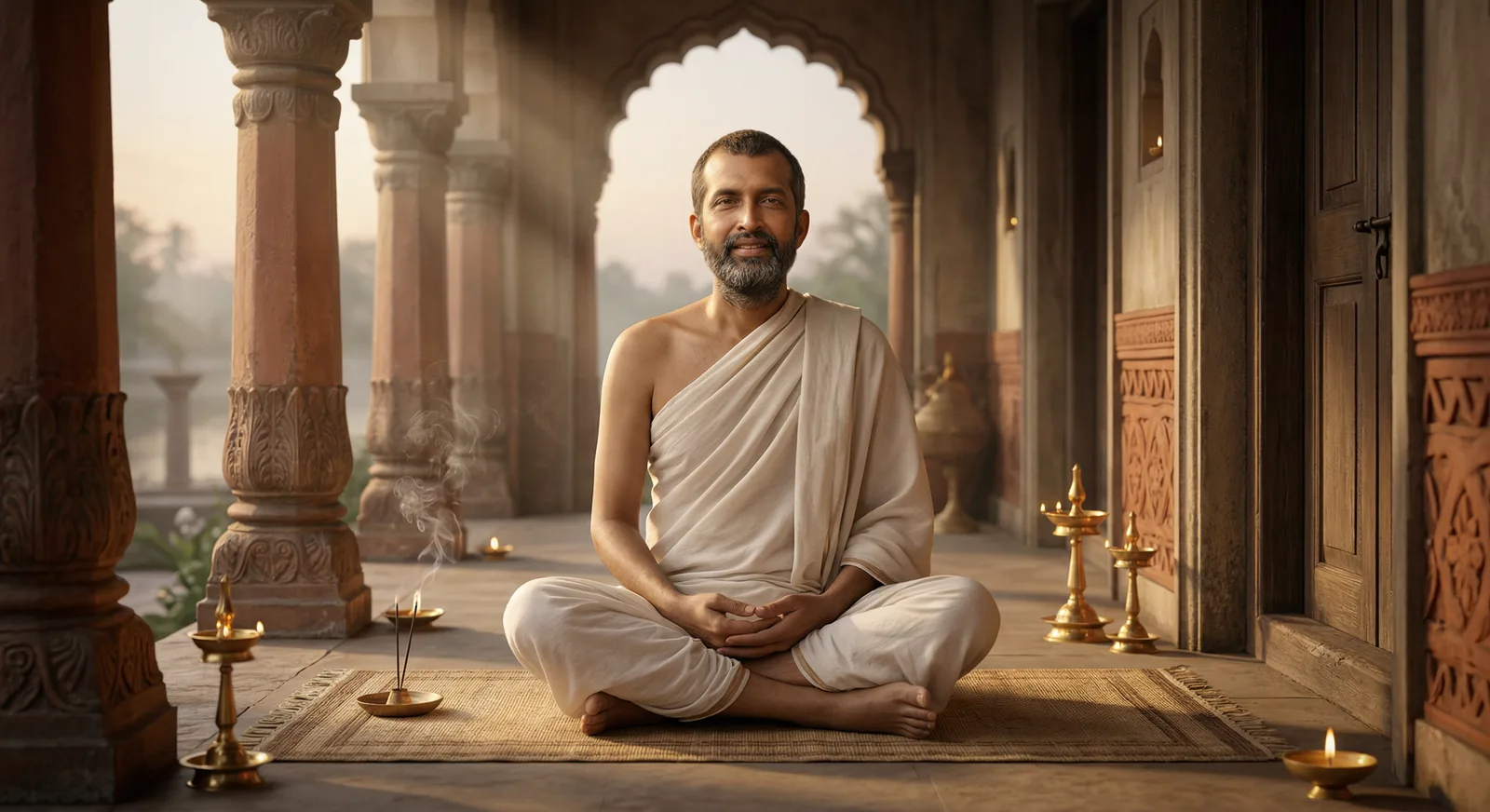
In the 20th century, the sage Sri Ramana Maharshi of Tiruvannamalai brought Vedanta back to its simplest, most direct application through Atma Vichara (Self-Inquiry).
In his seminal text Who Am I? (Nan Yar?), Ramana instructed seekers to trace every thought back to its origin:
[Thought or Emotion Arises] ──► Ask: "To whom does this thought arise?"
                                        │
                                        ▼
                                 "It arises to ME."
                                        │
                                        ▼
                                 Ask: "WHO AM I?"
                                        │
                                        ▼
                      [Mind Turns Inward to Source]
When you ask "Who am I?", you do not answer with words ("I am John, an engineer"). Instead, you hold attention on the feeling of "I AM" before any label is attached to it.
Gradually, the mind dissolves into its source, revealing unbroken peace.
3 Practical Self-Inquiry Disciplines for Daily Life
You can integrate Vedantic self-inquiry into your daily routine:
1. The "Neti Neti" (Not This, Not This) Exercise
Whenever you feel overwhelmed by a negative thought, body sensation, or criticism:
- Silently tell yourself: "Neti, Neti—I am aware of this thought, so I cannot BE this thought. I am the observer watching it."
- Notice the immediate space and emotional relief created between you and the reaction.
2. Ramana Maharshi's "To Whom?" Pause
Whenever anxiety or impatience strikes during your day:
- Pause and ask: "To whom has this anxiety come?"
- Answer: "To me."
- Follow up with: "Then who am I?" Turn your attention inward to the silent witness observing the anxiety.
3. Morning Meditation on the Four Mahavakyas
Integrate Aham Brahmasmi into your Vedic Meditation session. Sit in silence, repeat "Aham Brahmasmi" slowly with your breath, and rest in spacious, open awareness.
Interlinking & Deepening Your Knowledge
Explore how Advaita Vedanta connects to the rest of the wisdom library:
- Transcending the fear of death: The Upanishads on Death & Fear
- Acting in the world without ego: Karma Yoga: Selfless Action
- Calming overthinking: The Bhagavad Gita's Guide to Anxiety
- Foundational texts overview: Hindu Scriptures Explained
- Connecting with guides: Meet the Gurus
Conclusion: Awakening from the Dream of Separation
Advaita Vedanta's greatest message is that you do not need to "become" spiritual or manufacture peace. You are already the whole, complete, infinite consciousness you have been seeking.
When you stop mistaking the temporary wave for the ocean, your true nature shines forth.
Ready to deepen your self-inquiry practice? Start My Transformation and explore AI guidance trained on Vedanta and timeless world wisdom.