Why Everyone Is Talking About Meditation — And Why Most Miss the Point
Meditation has exploded into global culture. Guided meditation apps, corporate wellness retreats, biohacking podcasts, and scientific journals all promote its benefits. Science confirms what ancient meditators knew: regular meditation lowers serum cortisol, increases gray matter density in the prefrontal cortex, stimulates vagal tone, and calms an overactive default mode network (DMN).
Yet, despite its popularity, many people feel frustrated by their practice. They sit down, try to meditate, get bombarded by thoughts, and conclude: "I am just not good at meditation."
The ancient Vedic tradition that birthed meditation had a far more radical purpose than managing stress or relaxing after work.
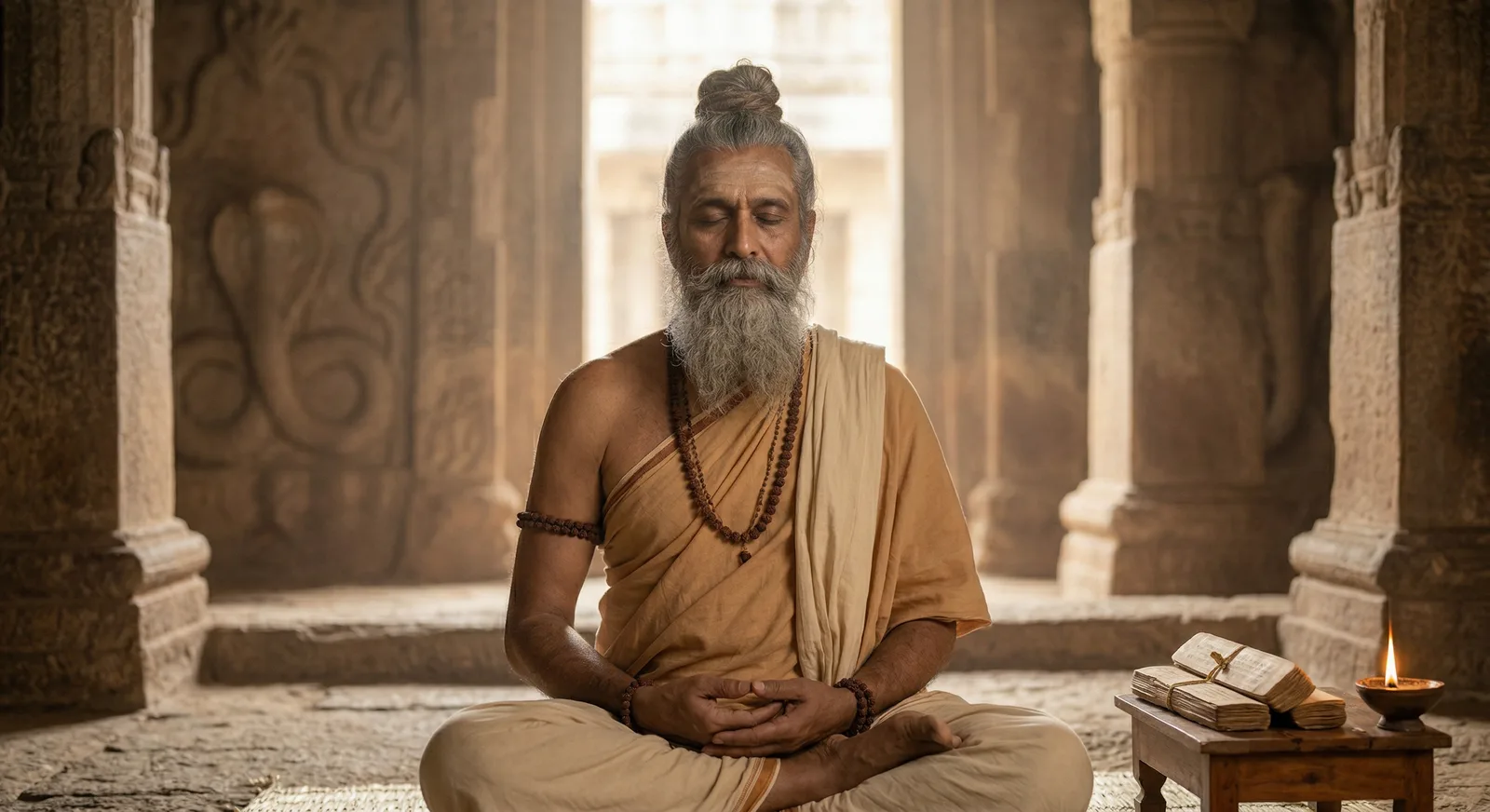
For the rishis (ancient seers) of Vedic India, meditation (Dhyana) was not a stress-fix technique—it was a precise, empirical science of human consciousness. It was designed to answer the ultimate existential question: Who am I? Not as a title, profession, or personality, but at the absolute root of awareness itself.
Key Takeaways from Vedic Meditation
- The 4 Layers of Mind: Understanding how your mind processes thoughts (Antahkarana) removes self-judgment during practice.
- Turiya (The 4th State): Meditation is not about forcing sleep or intense concentration, but uncovering the silent witness within.
- Mantra & Breath Synchrony: Utilizing classical tools like the So-Hum mantra anchors attention effortlessly without tension.
The Four Layers of Mind: Vedic Psychology (Antahkarana)
Long before modern neuroscience divided the brain into regions, the Upanishads and Patanjali mapped the internal apparatus of consciousness, known as the Antahkarana (अन्तःकरण - the inner instrument).
Vedic psychology divides mental function into four distinct layers:
  ┌───────────────────────────────────────────────────────────┐
  │                    ANTAHKARANA (Mind)                     │
  └─────────────────────────────┬─────────────────────────────┘
                                │
  ┌───────────────┬─────────────┴─────────────┬───────────────┐
  │               │                           │               │
┌─▼──────────┐ ┌──▼─────────┐           ┌─────▼─────┐   ┌─────▼─────┐
│   MANAS    │ │  BUDDHI    │           │ AHAMKARA  │   │  CHITTA   │
│ (Sensory)  │ │(Intellect) │           │   (Ego)   │   │(Storehouse│
└────────────┘ └────────────┘           └───────────┘   └───────────┘
- Manas (मनस् - The Sensory Mind): The surface level that processes sensory inputs (sights, sounds, touch) and generates rapid, reactive thoughts. When you feel distracted by ambient noise or racing thoughts, Manas is at work.
- Buddhi (बुद्धि - The Intellect): The higher faculty of judgment, discrimination, decision-making, and wisdom. Buddhi allows you to evaluate options and observe situations objectively.
- Ahamkara (अहंकार - The Ego / I-Maker): The identity matrix that claims ownership of thoughts: "This is MY fear," "This is MY success." It creates the illusion of a separate personal self.
- Chitta (चित्त - The Storehouse): The deep reservoir of subconscious memory, karmic impressions (Samskaras), and pure foundational awareness.
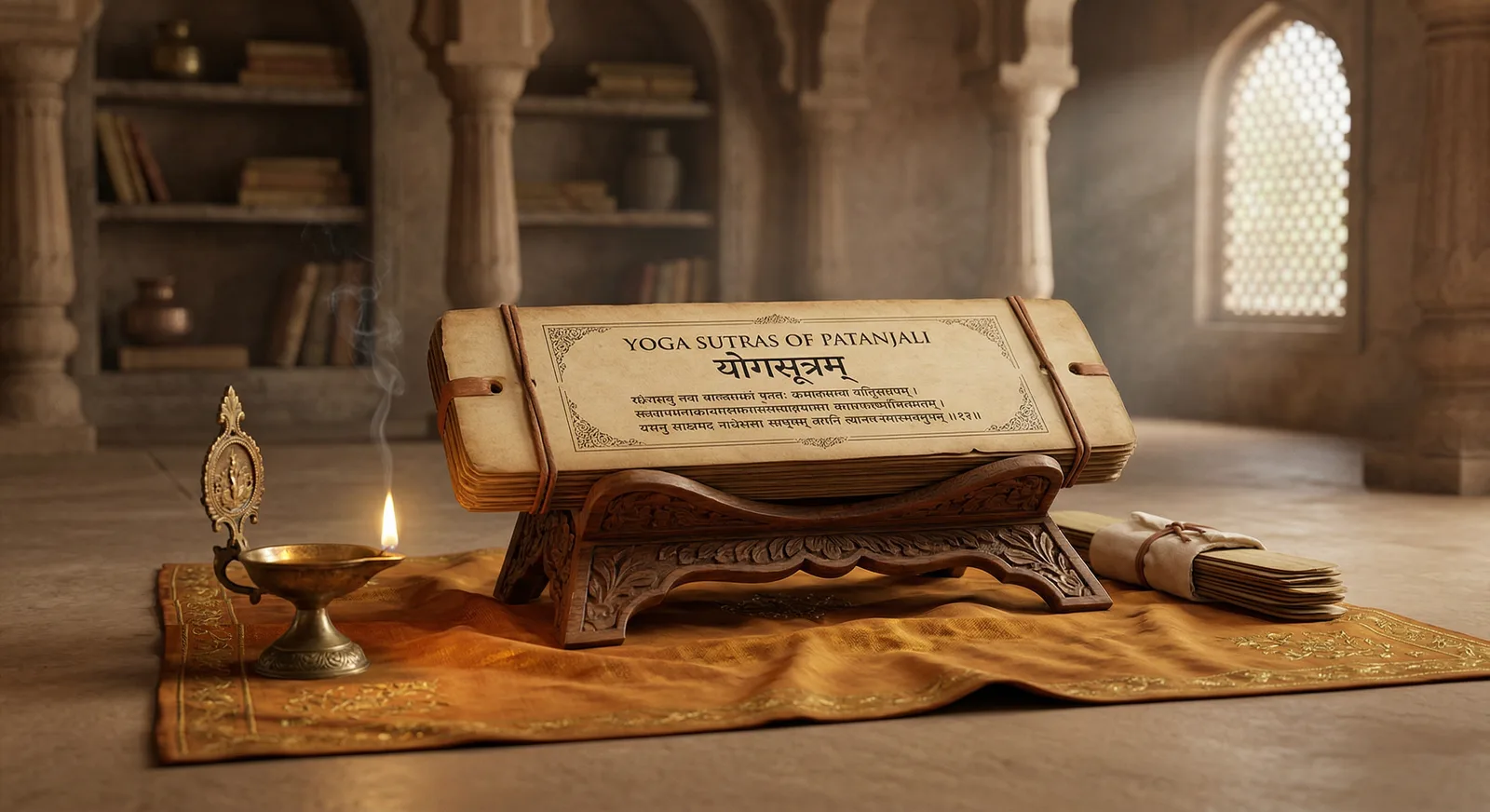
Most modern mindfulness apps focus only on soothing Manas—calming the surface waves. But Patanjali's Yoga Sutras (1.2) state the true goal of meditation:
"Yogas Chitta Vritti Nirodhah"
Translation: "Yoga is the intentional quietening of the fluctuations (Vrittis) of the mind-stuff (Chitta)."
When the waves of Chitta subside, the pure light of the true Self (Atman) reflects clearly, revealing what the Upanishads describe as Sat-Chit-Ananda (Pure Being, Pure Consciousness, Pure Bliss).
Sacred Texts & The Science of Consciousness
Vedic meditation is grounded in classical sacred texts:
Rigveda & The Gayatri Mantra
The Rigveda (3.62.10) contains the oldest recorded meditation chant in human history, the Gayatri Mantra:
"Om Bhur Bhuvaḥ Svaḥ | Tat Savitur Vareṇyaṁ | Bhargo Devasya Dhīmahi | Dhiyo Yo Naḥ Pracodayāt ||"
Meaning: "We meditate upon the radiant light of the Divine Sun of Consciousness; may that inspiring illumination awaken our higher intellect."
Ancient Vedic seers recognized that specific Sanskrit sound frequencies alter brainwave patterns, shifting the brain from high-beta stress frequencies to alpha and theta states conducive to deep insight.
Mandukya Upanishad & The Four States (Turiya)
The Mandukya Upanishad presents one of the most sophisticated maps of human consciousness ever written. It details four states of experience:
| State | Consciousness Realm | Description |
|---|---|---|
| Jagrat | Waking State | External sensory awareness focused on physical reality. |
| Svapna | Dreaming State | Internal subtle awareness focused on mental imagery and dreams. |
| Sushupti | Deep Sleep State | Causal unbroken rest without dreams or active thought. |
| Turiya | The Fourth State | Pure unbroken witness awareness underlying all three states. |
Turiya (तुरीय) is not a mystical trance state reserved for ascetics. It is the silent, effortless background of awareness present right now while you read these words. Meditation is simply learning to recognize and rest in Turiya.
For a deeper exploration of how Turiya relates to individual identity, see our guide on Vedanta & Self-Inquiry (Who Am I?).
Common Myth: "Meditation Means Emptying the Mind"
The single biggest obstacle beginners encounter is the belief that meditation requires forcing thoughts to stop.
The mind's job is to think. Trying to force the mind to stop thinking is like trying to force your heart to stop beating. The harder you fight your thoughts, the more power you give them.
Vedic meditation changes your relationship to thoughts through the practice of Sakshi Bhava (witnessing attitude):
FIGHTING THOUGHTS:
[Thought Arises] ──► (Resistance / Frustration) ──► [Agitated Mind]

VEDIC WITNESS PRACTICE:
[Thought Arises] ──► (Quiet Observation) ──► [Thought Dissolves Naturally]
You are not your thoughts; you are the space in which thoughts appear and disappear. Just as storm clouds pass through the sky without staining the blue background, thoughts pass through your awareness without touching the underlying peace of your true Self.
3 Step-by-Step Vedic Meditation Protocols
To build a consistent, authoritative practice, implement these three classic disciplines:
1. Nadi Shodhana Pranayama (Alternate Nostril Breathing)
Before sitting for meditation, balance the sympathetic and parasympathetic nervous systems using alternate nostril breathing (Patanjali Yoga Sutra 2.49).
- Sit with a straight spine. Close your right nostril with your right thumb. Inhale deeply and quietly through your left nostril for 4 counts.
- Close your left nostril with your ring finger, release your right nostril, and exhale smoothly for 4 counts.
- Inhale through the right nostril for 4 counts, switch, and exhale through the left for 4 counts.
- Repeat for 5–10 cycles. This balances energy pathways (Nadis) and prepares the brain for Dhyana.
To learn more about breathwork integration, explore The Ancient Science of Yoga.
2. The So-Hum Mantra Meditation
So-Hum is known as the Ajapa-Japa (unuttered mantra) because it mimics the natural sound of human breathing.
- Close your eyes. As you inhale naturally, silently hear the sound "Sooooo" in your mind.
- As you exhale naturally, silently hear the sound "Hummmmm" (Sanskrit: "I am That").
- Practice this for 15–20 minutes every morning during Brahma Muhurta (before dawn) or at dusk.
3. Sakshi Bhava (The Evening Witness Review)
At the end of your day, sit quietly for 5 minutes and replay the events of your day like a movie on a screen.
- Watch your victories, mistakes, stress triggers, and conversations without judging yourself.
- Remind yourself: "I was the observer of all these events. I am not the events themselves."
- This practice purifies subconscious impressions (Chitta) before sleep.
Interlinking & Further Exploration
Vedic meditation is deeply connected to the broader ecosystem of Indian philosophy:
- Ground your practice in What Is Hinduism and Hindu Scriptures Explained.
- Understand how meditation helps break karmic conditioning in Karma and Reincarnation.
- Apply meditative calm to daily action with Karma Yoga: Selfless Action.
Conclusion: Returning to Your Natural State
Meditation is not something you "do" or force; it is something you uncover. Peace is not an achievement at the end of a long journey—it is the underlying nature of your own consciousness when the noise subsides.
By practicing Vedic meditation consistently, you return home to your true Self.
Are you ready to explore deeper spiritual practice with personalized support? Start My Transformation and connect with wisdom guidance tailored to your life.